Executive Overview
The future of urban transportation has officially rolled off the assembly line and onto public streets, bearing a striking resemblance to a high-tech kitchen appliance. Zoox, the autonomous vehicle subsidiary acquired by retail giant Amazon in 2020 for $1.2 billion, has officially initiated commercial operations, beginning to charge fares for rides in San Francisco and Las Vegas.
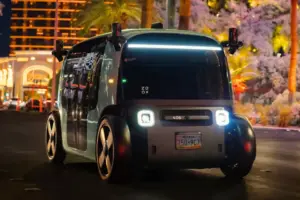
These distinctive, bi-directional, all-electric vehicles represent a radical departure from traditional automotive design. Most notably, they are the first autonomous robotaxis approved for public roadways that completely lack human-centric controls—meaning no steering wheels, no dashboards, and no pedals. Passengers step into a carriage-style interior facing one another, surrounded by glass panels, riding inside what early adopters have playfully dubbed "self-driving toasters."
While the aesthetic is undeniably quirky, the business implications are deadly serious. Amazon’s commercial rollout arrives amid a high-stakes, multi-billion-dollar race for dominance in the autonomous vehicle (AV) sector. Financial institutions like Goldman Sachs project that the global robotaxi market will experience an astronomical ascent, ballooning from a modest $376 million last year to an estimated $19 billion by 2030.
Yet, as Zoox takes its first revenue-generating trips, it enters a fiercely contested arena. Alphabet’s Waymo has already firmly established a commercial footprint with massive weekly booking volumes across multiple metropolitan areas, while Elon Musk’s Tesla presses forward with volume production of its Cybercab. For Amazon, the success of Zoox is not merely about conquering urban transit; it is a critical proving ground for autonomous technology, urban logistics, and the future of consumer mobility.
Detailed Chronology: From Acquisition to Commercial Launch
To understand how Amazon’s toaster-shaped robotaxis materialized on the streets of San Francisco and Las Vegas, one must examine the meticulous, multi-year developmental timeline orchestrated by Zoox and its parent company.
2014–2020: The Genesis and Acquisition
Founded in 2014 by Tim Kentley-Klay and Jesse Levinson, Zoox took a radically different approach to autonomous driving from day one. While competitors retrofitted existing conventional cars—such as Chrysler Pacificas or Jaguar I-Paces—with sensor suites, computers, and specialized software, Zoox set out to build an autonomous vehicle entirely from scratch. The vision was a symmetrical, pod-like vehicle designed explicitly for ridesharing rather than human driving.
By early 2020, the startup faced the capital-intensive realities of hardware manufacturing compounded by economic pressures. Enter Amazon. Recognizing the strategic value of autonomous technology not just for passenger transit, but potentially for its sprawling logistics and delivery network, Jeff Bezos’s empire swooped in. In June 2020, Amazon officially acquired Zoox for $1.2 billion, providing the startup with the financial runway, computing power, and corporate backing necessary to bring its unconventional design to market.
2020–2023: Testing, Refining, and Regulatory Hurdles
Following the acquisition, Zoox accelerated its engineering and testing phases. Unlike competitors who deployed vehicles on public roads with safety drivers behind the wheel immediately, Zoox had to design a vehicle that couldn’t be driven by a human because it possessed no manual controls.
In late 2020, Zoox unveiled its custom-built, battery-powered robotaxi. Capable of speeds up to 75 mph in later testing environments, the vehicle underwent rigorous closed-course evaluations in California, Nevada, and Washington. Simultaneously, Zoox engaged in exhaustive dialogue with federal and state regulators, most notably the National Highway Traffic Safety Administration (NHTSA), to secure the necessary exemptions and approvals required to operate a vehicle without traditional safety mechanisms on public streets.
2024–Present: The Commercial Debut
The milestone transition arrived this month as Zoox officially transitioned from a testing entity to a commercial service, initiating paid rides for the general public in designated zones of San Francisco and Las Vegas. This launch marks a watershed moment: consumers are no longer just passive observers of autonomous testing; they are paying customers riding in vehicles completely devoid of human-operated fail-safes.
However, the rollout is measured and strictly governed. Under approvals granted by the NHTSA, Zoox is permitted to scale its operations up to 5,000 vehicles over a two-year period, with a crucial operational caveat: these vehicles are currently restricted to roads with speed limits of 45 mph or lower.
Supporting Context & Metrics: The Economics and Engineering of Autonomous Fleets
The launch of Amazon’s Zoox fleet does not happen in a vacuum. It is propelled by staggering market projections, intense competitive pressures, and unique engineering milestones.
Market Projections and Financial Stakes
The commercialization of robotaxis represents one of the most lucrative frontiers in modern technology. According to recent forecasts by Goldman Sachs, the global robotaxi market is positioned for explosive growth:
- 2023 Market Size: Approximately $376 million.
- 2030 Projected Market Size: Nearly $19 billion.
This compound annual growth rate reflects shifting consumer habits, urbanization, and the potential reduction in the total cost of urban mobility when human drivers are removed from the equation. For Amazon, capturing a slice of this multi-billion-dollar pie offers diversification beyond e-commerce, cloud computing (AWS), and digital advertising.
The Competitive Landscape
Amazon is far from alone in this race. The autonomous vehicle ecosystem is currently dominated by three distinct strategies, each championed by a tech heavyweight:
- Waymo (Alphabet): The incumbent frontrunner. Waymo currently operates at a commercial scale that dwarfs its competitors, logging roughly 250,000 paid robotaxi rides per week across multiple major U.S. cities, including Phoenix, San Francisco, Los Angeles, and Austin. Waymo relies on a heavily modified fleet of traditional vehicles equipped with advanced LiDAR and camera arrays.
- Tesla: The wildcard disruptor. Tesla has entered the fray with its dedicated "Cybercab," which also rejects traditional steering wheels and pedals. Tesla’s approach leans heavily on vision-only neural networks and aggressive volume production strategies. However, Tesla currently lacks the specific regulatory approvals and commercial ride-hailing permits that Zoox and Waymo have secured, meaning the Cybercab’s path to public passenger deployment faces regulatory hurdles.
- Zoox (Amazon): The purpose-built pod pioneer. Zoox bridges the gap between hardware innovation and regulatory compliance. By securing NHTSA authorization for a vehicle without steering controls and successfully launching paid operations, Zoox has proven its unique form factor is viable on public roads.
Vehicle Specifications and Rider Experience
The Zoox vehicle is engineered specifically for dense urban environments:
- Capacity: Seats up to four passengers in a facing, "carriage-style" configuration.
- Powertrain: 100% electric, powered by a custom battery pack designed to support full-day urban shifts.
- Symmetry: Bi-directional capability—the vehicle can drive forward and backward with equal proficiency, eliminating the need to execute traditional U-turns in tight city streets.
- Safety Architecture: Features an unprecedented deployment of over 100 safety innovations, including custom airbag designs tailored for the opposing-seat layout, and a 360-degree sensor suite combining LiDAR, radar, and cameras to eliminate blind spots.
Official Statements and Industry Perspectives
The debut of a vehicle that looks like a toaster and drives itself has elicited a wide range of reactions from industry executives, regulatory bodies, and early passengers.
Passenger Reactions: The "Science Fiction" Factor
Riding in a driverless vehicle for the first time remains a psychological hurdle for many consumers. Med Trimidal, a retired electrical engineer who experienced a Zoox ride during its early public trials in June, captured the sentiment of many early adopters:
"It was exciting to witness something that seemed like science fiction," Trimidal noted, adding that despite the intellectual understanding of the technology, the complete absence of a human driver felt "disconcerting at first."
This psychological barrier—often referred to in the tech industry as "passenger trust"—is precisely why companies like Zoox, Waymo, and Cruise invest heavily in intuitive cabin design, clear communication interfaces within the vehicle, and smooth driving algorithms. When a passenger enters a Zoox pod, ambient lighting and digital screens clearly indicate what the vehicle is seeing, processing, and planning to do next, mitigating anxiety.
Regulatory and Safety Oversight
The National Highway Traffic Safety Administration (NHTSA) has maintained a cautious yet pragmatic stance toward autonomous vehicles. By granting Zoox the authorization to deploy up to 5,000 vehicles over a two-year window—subject to strict geographic and speed limitations (45 mph or lower)—regulators are balancing innovation with public safety.
Federal agencies require continuous data-sharing regarding disengagements, sensor performance, and incident reporting to ensure that driverless fleets meet or exceed human safety baselines before expanding into higher-speed or more complex interstate environments.
Future Outlook: Where Do Amazon and Zoox Go From Here?
As Zoox shifts from an experimental project to a revenue-generating commercial service in San Francisco and Las Vegas, the roadmap ahead is defined by geographic expansion, logistical integration, and technological refinement.
1. Geographic Scaling and Regulatory Approval
The immediate priority for Zoox is to densify its presence in its initial launch markets while petitioning regulators for permission to expand into new cities. Prime candidates include dense metropolitan areas with favorable weather patterns and supportive municipal frameworks. However, scaling beyond the 45 mph speed restriction will require demonstrating flawless safety metrics over millions of urban miles.
2. Fleet Integration and Logistics Synergy
While Zoox currently operates as a passenger ridesharing service, industry analysts continue to speculate on Amazon’s broader long-term strategy. The vehicle architecture, while optimized for human passengers, could theoretically be adapted for high-priority urban delivery, late-night logistics, or autonomous fulfillment shuttles. Integrating Zoox technology into Amazon’s legendary supply chain infrastructure represents a tantalizing future possibility that could fundamentally reshape urban last-mile delivery costs.
3. The War for Urban Mobility
By 2030, the battle lines drawn by Goldman Sachs’ $19 billion projection will be solidified. Zoox will have to prove that its custom-built, toaster-shaped pod can compete economically with Waymo’s established scale and Tesla’s potential manufacturing prowess.
For now, Amazon’s bold bet has broken the mold of traditional automotive design. By stripping away the steering wheel, pedals, and dashboard, Zoox has redefined what a car looks like—and in doing so, has taken a firm grip on the steering wheel of the future.