Executive Overview: The Dawn of AI-Generated Web Assets
For years, the process of synthesizing research—moving from raw data to a digestible, interactive format—has been a labor-intensive hurdle for students, professionals, and hobbyists alike. Whether it involves distilling complex literature, organizing project management documentation, or curating travel logistics, the leap from a "collection of notes" to a "structured presentation" often required significant manual design and coding expertise.
Google is now fundamentally altering this landscape with the latest update to Gemini Notebook. By enabling users to transform their aggregated research into functional, interactive websites, Google is positioning the platform as more than just a repository for information. It is evolving into a generative engine for knowledge visualization. This feature, which leverages Gemini’s multimodal capabilities, allows users to translate raw text, PDF, and image data into structured web pages with a single natural language prompt. This development represents a significant shift in how we interact with AI: rather than simply asking for answers, we are now asking for experiences.
Detailed Chronology: The Evolution of NotebookLM
To understand the significance of this feature, one must look at the rapid maturation of Google’s research tool. Initially launched as a sandbox for AI-assisted study, the tool quickly garnered a reputation for its ability to "ground" AI responses in specific, user-provided source material—a critical guardrail against the common hallucination issues found in general-purpose LLMs.
- Phase 1: The Repository: In its infancy, the tool served as a glorified smart-search engine. Users uploaded PDFs and text files, and the AI acted as a conversational layer, answering queries based solely on that documentation.
- Phase 2: Multimodal Synthesis: Google began integrating audio and video analysis, allowing users to extract insights from diverse media formats. The introduction of "Audio Overview"—where the AI generates a conversational, podcast-style summary of your notes—marked a turning point in accessibility and content engagement.
- Phase 3: Structural Generation: The recent shift toward generating structured outputs, such as mind maps, infographics, and now, interactive websites, marks the transition from information retrieval to information construction.
Currently, the website-building feature is rolling out to web app users, with mobile integration on the horizon. This iterative rollout suggests a strategy of perfecting the user experience in a desktop environment—where high-resolution research often happens—before moving to the more constrained mobile interface.

Supporting Context & Metrics: Testing the Limits of AI Synthesis
To assess the practical efficacy of this feature, I subjected it to a rigorous test using James Joyce’s 1914 short story collection, Dubliners. The objective was to determine if the AI could maintain structural integrity and thematic accuracy when tasked with creating a "mini-Wikipedia" style guide for complex literary works.
The Methodology of the Prompt
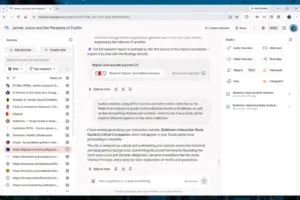
The prompt used was specific and intentional: "Build a website using all the sources and information collected so far. Make it an interactive guide to the individual stories in Dubliners, as well as the overarching themes and context. I want to use it as a study aid to explore different aspects of the story collection."
Within five minutes of inputting this command, the engine processed 26 distinct sources. The output was not merely a static document, but a functional HTML-based web application that included:
- Dynamic Navigation: Clickable pathways between individual stories and thematic motifs.
- Evaluative Components: An integrated quiz section to test user comprehension.
- Visual Logic: A graphical representation of the interconnectedness of Joyce’s narratives.
Metrics of Success
While the AI output carries the distinct, slightly sterile "aesthetic sheen" common to generative AI—characterized by standardized font choices and predictable color palettes—the structural logic was sound. From a pedagogical standpoint, the ability to turn a wall of text into a navigable user interface drastically reduces the cognitive load required to synthesize large datasets. For researchers handling high volumes of information, this serves as an essential tool for "spatializing" knowledge.

The Versatility of AI-Generated Sites
Beyond the literary analysis test case, the utility of this feature spans several professional and personal domains.
Corporate and Organizational Utility
In professional settings, the friction between data collection and data presentation is a major productivity killer. Imagine a project manager who has spent weeks compiling technical specifications, meeting minutes, and market research. Traditionally, this data resides in a sprawling series of documents. By utilizing Gemini Notebook’s new feature, the manager can generate a "Project Hub" that allows stakeholders to navigate project milestones, risk assessments, and technical workflows in an intuitive, interactive environment. This is a clear upgrade over the standard, often ignored, slide deck or PDF report.
Personal Knowledge Management (PKM)
For the individual, the potential applications are vast.
- Ancestry and Genealogy: Users with disparate sources—birth records, scanned photographs, and oral histories—can generate a centralized family tree website, allowing relatives to explore their history through an interactive, curated portal.
- Travel and Logistics: A complex, multi-week itinerary involving flights, hotel bookings, and restaurant research can be transformed into a functional, single-page application that serves as a living travel guide for fellow travelers.
Official Statements and Technical Considerations
Google’s official guidance emphasizes that this tool is not intended to replace professional web development platforms like WordPress or Squarespace. Instead, it is framed as a "functional visualization" tool.

Key technical parameters currently observed:
- Single-Page Architecture: The generated sites function primarily as single-page applications (SPAs). While they are highly interactive, they lack the multi-page complexity of a traditional website.
- Downloadable Assets: Because there is currently no native hosting or "publish" button, users must download the HTML code. This is an important distinction for users expecting a "plug-and-play" hosting solution.
- Prompt Engineering: The quality of the output remains highly dependent on the specificity of the user’s prompt. As with all LLM-driven tools, defining the scope, tone, and specific layout requirements leads to significantly higher-quality outputs than generic commands.
Future Outlook: The Intersection of AI and Web Sovereignty
The trajectory of Gemini Notebook suggests a future where the "creation" of a digital presence is democratized to the point of triviality. We are moving toward a paradigm where the barrier to entry for building custom web-based tools is zero.
Challenges on the Horizon
Despite the excitement, several hurdles remain. The first is the "hallucination factor." While grounding the AI in user-provided sources minimizes errors, the risk of misinterpretation of complex data remains. Second, the lack of native hosting limits the feature’s immediate utility for non-technical users who may find the prospect of downloading and deploying HTML code daunting.
The Long-Term Vision
We can anticipate that future updates will likely integrate hosting services—perhaps through Google Sites or Firebase—effectively closing the loop between research and publication. Furthermore, as the AI’s ability to customize CSS and layout improves, the "AI sheen" identified in current iterations will likely fade, allowing for more diverse, aesthetically unique digital environments.

Ultimately, Google is providing users with a new way to externalize their thinking. By moving from linear, text-based notes to interconnected, interactive web nodes, users are not just organizing data; they are building a "second brain" that is as accessible as it is analytical. In a world drowning in information, the ability to build a personalized, interactive structure to navigate that data is not just a luxury—it is an essential skill for the modern era. As Gemini Notebook continues to evolve, we should expect these tools to become the standard interface through which we manage, share, and ultimately understand the complex information of our lives.