Executive Overview
The landscape of digital crafting and rapid prototyping is undergoing a profound structural shift. While the past decade belonged to the democratization of 3D printing and the mainstream adoption of consumer-grade laser cutters, a more industrial technology is quietly positioning itself for a massive breakthrough. By 2027, Computer Numerical Control (CNC) milling and carving machines are expected to transition from the dusty confines of industrial auto-shops and heavy woodworking spaces into the modern home studio, transforming independent creators into micro-manufacturers.
For years, subtractive manufacturing—the process of carving solid blocks of metal, stone, or high-density engineering plastics into finished components—has remained prohibitively expensive, intimidatingly complex, and physically impractical for residential spaces. Industrial-grade CNC systems have traditionally required heavy-duty electrical infrastructure, structural floor reinforcement, specialized CAD/CAM programming degrees, and capital investments scaling well beyond $50,000.
However, a new wave of forward-thinking hardware manufacturers is actively dismantling these barriers. Companies such as InfiMaker, Makera, and ACMER are pioneering a new class of compact, user-friendly desktop CNC systems. These platforms compress multi-axis milling power into manageable footprints priced comfortably under $5,000—and in some cases, hovering around the $1,000 mark.
Coupled with the integration of artificial intelligence for workflow automation, auto-calibration features, and intuitive software suites, CNC technology is rapidly approaching its long-awaited "Bambu Lab consumer moment." This in-depth report explores the technological evolution, market dynamics, and future outlook of desktop CNC machining, detailing how creators can leverage these powerful tools to build sustainable, high-margin home businesses.
Detailed Chronology: The Evolution of Subtractive Desktop Fabrication
To understand where desktop CNC manufacturing is heading, it is necessary to examine how digital fabrication tools have evolved over the past fifteen years.
Phase 1: The Industrial Monopolization (Pre-2015)
For decades, CNC machining was strictly the domain of aerospace manufacturing, automotive prototyping, and professional furniture production. Operating a CNC router or milling machine required extensive technical training in G-code, manual tool-path optimization, and strict safety protocols. Machines were large, loud, and dangerous, demanding dedicated workshops equipped with heavy dust extraction systems and 3-phase power supplies. Independent creators and artists relied entirely on outsourcing their metal and hardwood components to commercial machine shops, severely limiting rapid iteration.
Phase 2: The 3D Printing & Laser Cutting Boom (2015–2023)
The democratization of digital manufacturing officially began with the open-source 3D printing movement, quickly followed by the proliferation of affordable desktop diode and CO2 laser cutters. While these tools revolutionized home-based making, they operated primarily via additive methods (laying down molten plastic filament or curing liquid resin) or low-power surface modification (laser etching and light cutting of plywood and acrylic).
While accessible, these methods have inherent structural limitations. 3D-printed plastic parts often lack the tensile strength, thermal resistance, and professional-grade finish required for heavy-duty, functional mechanical components. Laser cutters excel at 2D slicing and surface design, but cannot true-carve complex 3D contours out of solid blocks of aluminum, brass, or stainless steel.
Phase 3: The Convergence of Smart Desktop Hardware (2024–Present)
Recognizing a gap in the maker market, hardware innovators began developing hybrid and dedicated desktop CNC machines designed specifically to bridge the divide between rapid prototyping and end-use industrial production. Brands began shrinking industrial multi-axis capabilities into enclosed desktop chassis.
Simultaneously, software interfaces transformed. Instead of forcing users to manually program complex tool paths through archaic engineering software, modern desktop CNC platforms began incorporating automated bed-levelling, smart tool-changers, integrated dust collection, and cloud-connected CAM generation.
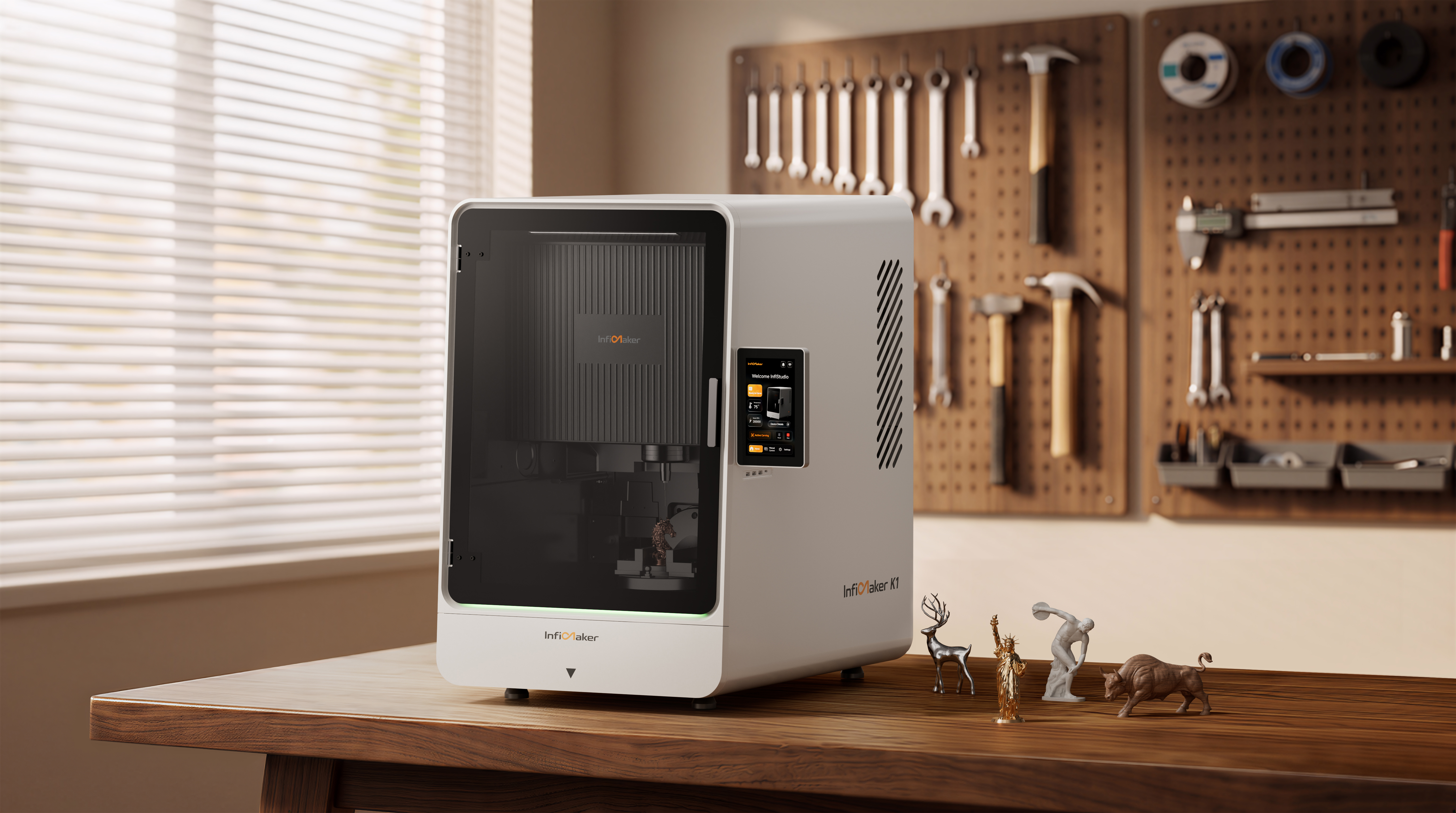
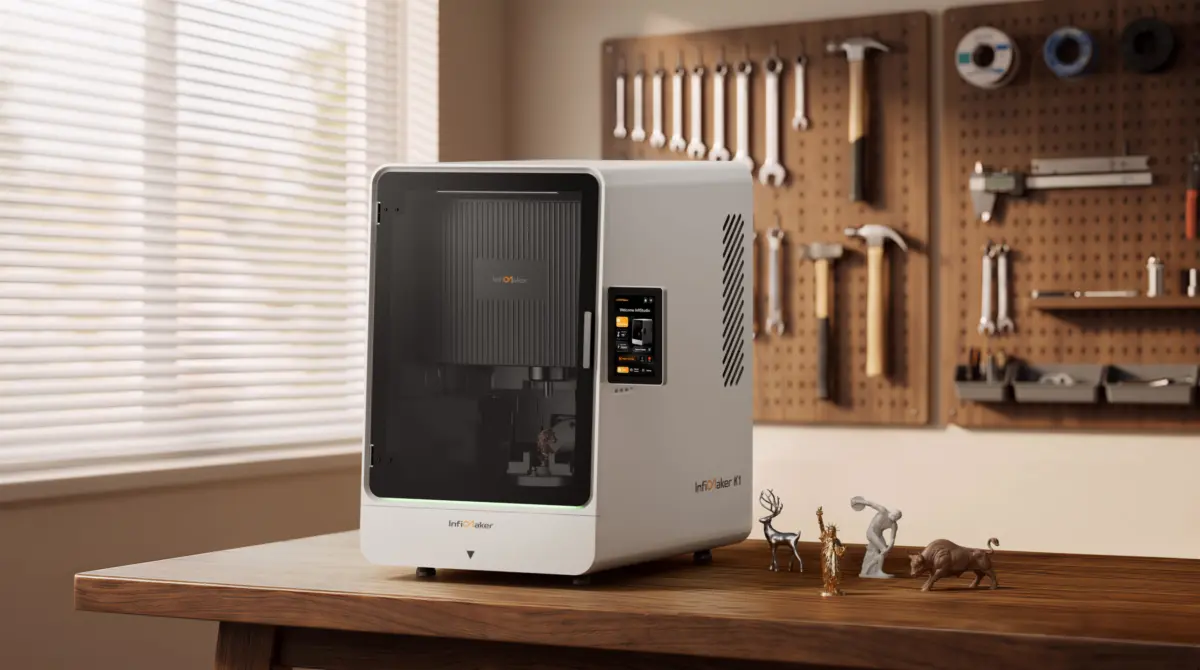
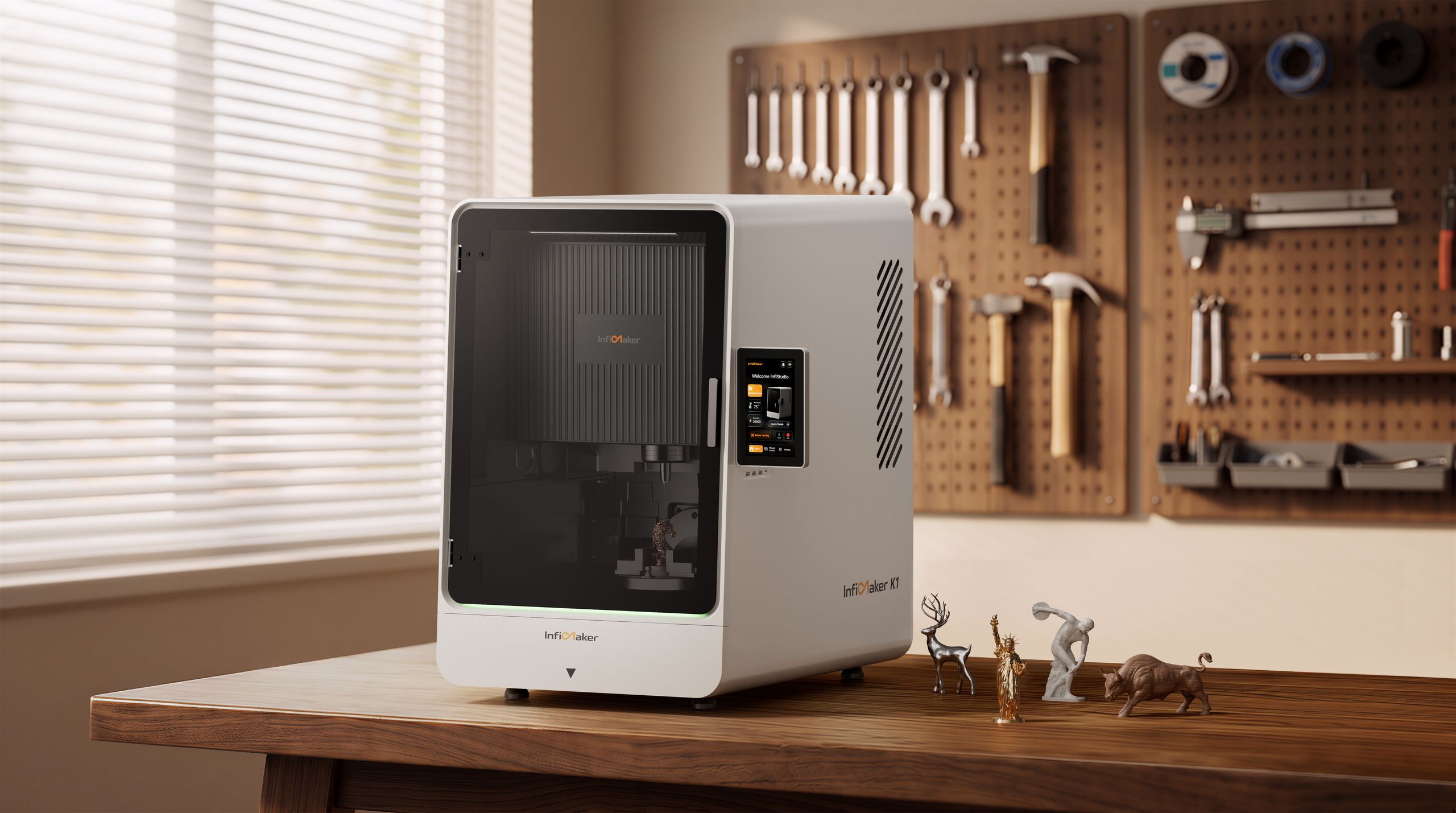
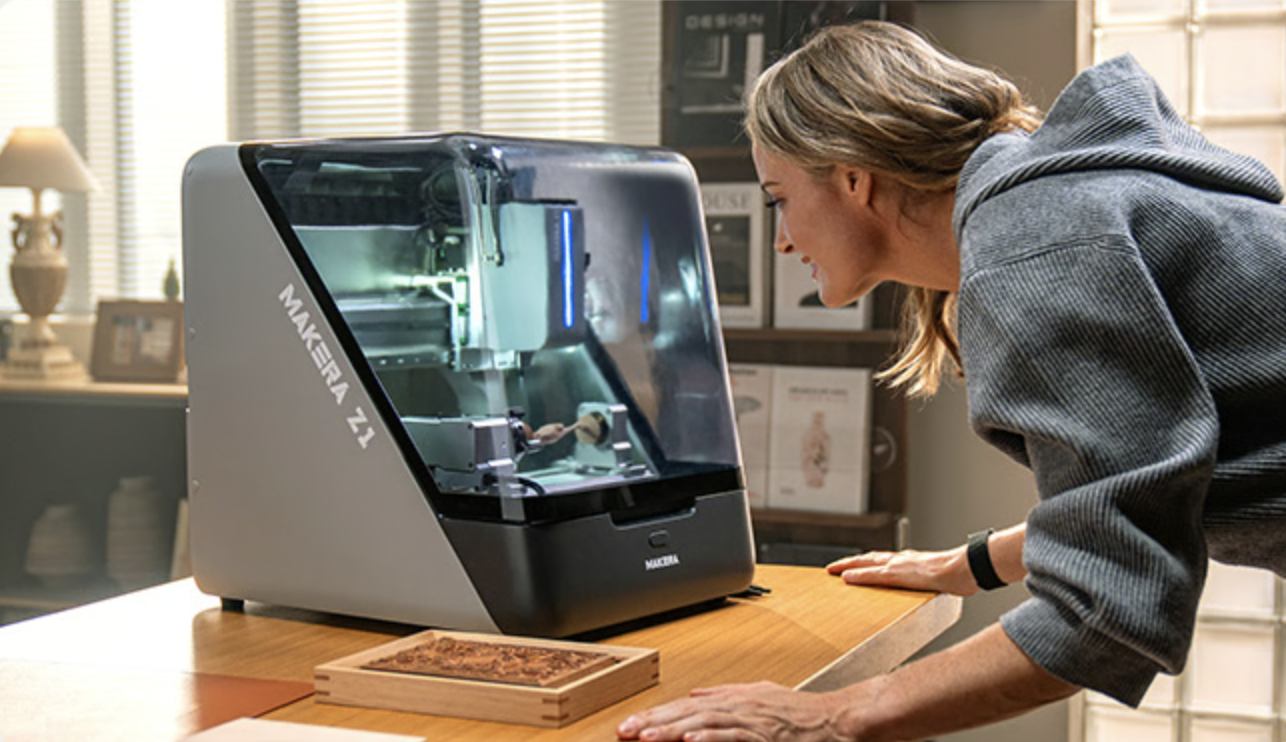
The upcoming launch of the InfiMaker K1—a professional-grade desktop 5-axis CNC machine—signifies a watershed moment for the industry. Scheduled for crowdfunding and broad market release, the K1 introduces advanced multi-axis capabilities and AI-assisted workflows to users with little to no prior machining experience. Meanwhile, established desktop models like the Makera Z1 have already proven that reliable, enclosed, auto-calibrating CNC milling can be successfully packaged for the sub-$1,200 consumer market.
Supporting Context & Metrics: The Shift from Plastic to Metal
The transition from additive plastic printing to subtractive metal and composite milling represents a fundamental change in what home-based creators can produce. The economics and material capabilities of modern desktop manufacturing highlight why this shift is accelerating.
Material Superiority and Functional Integrity
While advanced filaments like Bambu Lab’s PLA Pure have made household 3D printing safer, cleaner, and more eco-friendly around families and pets, plastic components inherently struggle in high-stress, high-temperature, or high-friction environments.
CNC machines, by contrast, operate natively on engineering-grade substrates:
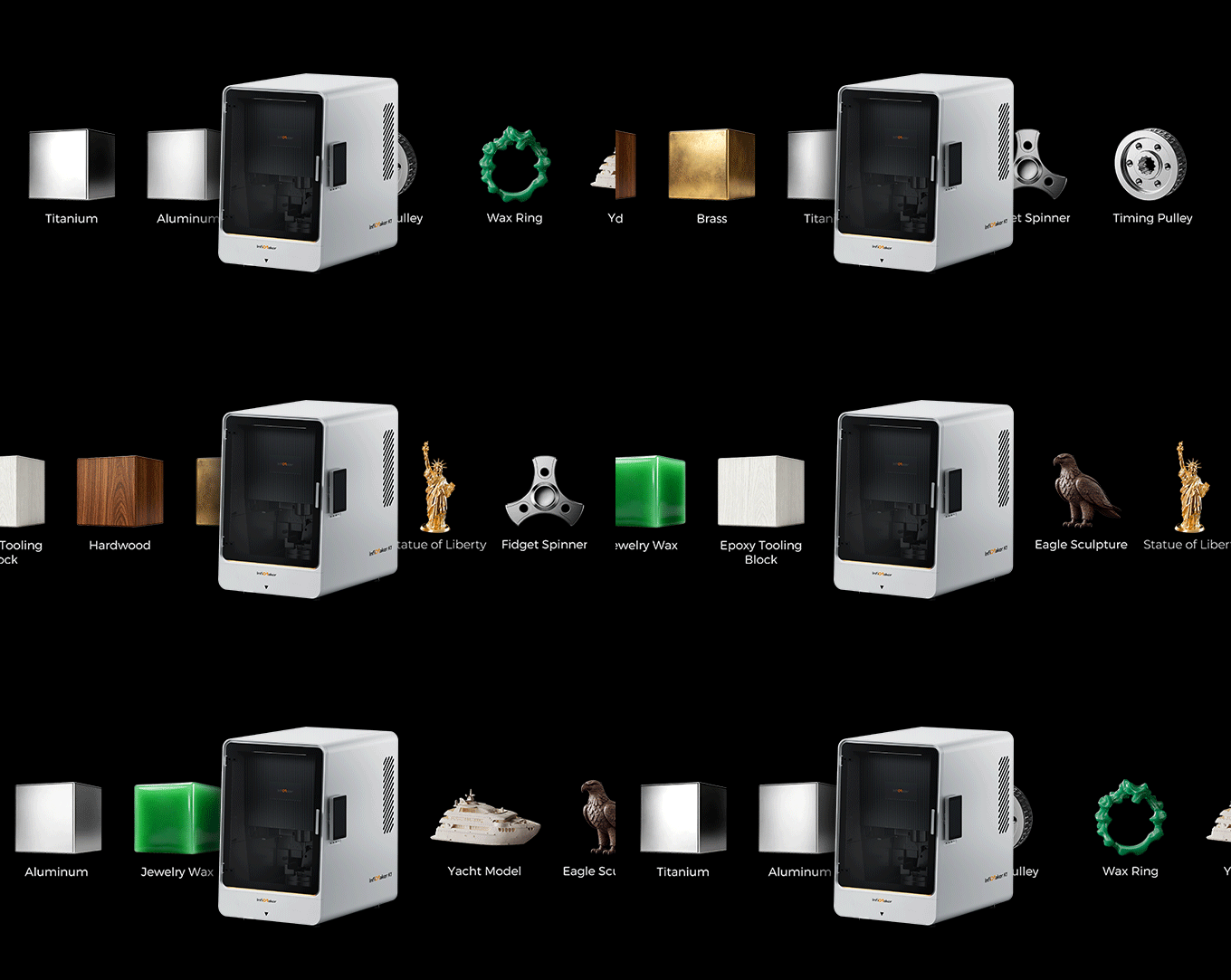
- Aluminum and Brass: Ideal for custom mechanical gears, robotics chassis, camera accessories, and premium jewelry.
- Copper: Essential for electronics prototyping, custom heatsinks, and conductive artistic elements.
- Hardwoods and Engineered Resins: Perfect for heirloom-quality cabinetry, intricate furniture joints, acoustic panels, and architectural models.
- Exotic Materials: Including carbon fiber composites, jade, and engineering plastics like POM (Delrin) and Peek.
Cost and Footprint Reduction
Historically, acquiring a multi-axis CNC machine capable of milling aluminum meant purchasing industrial-surplus equipment or commercial vertical machining centers (VMCs). These machines routinely exceeded 1,000 pounds, demanded forklift delivery, and cost upwards of $50,000.
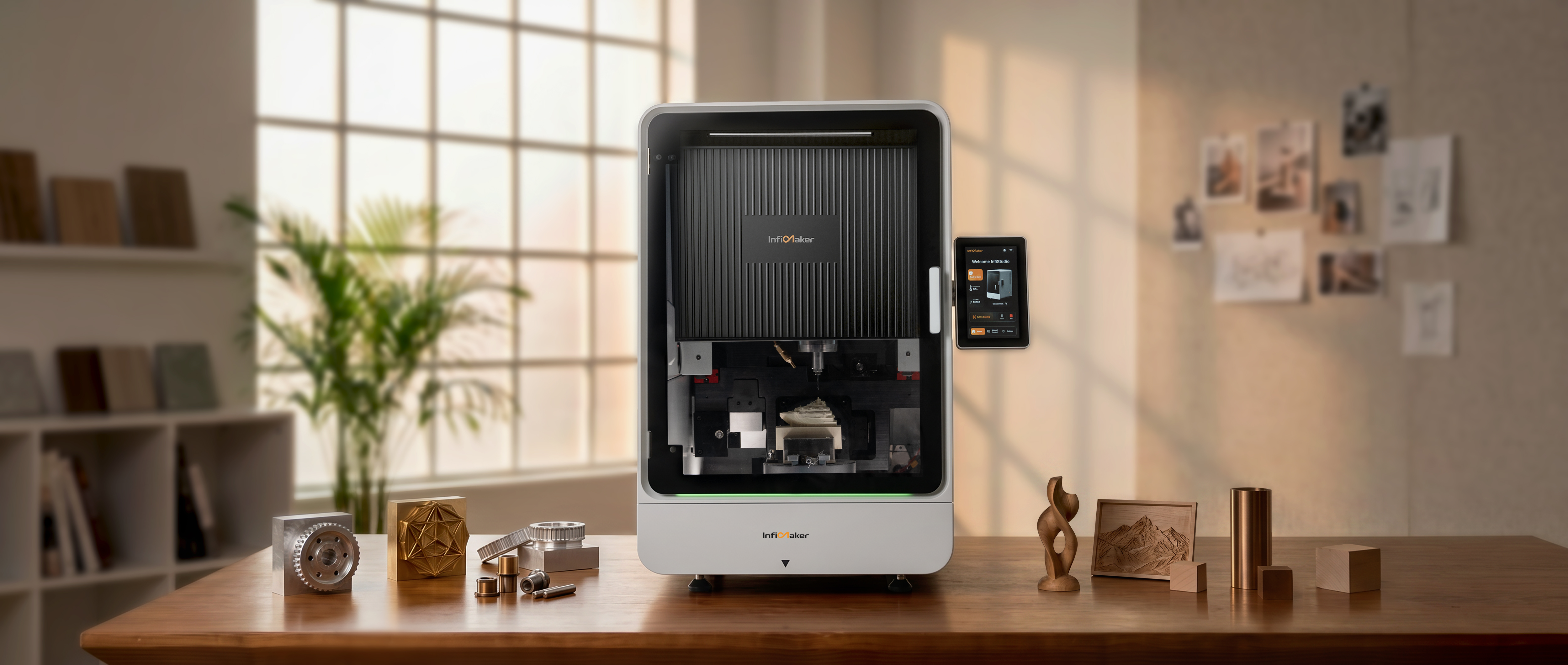
Today’s desktop ecosystem has inverted these metrics:
| Metric | Industrial CNC (Legacy) | Modern Desktop CNC (Current/Emerging) |
|---|---|---|
| Average Cost | $30,000 – $100,000+ | $1,000 – $5,000 |
| Footprint | Requires dedicated warehouse/shop | Fits on a standard studio workbench |
| Power Supply | 3-phase industrial wiring (220V/440V) | Standard household outlet (110V/240V) |
| Software Barrier | Complex manual G-code & CAM programming | AI-assisted tool paths & cloud slicing |
| Enclosure & Safety | Open frame, hazardous debris/noise | Fully enclosed, integrated dust extraction |
The Rise of All-in-One Manufacturing Studios
As desktop manufacturing matures, single-purpose tools are increasingly being supplanted by multi-functional hybrid workhorses. Creators are moving beyond standalone laser cutters and adopting all-in-one manufacturing hubs—such as the xTool O1 Omni or HeyGears G1X systems. These versatile machines integrate laser engraving, blade cutting, and high-precision CNC routing into a single chassis, maximizing workspace efficiency and capital investment return for micro-studios.
Official Industry Insights & Perspectives
Industry analysts and pioneering makers point to user experience as the final frontier for desktop CNC adoption.
"CNC still hasn’t had its ‘Bambu Lab’ consumer moment, but I predict that it’s coming," notes industry design and tech commentator Beth. "Makers are now moving beyond even the best laser cutters and engravers and switching over to all-in-one machines… CNC machines have the ability to create products unlike anything you’ll find at a local craft fair, helping makers stand out and create sustainable businesses from home."
The comparison to Bambu Lab is deliberate. Bambu Lab fundamentally transformed 3D printing by taking a notoriously finicky, calibration-heavy hobby and turning it into an out-of-the-box, "plug-and-play" consumer appliance. By automating bed-leveling, filament flow calibration, and remote monitoring via mobile apps, they lowered the barrier to entry so drastically that millions of mainstream consumers adopted the technology.
Desktop CNC manufacturers are pursuing an identical playbook. By integrating features such as automated tool-length calibration, vision-system alignment, real-time error detection, and AI-driven feed-rate optimization, brands like Makera and InfiMaker are removing the fear of broken end-mills and ruined workpieces.
Furthermore, educational institutions and STEM programs are driving institutional demand. The introduction of compact, fully enclosed 5-axis machines like the InfiMaker K1 allows engineering students and industrial design classrooms to gain hands-on experience with complex multi-axis milling without exposing students to the safety hazards and massive footprints of legacy industrial mills.
Future Outlook: The 2027 Horizon and Beyond
As the industry marches toward 2027, several key technological and economic trends will define the trajectory of desktop CNC manufacturing:
1. Artificial Intelligence and Natural Language CAM
The most significant hurdle for prospective CNC users has always been Computer-Aided Manufacturing (CAM)—the process of translating a 3D digital model into physical machine instructions. Future desktop CNC ecosystems will increasingly leverage local and cloud-based AI to analyze 3D models, automatically determine optimal material feeds, select the appropriate cutting bits, and generate collision-free tool paths based on natural language prompts from the user.
2. Mainstream Commercialization and Micro-Enterprise
With high-end desktop CNC units dropping below the $2,000 threshold, the barrier to entry for independent product designers is lower than ever. Creators no longer need to rely on overseas mass-manufacturing or meet minimum order quantities (MOQs) of 5,000 units to bring a metal-bodied product to market. Instead, designers can prototype, test, and manufacture end-use products entirely from a spare bedroom or home garage, selling direct-to-consumer via online marketplaces.
3. Sustainable and Localized Manufacturing Supply Chains
As global logistics face continuous volatility and environmental consciousness drives consumer demand for locally sourced goods, desktop manufacturing provides a viable counter-model. Home studios equipped with hybrid CNC and 3D printing setups function as micro-factories capable of producing replacement parts, custom hardware, and bespoke artistic goods on demand, drastically reducing shipping emissions and material waste.
Conclusion
The narrative that desktop fabrication belongs exclusively to plastic printing and surface laser etching is rapidly expiring. As hardware engineering catches up with creative ambition, desktop CNC machines are shedding their intimidating industrial reputation. For makers looking to elevate their craft, stand out in crowded online marketplaces, and build resilient home-based businesses, mastering the upcoming generation of desktop CNC technology will be the definitive creative advantage of 2027 and beyond.