Executive Overview
In the modern landscape of professional sports, the athlete-brand endorsement is a well-worn, highly predictable ritual. A press release drops with familiar phrasing—“Proud to partner,” “Excited to join the family”—a logo is swapped, a quarterly check is cleared, and the machinery rolls on. To the casual observer, it is impossible to distinguish between an athlete who is simply marketing a product and one who is actively building a business.
Yet, a fundamental shift is underway. Elite athletes are increasingly bypassing traditional, passive sponsorship deals in favor of genuine equity, co-founding enterprises, and investing their own capital. At the bleeding edge of this movement is the partnership between NFL superstar Christian McCaffrey and footwear veteran Todd Meleney.
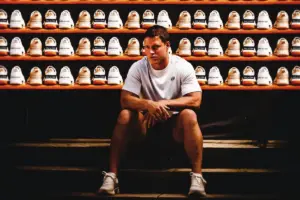
When McCaffrey let his nine-year Nike contract expire without renewal, it signaled more than a mere change of apparel; it marked the beginning of a deliberate transition from pitchman to builder. Alongside Meleney—former Chief Marketing Officer at Nobull, who scaled that brand from pre-revenue to $250 million in annual sales—McCaffrey helped co-found the performance wellness and footwear brand while on earth.
This venture is anchored by the launch of The CMC, a high-performance training shoe engineered specifically to address the stability, support, and versatility demands of elite athletes. Experiencing a staggering 250% year-over-year growth, while on earth is proving that when an athlete’s skin is genuinely in the game—financially, creatively, and operationally—the market responds with unprecedented demand. This deep-dive investigation explores the mechanics, mindset, and market math behind one of the most compelling founder-athlete partnerships in modern commerce.
Detailed Chronology: From a Charlotte Deck to "The CMC"
The Genesis: Breaking the Mold (and the Prototype)
The genesis of while on earth did not happen in a sterile corporate boardroom or during a polished PR briefing. It occurred on Christian McCaffrey’s back deck in Charlotte, North Carolina.
During an early meeting—long before the word "co-founder" was spoken aloud—Todd Meleney handed McCaffrey an early prototype of a training shoe. McCaffrey took the shoe, bent it clean in half with his bare hands, and delivered a blunt, unfiltered assessment:
"This is a problem for me. I can’t find a shoe that gives me the support and stability I need for training."
In a traditional endorsement arrangement, hearing such candid feedback from a marquee athlete is a rarity. Agents typically sanitize critiques, insulating brands from raw consumer friction. But on that deck in Charlotte, five minutes into their relationship, one of the best athletes in the world was rolling up his sleeves to help engineer a better product.
The Evolution of the Trainer
That initial friction sparked a year of intense collaboration. McCaffrey and Meleney communicated almost daily through voice memos, video calls, and rapid-fire design iterations.
The collaborative process was far from a rubber-stamp exercise. A prime battleground emerged over colorways and aesthetic details. Meleney favored a tonal, understated look to maximize broad consumer appeal, while McCaffrey pushed for higher contrast and a distinct arch through the sole to deliver a faster, more aggressive athletic silhouette. Ultimately, "Dune" was selected as the hero colorway—balancing aesthetic versatility with high-performance edge.
A year after McCaffrey let his Nike deal expire—backed by a supportive household environment curated by his wife, Olivia Culpo—the brand refined its vision. The result is The CMC, a flagship training shoe built as a direct, functional answer to the structural weaknesses McCaffrey exposed on his back deck.
Supporting Context & Metrics: The Math Behind the Momentum
Scaling Beyond the Hype
In the footwear and apparel industry, staggering growth figures are frequently tossed around and rarely scrutinized. When Todd Meleney cites a 250% year-over-year growth rate for while on earth, those metrics carry weight because of his pedigree. Having spent a decade at Nobull steering growth from the ground up, Meleney understands the brutal reality of fighting for shelf space against legacy goliaths like Nike and Adidas.
Despite being less than two years old, while on earth is outpacing traditional footwear growth curves. The brand’s direct-to-consumer (DTC) model has frequently run into inventory constraints, with delivery lead times stretching to 30 to 60 days. Over 10,000 customers currently sit on the waitlist for restocks and upcoming drops.
The Conversion Power of Authentic Equity
While famous names can generate top-of-funnel awareness, they rarely convert casual observers into loyal brand evangelists unless there is palpable authenticity behind the endorsement. Post-purchase consumer data for while on earth reveals a telling trend: a meaningful percentage of new buyers cite Christian McCaffrey by name as their discovery channel. They are not buying because "an athlete" told them to; they are buying because they trust McCaffrey’s personal investment in the product’s performance.
This momentum is now opening doors to traditional retail channels. The brand is preparing to launch its first major wholesale partnership with SCHEELS. According to Meleney, McCaffrey completely changes the tenor of those retail negotiations before a single product sample is even unboxed.

"He gives the product a reason to exist," Meleney notes.
By dropping The CMC strategically ahead of the high-attention confluence of the NFL season and the back-to-school shopping rush, the company is expertly converting peak cultural awareness into immediate inventory turnover.
Official Statements & Industry Insights
Anatomy of an Unsentimental Partnership
The graveyard of athlete-brand collaborations is populated by ventures built on ego, mismatched incentives, and power imbalances. Typically, one party needs the partnership more than the other—a dynamic that inevitably poisons the product roadmap and marketing strategy.
What distinguishes while on earth is the absolute lack of sentimentality and ego between its key players. The communication pipeline between McCaffrey and Meleney is defined by radical transparency: what is working, what is failing, and how to fix it.
Moreover, McCaffrey’s stake is not merely a symbolic, gratis equity grant designed for press releases. He deployed his own capital into the company—a rare move in an industry where companies traditionally hand over equity to secure star power without financial risk. By putting his own money on the line, McCaffrey signaled that his commitment to while on earth runs deeper than a marketing contract.
The Human Element: Presence Over Performance
Balancing the grueling physical demands of an elite NFL running back career, fatherhood, and building a high-growth performance wellness brand requires a rare psychological framework. When asked how he manages the juggle, McCaffrey bypasses conventional productivity tropes, focusing instead on the concept of presence.
"The waves are coming, and you better learn how to ride them instead of trying to stop them," McCaffrey reflects.
He rejects the naive notion that an entrepreneur or athlete must love every single minute of the grind, admitting that expecting constant euphoria—even in professional football—is unrealistic. Instead, he is driven by a fear of wasted opportunity, having witnessed athletes reach the summit of their respective sports only to realize they were mentally absent for the journey.
"I’ve seen guys who have been at the top of the mountain but weren’t really there. They may have missed it."
Future Outlook: A Legacy Beyond the Gridiron
As while on earth prepares for its next phase of retail expansion and product diversification, the true measure of its success will lie in its longevity. The brand is no longer just a startup experiment; it is a case study in how modern athletes can transition from temporary pitchmen into permanent industrial founders.
For McCaffrey, the ultimate stakeholder in this venture is not an institutional investor or a retail partner, but his family. Discussing his daughter, Colette, and the impending arrival of his second child, McCaffrey reflects on the core ethos of the brand’s name: while on earth.
"Time does run out one day," McCaffrey says. "In today’s era, there are so many distractions and things that can stray you off the best path. Time is limited, and I want for her to enjoy it, work hard, and stay true to who she is."
After enduring nine punishing NFL seasons of physical collisions that few outside the game can comprehend, McCaffrey’s physical window on the gridiron is finite. But the infrastructure he is building alongside Todd Meleney, Brooke Wells, and the rest of the while on earth team is designed to endure long after the football pads are permanently stored away.
The shoe—rigorously tested, continually refined, and built without compromise—is simply the physical proof of that enduring philosophy.