
Executive Overview
The architecture of digital discoverability has undergone a fundamental transformation. While passive, off-platform discovery now dominates the early-stage user journey, the open web’s underlying mechanics remain anchored to traditional foundations. Google continues to dispatch over a trillion clicks annually to the open web, with up to 86% of those interactions driven by discovery-led behaviors. Despite predictions that search engine optimization (SEO) will dissolve into automated feed management, the reality is far more nuanced. Websites and digital publishing networks remain the primary engines feeding answer engines, large language models (LLMs), and recommendation feeds.

Consequently, the core purpose of an SEO audit has evolved. Traditional audits historically focused on raw ranking factors; modern audits establish whether a brand can be effectively retrieved, resolved, and cited across a fragmented, multi-surface ecosystem. For enterprise publishers, ensuring that content is properly crawled, rendered, indexed, and cited requires a strategic approach that unifies technical execution, content value, E-E-A-T (Experience, Expertise, Authoritativeness, and Trustworthiness), and entity consistency.

Detailed Chronology: The Evolution of Search and Publisher Discoverability
Phase 1: The Traditional Search Era (Pre-2020)
For decades, SEO auditing followed a linear, predictable path. The primary objective was securing blue links on search engine results pages (SERPs). Publishers focused heavily on keyword density, metadata optimization, backlink acquisition, and basic technical hygiene like XML sitemap generation and resolving broken internal links. Discoverability was almost exclusively active and search-initiated, with Googlebot acting as the primary gatekeeper of the open web.

Phase 2: The Rise of Zero-Click and Fragmented Discovery (2020–2024)
As search engines integrated direct answers, featured snippets, and localized knowledge panels, user behavior shifted. A growing percentage of searches resulted in zero clicks to publisher sites. Concurrently, social discovery platforms, recommendation widgets, and algorithmic feeds began capturing significant attention during the early-stage user journey. Publishers faced shrinking organic referral traffic, forcing a re-evaluation of on-site user experiences and audience retention strategies.

Phase 3: The Generative AI and Answer Engine Paradigm (2024–Present)
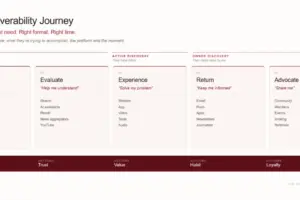
Today, discovery spans passive, active, and owned channels. Answer engines, generative AI overviews, and multi-modal recommendation systems parse web content in real-time. Discovery is no longer just about ranking; it is about retrieval share and citation authority. Websites must operate as machine-first architectures, structured in a way that allows autonomous agents, crawlers, and AI systems to seamlessly read, interpret, and attribute content back to the originating publisher brand.

Supporting Context & Metrics: The Four Pillars of Modern Auditing
To address the complexities of the modern web, SEO audits must be framed around clear business objectives rather than vanity metrics. Every recommendation should be evaluated using a Scale x Impact x Effort matrix to prioritize high-leverage initiatives over trivial technical fixes.

[Scale (Sitewide / Template-Level)]
       x
[Impact (Alignment with Business Goals: ARPU, Subscriptions, Revenue)]
       x
[Effort (Development & Editorial Resources Required)]
Modern publisher SEO audits rest on four non-negotiable pillars:

- Technical Readiness (Reaching, Understanding, Linking, Serving): Ensuring bots can access, parse, and load content efficiently without wasting crawl budgets on outdated architectures or unoptimized client-side rendering.
- Content Value and Relevance: Moving away from commoditized, low-effort keyword targeting. Content must demonstrate unique reporting, expert perspectives, and high audience engagement.
- E-E-A-T and Trust Infrastructure: Acting as a qualitative measure of site and page credibility, backed by robust authorship profiles, transparent corrections policies, and verified off-site sentiment.
- Entity Consistency: Unifying a brand’s digital identity across on-site structured data, owned social channels, and earned third-party knowledge bases to reduce ambiguity for search engines and AI agents.
Technical Performance and Crawl Economics
Publishers frequently suffer from severe technical debt. For instance, crawl stats reports often reveal that a staggering percentage of bot resources are wasted on temporary redirects (such as 302 status codes) or unoptimized JavaScript rendering paths. News articles, in particular, face tight temporal constraints; if important breaking content requires heavy client-side processing, it may be indexed too late to capture Top Stories visibility.

Furthermore, Core Web Vitals (CWV) play a critical role in bot efficiency and user retention. Slower sites burn through user engagement and force crawlers to work harder, reducing crawl depth. Utilizing field data from the Chrome User Experience Report (CrUX) alongside lab data allows publishers to diagnose performance bottlenecks—such as pre- and post-consent user experiences—ensuring the majority of the audience receives a high-performing experience.

Content Taxonomy: News, Evergreen, and Discover
- News Content: Requires absolute accuracy upon publication. Success relies on editorial speed, optimized headlines, large image previews (minimum 1200px wide), and aggressive amplification during the critical "Golden Hour" across social channels and newsletters.
- Evergreen Content: Commoditized, keyword-led evergreen articles are losing value in the AI era. Publishers must audit evergreen portfolios for genuine uniqueness and utility. Content pruning—removing underperforming pages that fail to drive micro-conversions or engagement—is essential for sprawling publisher architectures.
- Google Discover: Demands evocative imagery, compelling Open Graph (OG) headlines, and frictionless user experiences. While Discover drives massive referral volume, paywalled publishers must evaluate whether opening up surfaces aligns with their broader subscriber acquisition strategies.
Official Perspectives and Industry Insights
Industry experts emphasize that technical structures must evolve to accommodate machine-first reading habits. Jono Alderson notes that semantic HTML—utilizing tags like <article>, <nav>, and <section>—is not merely decorative; it is a structured language that expresses intent and hierarchy to accessibility tools, search engines, and AI agents, helping to eliminate the "div soup" common in legacy CMS platforms.

Similarly, technical authorities stress the importance of understanding crawl budgets. Barry Adams highlights that advanced crawl optimization for publishers requires strict control over how Googlebot navigates syndicated feeds, category pagination, and real-time live blogs.

Regarding brand reputation, recent data from the Reuters Institute Digital News Report underscores a troubling decline in public trust across global markets. This makes rigorous E-E-A-T auditing and entity disambiguation vital for publishers striving to prove their authenticity to both human readers and algorithmic review systems. As noted in recent cross-platform studies (such as Seer Interactive’s analysis on brand review profiles), establishing a robust off-site reputation dramatically increases AI citation rates, whereas a complete lack of verified third-party sentiment leaves brands invisible in generative search results.

Future Outlook: The Road Ahead for Publisher Discoverability
As the digital ecosystem continues to mature, the traditional boundaries between SEO, brand marketing, public relations, and technical engineering will continue to dissolve. Several key trends will define the future of publisher discoverability:

- The Rise of Generative Citation Share: Success will increasingly be measured not by keyword rankings alone, but by how frequently a brand is cited and referenced within AI-generated synthesis and multi-modal answer engines.
- Stricter Quality Thresholds: Search engines and AI aggregators will further penalize scaled, unoriginal content. Publishers will be forced to double down on exclusive investigative journalism, deep domain expertise, and distinct editorial voices.
- Consolidated Entity Management: Brands that actively manage their digital footprint—leveraging structured data (such as Schema.org
Organization,Person, andsameAsproperties), claiming knowledge panels, and maintaining transparent cross-platform profiles—will dominate retrieval algorithms. - Balancing Automation with Editorial Integrity: While AI-driven tooling and natural language processing will streamline internal linking, crawl analysis, and content categorization, human oversight will remain irreplaceable for upholding journalistic standards and building lasting audience loyalty.
Ultimately, the publishers who thrive in this new era will be those who recognize that an SEO audit is no longer just a technical checklist. It is a comprehensive business diagnostic designed to secure brand visibility, safeguard content value, and establish undeniable trust across every digital surface where audiences seek information.