Executive Overview
The paradigm governing artificial intelligence interaction is undergoing a structural shift. Since the public rollout of ChatGPT, enterprise engagement with large language models (LLMs) has remained largely transactional: a user enters a discrete prompt, evaluates the output, and iteratively provides follow-up instructions. This manual, human-driven operational loop restricts AI to an advisory or drafting capability.
The emergence of autonomous agentic platforms fundamentally breaks this pattern. Front and center in this evolution is Claude Cowork, an agentic deployment platform engineered to transition AI from a passive chatbot into an autonomous, task-executing team member capable of operating across an organization’s entire technology stack.
Originally developed internally by Anthropic under the moniker Claude Code to assist software engineers, the core engine demonstrated capabilities far exceeding programmatic code generation. However, its original terminal-based command-line interface (CLI) posed an adoption barrier for non-technical business operators.
Claude Cowork solves this accessibility bottleneck by wrapping Anthropic’s underlying agentic engine in an intuitive desktop interface. The platform visually surfaces connected local directories, displays real-time execution plans with dynamic step-completion tracking, and provides absolute operational visibility without requiring command-line proficiency.
       [ Human Operator: Defines Goals & Constraints ]
                           │
                           ▼
  ┌──────────────────────────────────────────────────┐
  │                  CLAUDE COWORK                   │
  │                                                  │
  │  1. Autonomous Planning  ➔ Step-by-step execution│
  │  2. Persistent Memory   ➔ Local Markdown files   │
  │  3. Tool Orchestration  ➔ APIs & Connectors      │
  └────────────────────────┬─────────────────────────┘
                           │
         ┌─────────────────┼─────────────────┐
         ▼                 ▼                 ▼
   Native APIs        Vendor/Custom      Browser Extension
  (Drive, Notion)         MCPs           (UI Automation)
According to enterprise automation strategist Isar Meitis, speaking on the AI Explored podcast hosted by Michael Stelzner, three core architectural capabilities distinguish an agentic platform like Claude Cowork from standard conversational AI interfaces:
- Autonomous Planning and Execution: Rather than requiring turn-by-turn prompts, Cowork accepts high-level business goals, structural constraints, and source data. It autonomously generates a multi-step execution plan, displays it transparently, and systematically completes each phase.
- Persistent State and Memory: Unlike stateless chat sessions that reset upon closure, Cowork maintains persistent context across operational sessions using standard Markdown (
.md) files stored within local directories. Parameters such as brand guidelines, client histories, and process documentation remain continuously accessible. - Contextual Tool Orchestration: Cowork natively evaluates when and how to invoke external software tools—determining dynamically whether to extract a transcript from call-recording platforms like Fathom, update records in a CRM, or draft formatted communication via email clients.
By combining these pillars, organizations can automate complex workflows—such as compressing a two-hour sales proposal process down to ten minutes—while retaining complete human oversight over final execution.
Detailed Chronology: The Blueprint for Deploying Agentic Automations
Deploying robust AI automations within Claude Cowork requires a structured methodology to ensure deterministic, scalable outcomes. Below is the technical deployment sequence recommended for translating complex business routines into self-executing agentic workflows.
+-----------------------------------------------------------------------------------+
|                            DESTRUCTION OF COMPLEXITY                              |
+-----------------------------------------------------------------------------------+
|  [Phase 1: Task Selection]    --> Identify high-volume, repeatable business pain. |
|  [Phase 2: PRD Generation]    --> AI-led 40-question technical interview (30m).   |
|  [Phase 3: MVP Isolation]     --> Extract core value-driver (e.g., transcript ->  |
|                                   proposal) before adding downstream connections. |
|  [Phase 4: Multi-Pass Build]  --> Auto-generate skills, orchestrators & n8n hooks.|
+-----------------------------------------------------------------------------------+
Phase 1: Task Selection and Plain-Language Briefing
The integration process begins by isolating high-volume, repetitive processes that consume significant human bandwidth or introduce operational friction. Once selected, the process is framed in descriptive, natural language—analogous to onboarding an enterprise consultant.
The briefing must formally establish five core parameters:
- Organizational Role: The operational perspective the agent must assume.
- Corporate Context: Relevant background, industry positioning, and operational mandates.
- Execution Frequency: Cadence and trigger conditions for the workflow.
- Data Sources: Raw inputs, files, database records, or transcripts required for ingestion.
- Destination Specifications: The exact target formats, software endpoints, and directory structures for final output delivery.
Phase 2: Requirements Architecture via Automated PRD Generation
Vague instructions lead to excessive token consumption, degraded output quality, and execution failures. To achieve high operational precision, developers and business leaders utilize Product Requirements Documents (PRDs) generated via an interactive, AI-driven discovery session.
- The AI Discovery Interview: The operator provides a high-level operational brief to Claude within Cowork. Claude then conducts an exhaustive interview—asking approximately 40 targeted technical and procedural questions over a 30- to 60-minute session.
- Document Synthesis: Based on the operator’s responses, Claude compiles a 25- to 40-page functional PRD. This document specifies data schemas, operational boundaries, edge-case protocols, and visual output standards.
- Executive Validation: Because the PRD is synthesized directly from validated operational answers, manual end-to-end verification is unnecessary. The operator requests a concise executive summary, validates core strategic alignments, and approves the blueprint.
Phase 3: MVP Isolation and Architectural Prioritization
Rather than deploying a fully connected enterprise automation on day one, human judgment is applied to isolate a Minimum Viable Product (MVP).
For example, in a sales proposal workflow, the complete target architecture includes call transcript parsing, Web research, proposal drafting, CRM updates, file storage in Google Drive, and draft email creation. To lower risk and ensure early validation, the MVP strictly isolates the highest-value component: converting raw call transcripts into a structured proposal document. Downstream integrations (CRM updates, cloud file saving, email drafting) are deferred to subsequent development sprints.

Phase 4: Autonomous Build and Iterative Expansion
With the MVP defined and documented in the PRD, the operator instructs Claude Cowork to execute the implementation. In a single operational pass, Cowork can generate:
- Custom operational modular "skills."
- Master agentic orchestrator logic.
- Middleware workflows (such as n8n execution pipelines) to bridge disparate APIs.
- Native system connectors (e.g., Google Workspace/Gmail protocols).
Following MVP validation, development progresses via structured operational prompts. Operators query the platform: "Where are we in the development cycle, what is the recommended next step based on dependencies, and why?" Cowork identifies technical prerequisites, proposes prioritizing next-phase connectors, and proceeds upon human authorization.
Supporting Context & Metrics: Technical Architecture and Integration Topography
The technical stability of Claude Cowork relies on strict directory sandboxing paired with a clear hierarchy of system integration vectors.
       ┌────────────────────────────────────────────────────────┐
       │                SECURITY SANDBOX LAYER                  │
       │                                                        │
       │   Local Directory: /ClaudeCowork (Root Isolation)      │
       │   ├── /Project_Sales_Automation                        │
       │   └── /Project_Content_Curation                        │
       └───────────────────────────┬────────────────────────────┘
                                   │
              ┌────────────────────┴────────────────────┐
              ▼                                         ▼
   [Persistent Markdown Memory]              [macOS Keychain Integration]
   - Style Guides / Brand Voice              - Secure API Token Handling
   - Active PRD Documentation                - Credential Isolation from LLM
   - Execution State Logs
Local Sandboxing and State Management
Security and data containment are governed at the operating system level. Access is established via visual folder assignment within the Cowork interface:
- Directory Sandboxing: Access is strictly bounded to a user-designated local root directory (e.g., standardizing on a dedicated
ClaudeCoworkroot folder containing isolated sub-folders per business project). Cowork cannot read, modify, or execute files outside this connected file path, creating an explicit security perimeter. - Persistent Markdown Context: Memory across operating sessions is maintained via structured
.mdfiles stored within the project directories. These files serve as stateful databases storing brand voice definitions, proposal templates, competitive databases, and ongoing task logs.
The Connectivity Hierarchy
To interact with third-party SaaS platforms, databases, and internal enterprise tools, Claude Cowork operates across a four-tiered connectivity hierarchy:
| Priority Tier | Integration Method | Description & Architectural Purpose | Security & Implementation Model |
|---|---|---|---|
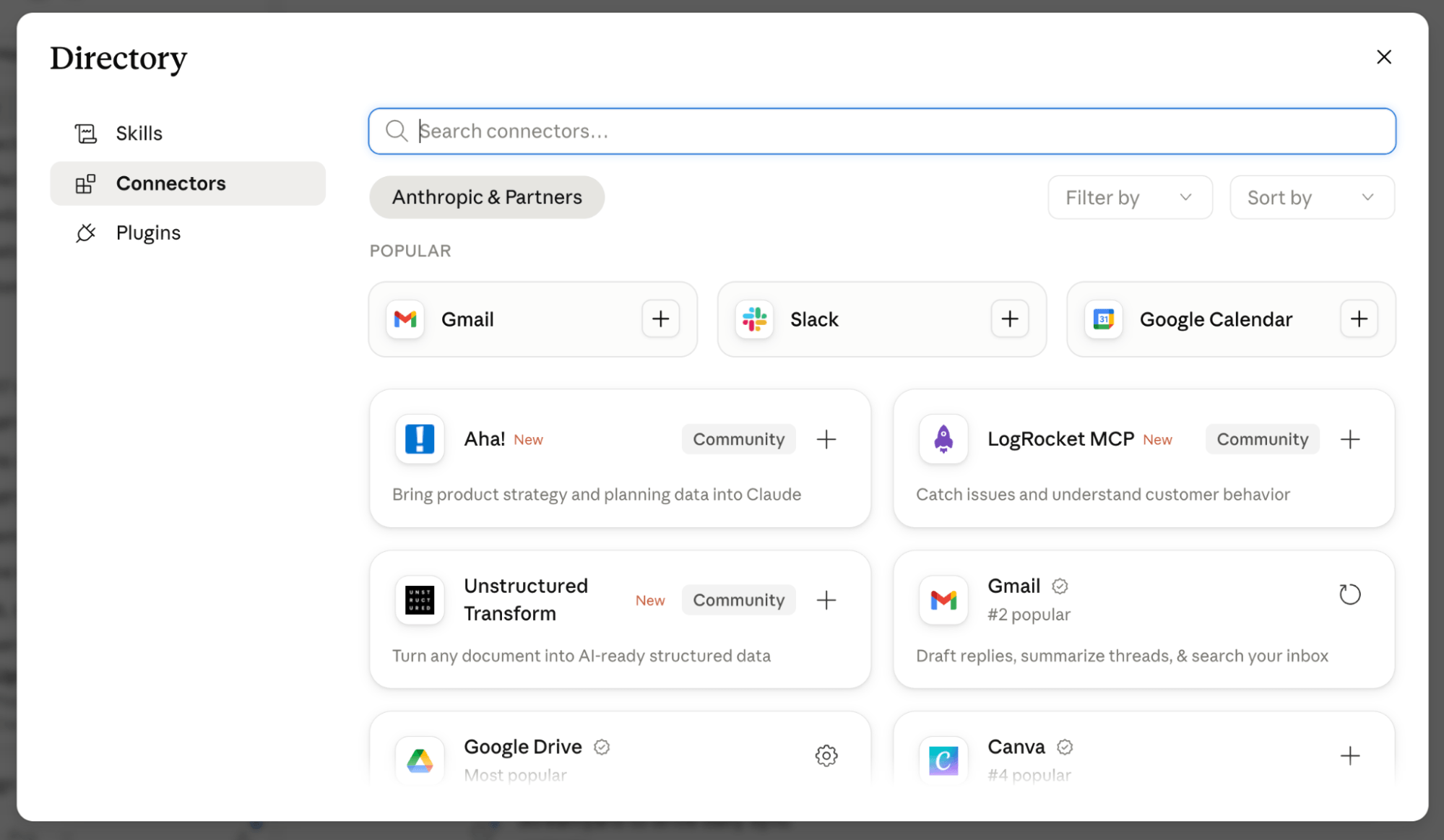
| Tier 1 | Native Connectors | Pre-built, vendor-maintained API connectors engineered directly by Anthropic for platforms like Google Drive, SharePoint, Notion, ClickUp, Asana, and monday.com. | Fully authenticated, tested, and maintained. Represents the most stable and performant integration path. |
| Tier 2 | Vendor-Published MCPs | Model Context Protocol (MCP) integrations published directly by software vendors. MCP acts as an open standard enabling standardized AI-to-API communication. | High security; maintained by official vendors. Standardized endpoints allow instant setup without custom coding. |
| Tier 3 | Custom Claude-Built MCPs | Custom MCP servers developed directly by Claude within Cowork when standard integrations do not exist. Generated via raw API documentation provided by the user. | API keys and secrets are securely routed through host operating system security (e.g., macOS Keychain), shielding raw credentials from the model. |
| Tier 4 | Browser Extension Automation | Direct web browser control leveraging the Claude Chrome Extension to visually navigate UIs, parse DOM elements, and click interface components. | Utilized for legacy software lacking APIs. Includes forced human authentication steps (the agent pauses for human login before executing actions). |
Integration Decision Flow:
Native Connector Available? ──YES──> Use Tier 1 (Native API)
             │ NO
Vendor MCP Available? ─────────YES──> Use Tier 2 (Vendor MCP)
             │ NO
API Documentation Exists? ─────YES──> Use Tier 3 (Custom MCP via Keychain)
             │ NO
Fallback ───────────────────────────> Use Tier 4 (Chrome UI Automation)
Operational Metrics: Manual vs. Agentic Workflow Efficiency
Comparative analysis between traditional manual business workflows and automated Claude Cowork deployment demonstrates significant time savings and productivity gains:

Process Execution Time Comparison (Minutes)

Manual Sales Proposal Workflow:
[■■■■■■■■■■■■■■■■■■■■■■■■■■■■■■■■■■■■■■■■■■■■■■■■■■] 120 Mins

Claude Cowork Automated Workflow:
[■■■■] 10 Mins (Human Review & Approval Only)
Case Study A: Enterprise Sales Proposal Pipeline
- Legacy Manual Process: Review call recordings, synthesize notes, perform prospect/market research, manually write customized proposal, update CRM records, save PDF to cloud repository, construct email draft with attachments. Total Time: ~120 minutes.
- Claude Cowork Pipeline: Fathom transcript ingested -> AI verifies request -> automated online market/prospect research executed -> proposal drafted -> human reviews output -> platform automatically updates CRM, archives PDF to Google Drive, and generates Gmail draft. Total Time: ~10 minutes (91.6% time reduction).
Case Study B: Content Research and Multi-Channel Curation
- Legacy Manual Process: Manually monitor industry trends, cross-reference internal video/podcast archives, generate multi-platform written copy, design graphics, edit short-form video clips, format posts across social platforms. Total Time: ~180 minutes per release cycle.
- Claude Cowork Pipeline: Cowork scans top-performing industry trends, cross-references internal media archives via local persistent vector memory, identifies matching historical talking points, generates customized multi-platform text and image assets, cuts matching video clips, and presents a complete review dashboard for human sign-off. Total Time: ~15 minutes.
Official Statements: Expert Analysis
During his detailed technical breakdown on the AI Explored podcast, automation strategist Isar Meitis emphasized the profound impact of shifting from chat-based AI to agentic desktop platforms.
On the paradigm shift away from traditional prompt engineering:
"Most people still interact with AI the same way they have since ChatGPT launched: type a prompt, get a response, type another prompt, get another response… Claude Cowork breaks that pattern. The user defines goals, constraints, and available data, and then the AI builds its own plan, displays it, and executes each step without requiring constant direction."
Regarding the operational necessity of comprehensive functional documentation (PRDs):
"Requirements are the tactical lever that makes everything work, because AI excels at execution. If the requirements define exactly what’s needed, including the data sources, workflow, connections, and expected outputs, the AI will implement it in minutes. Vague requirements lead to wasted time, wasted tokens, and wasted effort."
On maintaining structural safety and human accountability via "Human-in-the-Loop" architecture:
"Nothing gets posted without human approval… The system finds content actually created that aligns with current trends, generates posts and images, cuts video clips, and presents everything for review before publishing."
Future Outlook: The Trajectory of Desktop Agentic Computing
The introduction of Claude Cowork marks a decisive transition from browser-hosted LLM chat interfaces toward desktop-integrated operational agents. As platforms built around Anthropic’s Model Context Protocol (MCP) continue to mature, several key developments will reshape organizational workflows:
- Standardization of Model Context Protocol (MCP): Similar to how universal serial bus (USB) hardware standards unified device connectivity, MCP is rapidly becoming the universal software interface standard for AI agents. As enterprise software vendors natively embed MCP endpoints into their products, custom API coding will increasingly be replaced by instant plug-and-play integrations.
- Democratization of Software Creation: The transition from Claude Code (terminal-bound) to Claude Cowork (GUI-driven) enables non-technical business operators to design, build, and deploy complex software integrations. Business leaders can now orchestrate custom middleware and automation pipelines via natural language and structured interview sessions.
- Pervasive Human-in-the-Loop Governance: As autonomous agents gain deeper capabilities across enterprise environments, security governance will remain grounded in strict access sandboxing and human checkpoints. Future iterations of Cowork and related agentic platforms will likely introduce fine-grained permission models—allowing total autonomy for low-risk, internal actions while enforcing mandatory human authorization for external communications, financial transactions, and database updates.