By Investigative Staff
Updated | September 2026
Executive Overview
Universal Studios Hollywood has long mastered the art of cinematic illusion, but its latest engineering feat has collided with an unyielding reality: the human voice. When park executives conceptualized a high-speed, looping roller coaster designed to revitalize attendance and compete more aggressively with nearby Disneyland, they knew that bridging the gap between a high-octane thrill ride and an affluent residential boundary would be their greatest hurdle.
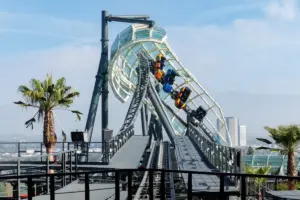
The resulting project—a staggering feat of mechanical engineering estimated to cost upwards of $200 million—was meticulously designed to be virtually silent. Engineers spent three years devising innovative noise-mitigation strategies, lining the 4,100-foot steel track with pea gravel to dampen structural vibrations, constructing towering glass "scream screens" to trap sound at its origin, and erecting a massive 940-foot sound wall utilizing aerospace-grade airport insulation. During uncrewed testing phases last month, residents of the adjacent, upscale Toluca Lake neighborhood lauded the park’s efforts, describing the mechanical hum as "whisper quiet."
However, the moment live passengers boarded the cars, the illusion shattered.
The introduction of real human riders transformed a state-of-the-art, whisper-quiet machine into an unyielding acoustic barrage. Every 30 seconds, for 10 hours straight, the track erupts with, in the words of one local homeowner, "bloodcurdling screams." Despite algorithmic car rotations engineered to turn riders’ mouths away from homes during key thrill moments, Universal’s technological safeguards proved entirely powerless against the unscripted volume of human adrenaline.
For parent company Comcast, the stakes extend far beyond local zoning disputes. Pushed by a recent 10% dip in park attendance and the looming shadow of Southern California’s expanding Disney properties, this new attraction was meant to be a cornerstone asset. Instead, it has triggered an immediate crisis of community relations, regulatory scrutiny, and corporate strategy—proving that while you can engineer a silent roller coaster, you cannot quiet the riders.
Detailed Chronology: From Blueprint to Backlash
Phase 1: Planning and Acoustic Mitigation (2023–Early 2026)
The genesis of Universal Studios Hollywood’s latest high-thrill roller coaster was fraught with engineering challenges from day one. Planners faced an immediate geographical constraint: the theme park sits perched directly above Toluca Lake, a historic, affluent residential enclave known for its quiet, tree-lined streets and privacy-conscious homeowners.
Recognizing that traditional roller coasters would inevitably draw swift legal action from the surrounding neighborhood, Universal’s R&D teams partnered with top-tier acoustic engineers to design a proprietary noise-reduction framework. Over a three-year development cycle, the team implemented measures previously unseen in the amusement park industry:
- Track Bed Modification: The entire 4,100-foot structural circuit was embedded within deep layers of specially graded pea gravel, engineered specifically to absorb kinetic energy and suppress low-frequency structural vibrations.
- Source Containment: Two massive, specialized glass "scream screens" were constructed at strategic elevation points along the track, designed explicitly to capture and reflect high-frequency sound waves back toward the park interior.
- The Aerodynamic Barrier: A monumental 940-foot acoustic barrier wall was installed along the park’s perimeter cliffside. Manufactured from heavy-duty, airport-grade insulation materials typically deployed to deflect deafening jet engine noise, this wall was billed as an impenetrable sonic shield.
Phase 2: Uncrewed Testing and False Confidence (July 2026)
By mid-summer, construction concluded, and the attraction entered its rigorous, uncrewed testing phase. Empty coaster trains hurtled along the track at speeds reaching 72 miles per hour, navigating loops, drops, and banked turns.
Local residents in Toluca Lake watched the early trials with cautious optimism. Without human voices aboard, the mechanical footprint of the coaster was remarkably subdued. The friction of steel wheels on track, the rushing of wind, and the hum of launch mechanisms were muffled successfully by the newly installed infrastructure. Homeowners publicly commended the park, with several describing the operational tests as "whisper quiet." Universal executives breathed a collective sigh of relief, believing they had successfully solved the notoriously difficult riddle of urban theme park design.
Phase 3: The Opening and the Acoustic Shockwave (August 2026)
That fragile peace evaporated the moment the ride opened to the public.
As soon as real passengers filled the seats, the acoustic profile of the attraction shifted dramatically. The mechanical silence was instantly overpowered by human biology. Without warning, Toluca Lake was subjected to a rhythmic, unceasing wave of high-decibel terror and excitement.
According to local homeowners, the sound does not fade into the background; it dominates it. The cadence of the ride—dispatching new cars every 30 seconds throughout the park’s standard 10-hour operating day—creates an endless loop of auditory intrusion. The community’s initial sense of betrayal was palpable, as the multi-million-dollar mitigation measures that sounded so promising during empty tests proved wholly inadequate against human lungs.
Supporting Context & Metrics: The Corporate and Community Impact
The Business Pressures Driving Comcast and Universal
To understand why Universal pushed forward with such a high-risk installation in a tightly constrained urban footprint, one must look at the broader economic pressures facing NBCUniversal and its parent conglomerate, Comcast.
| Metric / Financial Indicator | Context & Value | Strategic Significance |
|---|---|---|
| Parent Acquisition Cost | $23 Billion (historical NBCUniversal buyout) | Comcast has heavily leveraged capital into its media and theme park divisions to drive consistent growth. |
| Estimated Ride Investment | $200+ Million | Represents one of the single largest capital expenditures in Universal Studios Hollywood’s recent history. |
| Park Attendance Shift | 10% Year-Over-Year Decline | Created an urgent mandate for executive leadership to introduce a high-impact anchor attraction. |
| Regional Competition | Disneyland Resort (Anaheim) | Expanding aggressively with new lands and immersive experiences, threatening Universal’s market share in Southern California. |
Universal executives were banking on this 72-mph looping coaster to serve as a magnet for millennial and Gen Z thrill-seekers, balancing out the family-oriented appeal of the adjacent Super Nintendo World. However, the financial success of a $200 million asset is deeply threatened if municipal authorities or mounting lawsuits force the park to curtail operating hours, lower speeds, or implement crippling capacity restrictions.
The Human Toll on Toluca Lake
While corporate balance sheets reflect millions of dollars in capital expenditure, the residents of Toluca Lake report a very different set of metrics—measured in decibels, lost sleep, and disrupted livelihoods.
Craig Strong, a 25-year resident of the neighborhood, captured the sentiment of the community in interviews with The New York Times, noting that the idyllic atmosphere of his neighborhood has been permanently fractured by the recurring "bloodcurdling screams."
The intrusion is indiscriminate, affecting residents regardless of age or physical capability. One elderly homeowner reported that the piercing shrieks cut through her daily routine so aggressively that she could hear them clearly even with her hearing aids removed. Another resident, who operates a home-based meditation and mindfulness coaching business, expressed profound anxiety that the uninvited soundtrack echoing up the hillside would completely destroy her client base, rendering her professional workspace untenable.
Official Statements and Engineering Realities
The Illusion of "Key Scream Moments"
Perhaps the most fascinating aspect of Universal’s pre-emptive defense strategy was its reliance on behavioral choreography. Recognizing that human vocalization was an inevitability, engineers attempted to outsmart human psychology through ride design.
The coaster’s spinning cars were explicitly programmed with computerized telemetry to dynamically rotate passengers’ bodies—and crucially, their mouths—away from the residential valley below during what data models predicted would be "key scream moments," such as sudden drops and high-velocity inversions. Furthermore, acoustic modelers went so far as to broadcast recorded roller-coaster and scream audio down the hillside from loudspeakers prior to construction, attempting to simulate the acoustic scatter and adjust sound wall angles accordingly.
Yet, these sophisticated algorithms failed to account for the unpredictable nature of human emotion. Riders do not scream on a synchronized cue; they scream out of anticipation, terror, surprise, and joy at erratic intervals throughout the entire duration of the circuit. Furthermore, the acoustic reflection off canyon walls, atmospheric temperature inversions, and wind currents combined to bounce sound waves over and around the physical barriers in ways that computer models failed to predict.
Universal’s Response and Ongoing Remediation
Faced with mounting public outrage and intense media scrutiny, Universal Studios Hollywood has issued measured responses acknowledging the community’s concerns while defending the extensive investments already made.
In official statements, park representatives emphasized that they are actively monitoring sound levels at multiple boundary points along the Toluca Lake border. The resort has announced plans to implement secondary, supplementary sound-buffering measures—including enhancements to existing barriers and internal operational adjustments. Engineers are currently reviewing whether slowing down specific launch phases or altering daily operating hours can alleviate the relentless cadence of noise without degrading the guest experience.
However, park officials have stopped short of detailing specific timelines or guaranteeing that the noise can be reduced to pre-opening levels. For an industry built on delivering maximum sensory stimulation, finding a balance between visceral thrills and peaceful coexistence remains an elusive holy grail.
Future Outlook: A Precedent for Theme Park Development
As the dust settles over the hills of Toluca Lake, the unfolding situation at Universal Studios Hollywood serves as a cautionary tale for the global theme park industry.
Urban encroachment has increasingly placed high-intensity attractions directly adjacent to high-density residential zones. From Orlando to Osaka, operators are finding themselves squeezed between the commercial necessity of building faster, louder, and more immersive roller coasters to combat sluggish attendance, and the hardening legal resistance of local communities armed with decibel meters and organized legal representation.
What Lies Ahead for Universal and Toluca Lake?
- Regulatory Intervention: Local municipal boards and zoning commissions are already facing mounting pressure to step in. If voluntary mitigation efforts fall short, Universal could face formal noise ordinances, mandatory curfews, or fines that permanently impair the operational flexibility of the multi-million-dollar investment.
- Litigation Risks: Legal experts predict that if noise levels remain unmitigated, class-action lawsuits regarding private nuisance and diminished property values could follow, potentially forcing Comcast to consider even more radical physical modifications—such as total partial enclosures (tunnels) over exposed sections of the track.
- A Paradigm Shift in Ride Design: The failure of Universal’s computerized "scream rotation" technology will likely force theme park designers to fundamentally rethink how they model sound. Future attractions may need to rely far less on open-air layouts and much more on fully enclosed, indoor building structures—similar to modern dark rides—to keep high-decibel thrills strictly contained.
As one Toluca Lake homeowner grimly summarized as the daily symphony of shrieks echoed across the valley: "I have a feeling this isn’t going to be over anytime soon."
For Universal Studios Hollywood, the race to save its attendance numbers has only just begun, and the price of admission may ultimately be measured in courtrooms, community forums, and millions of dollars in retrofitted acoustic engineering.