This article is sponsored by Silver Arbitration Law, PLLC. The opinions expressed herein are those of the sponsor.
For years, digital marketers and account managers have performed a familiar, wearying dance. When a client asks why their Cost-Per-Click (CPC) has spiked despite steady ad quality, the answers are rehearsed: increased competition, a shift toward broader match types, a dip in Quality Score, or the need for a comprehensive account restructuring. These explanations are plausible, rooted in the standard operating logic of the Google Ads platform.
But what if the culprit wasn’t a fluctuating market or a suboptimal campaign structure, but rather an internal, invisible mechanism controlled by Google itself?
In August 2024, a landmark federal court ruling brought this suspicion into the light. Following a grueling ten-week trial, the court concluded that Google had "exercised its monopoly power by charging supracompetitive prices for general search text ads." For the advertising industry, this is not merely a legal footnote—it is a fundamental shift in how we understand the economics of the world’s largest digital marketplace.
Executive Overview: The "Pricing Knob" Reality
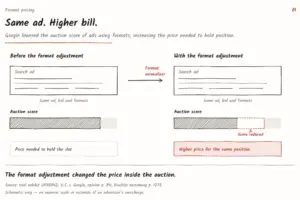
The term "supracompetitive" carries significant weight in antitrust law; it refers to prices inflated beyond what a healthy, competitive market would naturally produce. The trial record revealed that Google’s advertising team maintained internal "pricing knobs"—mechanisms capable of artificially raising the costs for winning bidders without requiring any improvement in ad quality or an increase in genuine competitive pressure.
Essentially, these knobs allowed Google to inflate the runner-up’s bid, which, due to the structure of the second-price auction, dictated the final price paid by the winner. For the digital marketing community, this revelation changes everything. It suggests that for years, many advertisers were paying a "monopoly premium" that had nothing to do with their marketing performance.

Detailed Chronology: Uncovering the Auction Manipulations
The court’s findings did not emerge from speculation; they were anchored in Google’s own internal documents and sworn testimony. The record indicates that Google’s leadership was well aware of the disconnect between their pricing strategies and advertiser transparency.
In a candid moment during the trial, Google’s Vice President of Ads testified with stark clarity: "We tend not to tell advertisers about pricing changes." The court’s memorandum opinion echoed this sentiment, noting that many advertisers remained entirely unaware that Google—not the market—was the primary driver behind sudden spikes in their CPCs.
The litigation highlighted specific auction changes that impacted pricing. While these changes were often framed as technical refinements, the court viewed them through the lens of monopolistic price-setting. For advertisers looking to audit their historical performance, the first step is to align their internal spend data with the specific windows of time identified in the litigation.
Advertisers must distinguish between different types of spend. The search monopoly ruling specifically addresses "general search text ads." It does not extend to the broader search advertising ecosystem, which includes retail-specific platforms like Amazon or Walmart. Furthermore, spend allocated to Shopping ads or Performance Max campaigns may fall outside the scope of these specific findings. Disaggregating your historical data by ad format is the essential first step in determining whether your account was subject to these inflated pricing mechanisms.
Supporting Context: Metrics and Economic Impact
If you suspect your account has been impacted, the potential financial implications are substantial. Economists testifying in these matters have estimated that Google’s overcharges hovered between 5% and 10%. Under the framework of antitrust law, proven damages are often subject to trebling—meaning that if a business can demonstrate a 10% overcharge, the potential recovery could be significantly higher.
Consider a mid-sized enterprise that spent $10 million on eligible search ads during the relevant period. A conservative estimate of damages could result in a claim ranging from $1.5 million to $3 million, before accounting for legal fees or case-specific adjustments. This is not a nominal figure; it represents a significant recovery of capital that was arguably extracted through non-competitive means.

The Display Advertising Dimension
The landscape of Google’s legal challenges expanded on April 17, 2025, when Judge Leonie Brinkema of the U.S. District Court for the Eastern District of Virginia ruled that Google had also monopolized key segments of the display advertising chain. While the search ruling impacts text-based search ads, the display ruling concerns the broader ad-tech ecosystem. Advertisers who purchased display inventory through Google’s proprietary tools must now evaluate their spend under the scrutiny of this second, distinct ruling.
It is vital to distinguish between court findings and trial evidence. A finding is a legal conclusion reached by a judge; an exhibit—such as a internal email or a transcript of testimony—is the evidence used to reach that conclusion. The arguments presented in this article rely on the court’s official findings, providing a solid legal foundation for those considering action.
Official Statements and the Path to Arbitration
Google has signaled its intent to appeal these rulings, maintaining that its auction practices were competitive and beneficial to the ecosystem. However, the regulatory environment is already shifting. As part of the court-ordered remedies finalized in September 2025, Google is now required to provide public disclosure regarding material changes to its ad auctions. This transparency mandate is a direct result of the court’s determination that the previous "black box" approach to pricing was a hallmark of monopolistic behavior.
Navigating the Arbitration Clause
For many, the path to recovering these costs lies within Google’s own Terms of Service. Google mandates that advertising disputes be resolved through individual arbitration rather than class-action lawsuits. While this may seem daunting, it is a process that thousands of U.S. advertisers have already initiated.
The process of filing an individual arbitration claim is less labor-intensive than most in-house legal departments anticipate. In many cases, gathering the necessary account records requires roughly one hour of staff time—typically split between the person with administrative access to the Google Ads account and an authorized signatory. Once the records are compiled, the heavy lifting of legal assessment and filing is handled by counsel.
The "Retaliation" Myth
The question most frequently asked by nervous advertisers is: Will filing a claim trigger retaliation from Google?

In the current climate, this fear is largely unfounded. With thousands of advertisers already engaged in active disputes, there is no evidence of systematic retaliation against claimants. Engaging in retaliatory practices against such a large cohort would create an immediate, severe, and public legal disaster for a company already under the intense, daily scrutiny of two federal courts. When you initiate arbitration, you are not "suing" Google in a traditional sense; you are utilizing the dispute resolution mechanism that Google explicitly wrote into its own contracts.
Future Outlook: Accountability in the Digital Age
As we look toward the future, the relationship between platform giants and the advertisers who sustain them is undergoing a permanent transformation. The era of the "black box" auction is drawing to a close, replaced by a new reality where transparency is not just a best practice—it is a legal requirement.
For agencies and in-house marketing leads, the mandate is clear: perform a rigorous audit of your historical spend. Identify which entity accepted the advertising terms and paid the invoices, as these entities hold the legal standing to pursue a claim. If your agency managed the account, they remain an invaluable partner in extracting the data, but the financial recovery rightfully belongs to the business that funded the campaigns.
To begin this process, it is recommended that advertisers consult with counsel specializing in arbitration. A preliminary assessment can clarify whether your specific spend patterns align with the findings of the federal courts.
The findings in these cases are not merely history; they are a window into the mechanics of the modern web. For businesses that have spent millions on search advertising over the last decade, the question is no longer whether Google’s auction practices were fair—the courts have already answered that. The question now is whether you are prepared to exercise your rights to recover the monopoly premiums you were forced to pay.
Disclaimer: This article is for general information purposes only and does not constitute legal advice or create an attorney-client relationship. Claims against Google are pursued through individual arbitration under Google’s Terms of Service, not in court. Prior results do not guarantee a similar outcome. Not affiliated with or endorsed by Google LLC.