Executive Overview
The digital marketing landscape is currently experiencing its most profound transformation since the inception of the search engine. As Large Language Models (LLMs) like ChatGPT, Claude, and Gemini reshape user behavior, a significant portion of the SEO industry has pivoted toward "Generative Engine Optimization" (GEO). The prevailing narrative suggests that if brands don’t optimize for AI citations, they will vanish from the digital ecosystem.
However, a massive, data-driven reality check is required. An extensive analysis of 100 diverse websites representing over 145 million sessions reveals that the industry’s obsession with direct LLM traffic is largely misplaced. While AI is indeed rewriting the rules of the internet, the actual return on investment (ROI) is not found in chasing chat-bot citations, but in preparing for the "Agentic Web"—a future where search engines function as active work coordinators rather than passive link directories.
A Detailed Chronology: From Search to Agentic Web
For years, the SEO community operated under a predictable framework: create content, rank on Google, drive traffic, and convert. When generative AI burst onto the scene, the initial reaction was one of existential dread, followed by a frantic attempt to influence LLM outputs.
In the early months of the ChatGPT era, many analysts observed a growth trend in referral traffic from AI platforms. If the math of that early exponential growth had held, it would have been logical to conclude that LLMs would soon eclipse traditional search. Yet, the data tells a different story.

By August 2025, in direct correlation with the release of GPT-5, the exponential growth of ChatGPT referral traffic across the analyzed datasets hit a ceiling. Since that plateau, the volume of referral traffic from LLMs has actually begun to decline. The "honeymoon phase" of direct AI-to-web traffic has ended, giving way to a more integrated, closed-loop system where AI platforms increasingly prioritize keeping users within their own ecosystems.
Supporting Context & Metrics: The Reality of Traffic
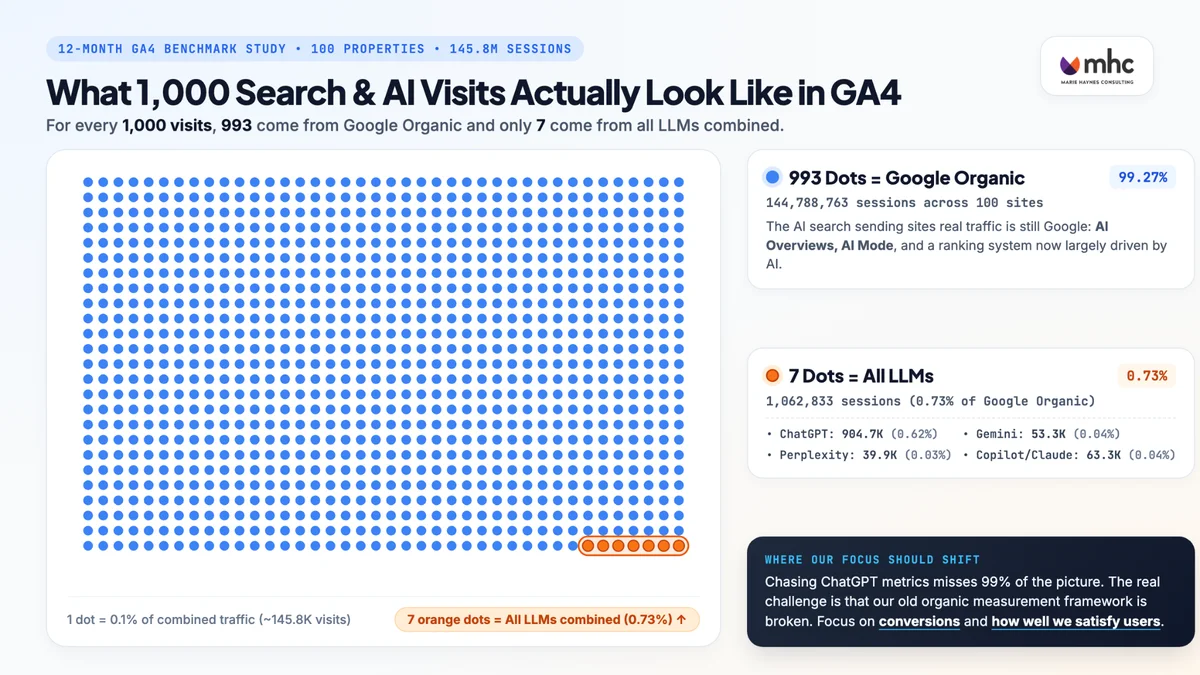
To understand the scale of this shift, we analyzed 100 websites across various industries, totaling 145 million sessions over a 12-month period. The findings are stark:
- ChatGPT Referral Traffic: Amounted to a mere 0.62% of the volume driven by Google Organic search.
- Total AI LLM Traffic: Even when including all other major LLMs in the dataset, the total combined traffic reached only 0.73%.
The Conversion Paradox
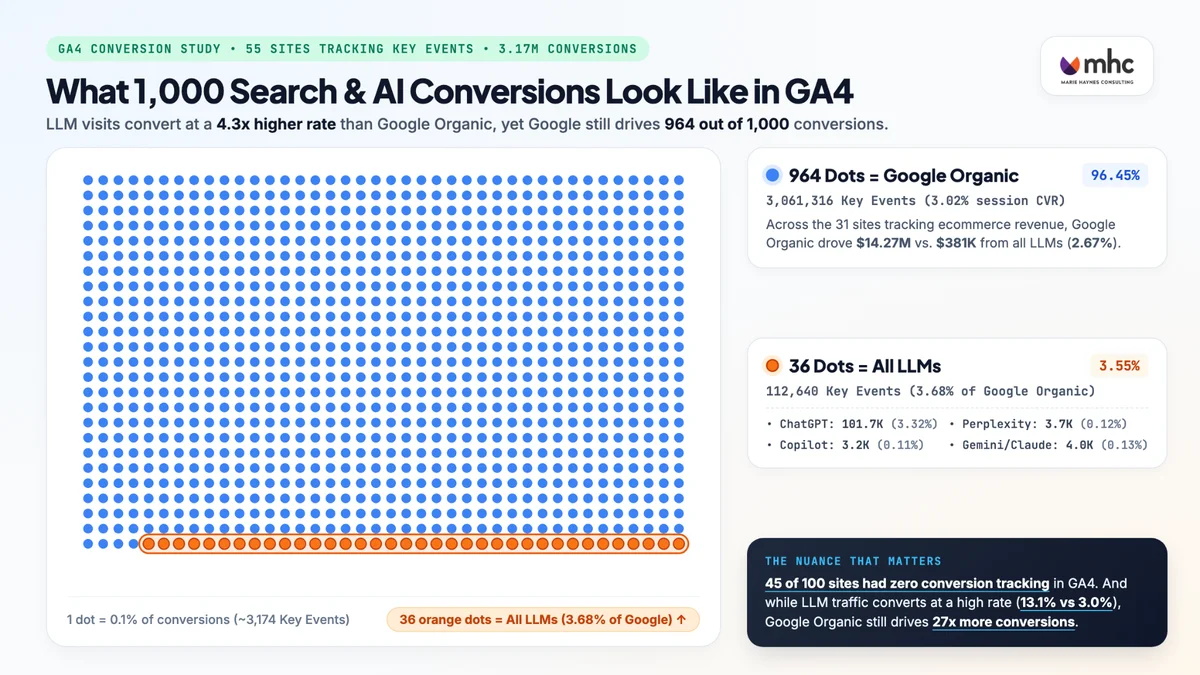
While LLM traffic is statistically minor, there is a nuance: users who do reach a website via an LLM often exhibit higher engagement. In the study, ChatGPT visitors converted at a rate 4.5 times higher than those from Google Organic.
However, this higher conversion rate is offset by the sheer volume disparity. Google Organic accounted for 96.5% of total conversions across the analyzed sites. In real terms, Google drove 27 times more conversions than all LLMs combined. The data suggests that while AI-driven traffic may be high-intent, it is not currently a viable substitute for the massive, top-of-funnel reach provided by traditional search.
Official Perspectives on the Agentic Future
Industry leaders are no longer talking about "search" in the traditional sense. Google CEO Sundar Pichai has explicitly noted that search is evolving into an "agent manager." This shift represents a transition from a passive link-finding utility to an active service layer that can perform tasks on behalf of the user.
Sergey Brin and Demis Hassabis have both signaled that the next decade will be defined by an "agent-first" web. As Hassabis noted, this web may not even need to render content for human eyes in the way we currently understand; it will be a machine-to-machine interface where agents interact directly with APIs and databases to fulfill user intent.
Future Outlook: Preparing for the Agentic Web
If the era of chasing blue-link clicks is waning, where should businesses focus their resources? The future of digital visibility is no longer just about "being found" by a human; it is about being "interoperable" with the agents that serve those humans.
1. The Rise of the Universal Cart
Google’s Universal Cart is a signal of things to come. By aggregating products from multiple retailers into a unified checkout within Google Wallet, Google is removing the need for the user to visit a website at all.

- Strategic Move: Businesses must master their Merchant Center data. The future belongs to those who provide the cleanest, most structured, and most up-to-date data, allowing Google’s AI to treat their inventory as a native component of its shopping interface.
2. The Universal Commerce Protocol (UCP)
Governed by a coalition including Google, Shopify, and Stripe, the UCP provides an open discovery layer for AI agents. It allows agents to compare inventory and execute purchases without the user ever leaving a Google surface.
- Strategic Move: SEO teams must evolve into "Agentic Discovery Specialists." Understanding
/.well-known/ucpand the technical requirements for agentic discovery will be as important as traditional keyword research is today.
3. WebMCP (Model Context Protocol)
WebMCP is perhaps the most exciting frontier for developers. It allows websites to expose interactive functions—such as calculators, booking schedulers, and dynamic forms—directly to AI agents.
- Strategic Move: Start experimenting with internal tools that can be "called" by an AI agent. If a user asks a chatbot to "book a consultation with [Company Name]," your site should be built to handle that request programmatically via WebMCP.
4. Intelligent Eyewear: The Ambient Web
With the launch of "Intelligent Eyewear" running Android XR, search is moving from the screen to the real world. This is the ultimate "See it, Solve it, Buy it" platform.
- Strategic Move: Consider how your business provides value in a real-world, context-aware environment. Whether it’s a plumbing assistant or a retail shopping guide, brands that develop for the "Ambient Web" will have a distinct advantage as AR hardware adoption grows.
Conclusion: The Path Forward
The industry’s preoccupation with GEO and LLM mentions is, at best, a distraction and, at worst, a misallocation of vital resources. We are witnessing the death of the "informational" web as we knew it, and the birth of an "agentic" web.
The most important search engine remains Google, but the way it interacts with your brand is changing. The goal for the next five years is not to rank for a specific keyword in a chat window, but to ensure your business data is machine-readable, your checkout processes are integrated into agentic ecosystems, and your customer service functions are accessible via WebMCP.
Stop measuring clicks from ChatGPT and start measuring "Key Events." Focus on user satisfaction, deep learning-aligned content quality, and technical readiness for the agentic era. The companies that thrive will be those that realize the web is no longer a place to visit—it is a system to be interacted with.
A Practical Framework for Your Business
To begin your transition, perform the following audit:
- Universal Cart Audit: Is your Merchant Center feed fully optimized? Does it provide real-time updates on stock, pricing, and promotions?
- WebMCP Pilot: Identify one "task" a customer does on your site (e.g., booking an appointment) and investigate how that could be exposed to an AI agent.
- Ambient Strategy: How can your brand assist a user in the physical world? If they were looking at your product through smart glasses, what information or action would be most helpful to them?
The web is not disappearing; it is simply becoming more efficient. Don’t get left behind by optimizing for yesterday’s search.