Executive Overview
In an era defined by perpetual notifications, infinite doomscrolling, and algorithmically engineered attention fragmentation, the modern web browser has increasingly become a site of cognitive exhaustion. Users open tabs intending to research a work-related query, only to find themselves three hours deep into a chaotic vortex of social media feeds, clickbait, and endless algorithmic rabbit holes. Into this landscape of sensory overload steps Opera, which has officially relaunched its wellness-focused lightweight web client: the Opera Air browser.
Originally introduced in early 2025 as an experimental antidote to digital chaos, the newly overhauled Opera Air returns with a comprehensive audiovisual toolkit designed to cultivate "mindful browsing." Eschewing the cluttered interfaces and aggressive, data-harvesting paradigms of legacy web giants, Air positions itself as a sanctuary of calm. The browser integrates custom ambient soundscapes, scheduled breathing exercises, physical wellness prompts, minimalist design aesthetics, and aggressive, built-in privacy safeguards like a free VPN and ad-blocker.
While cutting-edge artificial intelligence tools have increasingly dominated software development—often threatening to overwhelm users with automated tasks and chat interfaces—Opera Air takes a markedly restrained approach. AI integration is included via ChatGPT, but it remains strictly opt-in, disabled by default to prevent cognitive distraction. Instead, Air pivots toward human-centric ergonomics: encouraging users to look away from their screens, stretch their necks, regulate their breathing, and reclaim their agency over their online habits. Available entirely for free on Windows and macOS, the relaunched browser represents a fascinating shift in software design—one where success is measured not by how long a user stays glued to the screen, but by how mindfully they interact with the digital world.
Detailed Chronology: From Concept to Calm
To understand the significance of Opera Air’s latest iteration, it is essential to examine the developmental timeline that brought the software to this juncture.
Phase 1: The Genesis of Mindful Browsing (Early 2025)
The digital wellness movement has been simmering for years, driven by mounting psychological research linking hyper-connectivity to rising anxiety, attention deficit traits, and burnout. Recognizing that software developers had a moral and practical imperative to address this crisis, Opera first unveiled the conceptual framework for the Air browser in early 2025.
The initial release established the core philosophy of the project: minimalism as a virtue. Where traditional browsers boasted heavy resource utilization, dozens of persistent extension icons, and dynamic, attention-hijacking home pages, Air introduced a stripped-down, lightweight architecture. It forced users to be intentional about their digital workspace by requiring them to manually pin applications to the sidebar. However, while the first version laid the groundwork by offering a quieter workspace, it lacked the proactive wellness interventions required to truly break deep-seated, compulsive browsing loops.
Phase 2: The Refinement and Audiovisual Overhaul (Late 2026)
Following months of telemetry analysis, user feedback, and ergonomic research, Opera developers realized that simply offering a blank or minimalist page was insufficient to alter modern browsing habits. Users working in high-stress environments naturally gravitated toward ambient sound platforms, external meditation apps, and productivity timers to manage their focus.
Thus, in October 2026, Opera officially launched the major update to the Air browser. This new iteration shifted Air from a passively quiet browser into an active wellness companion. By embedding native audio landscapes directly into the software architecture, introducing automated physical wellness routines (such as scheduled neck stretches and breathing prompts), and refining its visual design language around "open spaces and natural textures," Opera transformed the browser into an integrated ecosystem for cognitive preservation.
Supporting Context & Metrics: The Anatomy of Modern Digital Fatigue
The release of the updated Opera Air browser does not occur in a vacuum; it arrives against a backdrop of escalating concern regarding human attention spans and the neurological toll of continuous partial attention.
The Psychology of the Rabbit Hole
Modern web architecture is deliberately engineered to exploit human psychology. Variable reward schedules—the same psychological mechanisms that drive slot machines—power social media feeds, infinite scroll mechanisms, and algorithmic recommendation engines. When a user opens a web browser, they are met with a barrage of visual stimuli designed to trigger dopamine release and extend session duration.
Studies in cognitive ergonomics indicate that every context switch—jumping from a work document to a Reddit thread, checking an email notification, and glancing at a news alert—carries a "attention residual" tax. It takes the human brain an average of more than 20 minutes to return to a deep state of focus after a single interruption. Over the course of a standard eight-hour workday, these micro-distractions compound, resulting in severe mental fatigue, diminished productivity, and elevated stress hormones.
How Opera Air Combats Cognitive Overload
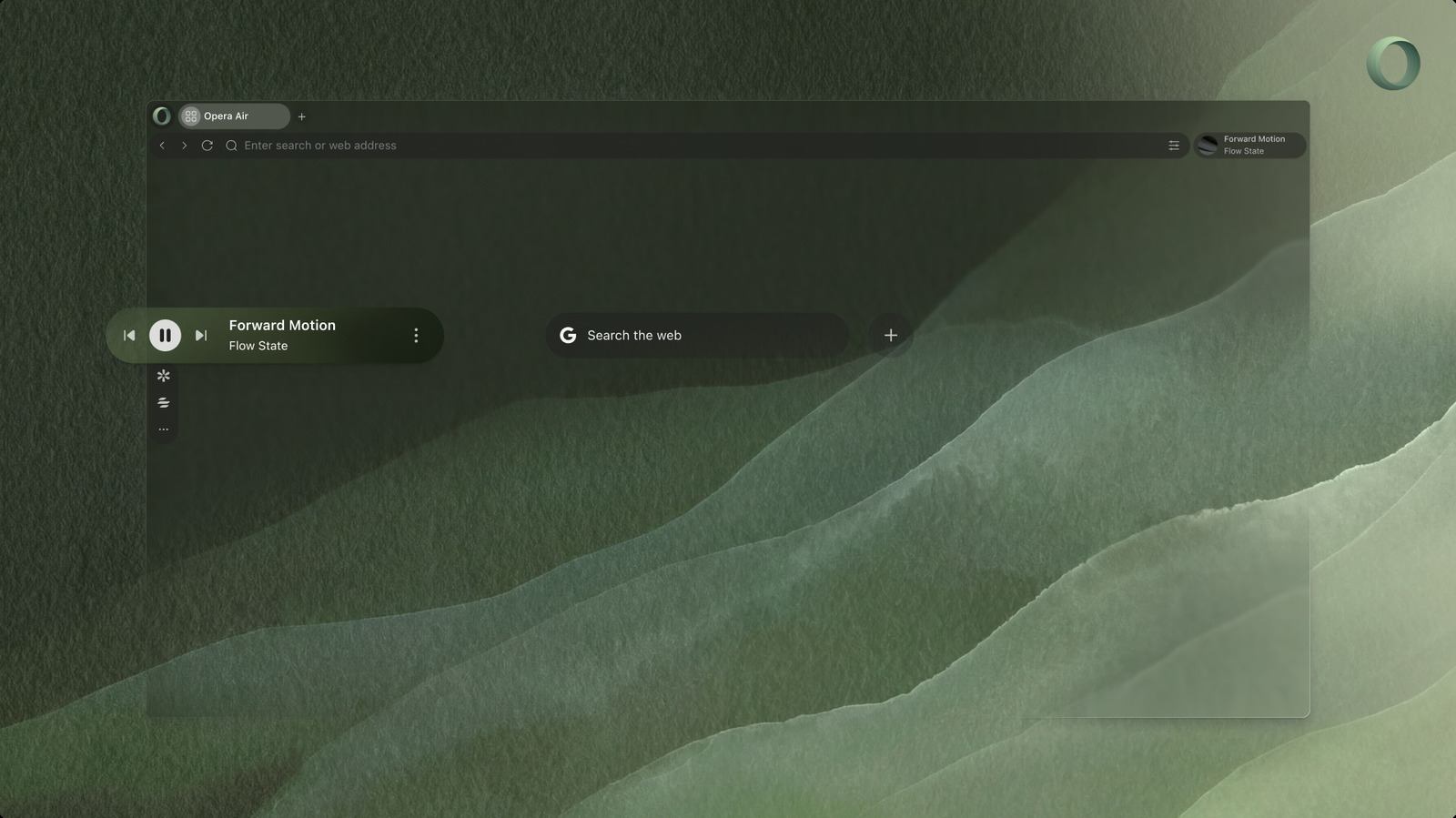
Opera Air addresses these systemic pain points through a multi-layered functional design:
- Air Soundscapes: Recognizing that ambient audio is a proven catalyst for deep work, Opera has developed an in-house sound engine. Users can select from four distinct operational moods: Focus, Relax, Work, and Ambience. Selecting the latter immerses the user in natural acoustic environments, such as rustling forests or rhythmic ocean waves, masking the harsh, unpredictable noises of the open office or busy home environment.
- Somatic Check-ins (Breathing and Ergonomics): Digital fatigue is not purely mental; it manifests physically in tight shoulders, strained eyes, and shallow breathing (often referred to as "email apnea"). Opera Air introduces customizable interval prompts for breathing exercises and guided neck stretches, pulling the user momentarily out of the digital trance and back into physical self-awareness.
- Intentional Design Language: To mitigate visual clutter, the browser incorporates high-end, serene wallpapers featuring natural textures, open spatial perspectives, and an automated dark mode designed to reduce ocular strain during late-night research or reading sessions.
- Privacy as a Mental Shield: The psychological burden of the modern web is heavily tied to surveillance capitalism—the constant, nagging feeling of being tracked, targeted, and manipulated by data brokers. By bundling a robust, native ad-blocker and a complimentary Virtual Private Network (VPN) directly into Air, Opera removes a significant layer of digital friction and background anxiety.
Official Statements and Industry Perspective
Industry analysts and Opera’s internal development teams have framed the Air browser not merely as a niche alternative product, but as a necessary course correction for an industry obsessed with engagement metrics over user well-being.
In press releases accompanying the relaunch, Opera representatives emphasized that the modern web has become fundamentally hostile to human concentration. "We spend our days navigating an obstacle course of pop-ups, trackers, autoplay videos, and endless feeds designed to steal our most precious non-renewable resource: our attention," notes the development philosophy behind Air.
By scaling back the digital noise, Opera is deliberately swimming against the current of major tech conglomerates. While competitors such as Microsoft (with Copilot) and Google (with Gemini) race to integrate aggressive, ubiquitous AI assistants into every corner of the browsing experience—often raising legitimate concerns regarding user privacy, data harvesting, and cognitive dependency—Opera has chosen a path of radical restraint.
While the browser does feature integration with OpenAI’s ChatGPT, the company made the deliberate architectural decision to leave this sidebar option unchecked by default. This ensures that users who want an AI-augmented experience can opt in, while those seeking a pure, distraction-free environment are not automatically subjected to automated prompts or conversational agents. This design philosophy acknowledges a growing consumer sentiment: artificial intelligence should serve as a tool of convenience chosen by the user, rather than an uninvited, omnipresent chaperone dictating the online experience.
Future Outlook: The Evolution of Wellness-Centric Software
As the digital wellness market transitions from a trendy lifestyle buzzword into a critical health and productivity necessity, the trajectory of software design is bound to shift. Opera Air provides a compelling preview of what post-attention-economy software could look like.
The Rise of Mindful Computing
For decades, the metric of success for internet applications has been "engagement"—a polite corporate euphemism for addiction. Software companies have competed aggressively for screen time, utilizing dark patterns, notification loops, and personalized algorithms to keep users tethered to their devices as long as possible.
However, a cultural counter-movement is rapidly gaining momentum. Consumers are increasingly pushing back against burnout culture, leading to the rapid growth of digital detox retreats, "dumbphone" revivals, and software built around digital minimalism. In this emerging paradigm, tools that actively help users disconnect or engage more efficiently hold immense intrinsic value.
What Lies Ahead for Opera Air?
Looking forward, the roadmap for browsers like Opera Air will likely involve deeper personalization of wellness metrics, expanded acoustic libraries, and integration with local health tracking ecosystems—all while maintaining the strict privacy standards that modern users demand. As remote and hybrid work models remain permanent fixtures of the global economy, the boundaries between professional obligations and personal digital consumption will continue to blur, making dedicated sanctuary spaces within our software indispensable.
Whether Opera Air can capture a dominant market share from entrenched giants like Google Chrome or Apple Safari remains to be seen. However, its true value may lie not in dominating market share, but in shifting the industry baseline. By proving that users are hungry for software that respects their time, cognitive limits, and mental well-being, Opera has thrown down a challenge to the entire tech sector: build tools that elevate humanity, rather than exploiting its vulnerabilities.
For now, Opera Air is available as a free download for both Windows and macOS users—offering a quiet, unbothered, and thoroughly moisturized digital harbor in an otherwise turbulent sea of modern connectivity.