
Executive Overview
The landscape of high-end gaming peripherals has long been dominated by specialized headsets, complex multi-monitor desk setups, and mechanical keyboards engineered for tactical precision. Yet, audio—the visceral, spatial cornerstone of immersive gaming—has remained tethered primarily to over-ear headphones or traditional, non-optimized desktop speakers. ASUS, through its elite Republic of Gamers (ROG) division, is looking to disrupt this paradigm with the official United States release of the ASUS ROG Gjallar.
Priced at $600, the Gjallar represents a monumental milestone for the hardware giant: it is the company’s very first dedicated gaming soundbar. Unveiled initially in early July and now rolling out to major US retailers like Best Buy and the official ASUS store, the Gjallar is not merely a downsized home theater soundbar retrofitted with RGB lighting. Instead, it has been engineered from the ground up specifically for multiplayer gaming, competitive audio cues, and seamless multi-platform ecosystems.
Named after Gjallarhorn—the legendary mythological horn of Norse lore whose blast could be heard across all realms—the ROG Gjallar aims to herald a new era of "headset-free" communication. Featuring a robust 5.1.2-channel speaker configuration, support for spatial Dolby Atmos, a dedicated wireless subwoofer, and an innovative all-in-one audio control hub complete with integrated beamforming microphones, the device commands a premium price point.
This comprehensive report examines the technical architecture, market positioning, competitive implications, and prospective future of ASUS’s high-stakes entry into the gaming soundbar market.
Detailed Chronology of the ROG Gjallar’s Development and Launch
To understand the engineering ambition behind the ROG Gjallar, it is necessary to retrace its trajectory from concept to commercial availability.
Phase 1: The Conceptualization of Headset-Free Multiplayer Audio
For decades, competitive multiplayer gaming has imposed an unwritten rule: if you want precise directional audio and crystal-clear voice communication with your squadmates, you must wear a headset. While effective, this requirement comes with inherent drawbacks—fatigue from extended wear, clamped headbands, heat buildup, and a tangled mess of cables or failing wireless batteries.
ASUS ROG’s audio engineering teams identified a gaping void in the market: gamers wanted the room-filling immersion and physical impact of external speakers, but lacked a hardware solution that could intelligently separate game audio from microphone input without capturing echo, feedback, or explosive in-game sound effects. The conceptualization of the Gjallar focused heavily on solving this acoustic dilemma, pivoting the design philosophy away from traditional movie-watching soundbars and toward competitive, communicative multiplayer scenarios.
Phase 2: The July Teaser and Global Anticipation
In early July, ASUS officially pulled back the curtain on the ROG Gjallar, generating immediate buzz across enthusiast communities and hardware blogs. Unlike standard peripheral announcements that target office workers or casual media consumers, the Gjallar’s specifications sheet targeted the hardcore demographic:
- A 5.1.2-channel architectural layout.
- A standalone, low-latency wireless subwoofer.
- An external desktop control hub equipped with a dedicated LCD screen and advanced voice-isolation technology.
The initial summer preview established high expectations, positioning the device as a luxury upgrade for dedicated battle stations where desk space and acoustic fidelity are equally at a premium.
Phase 3: The US Retail Debut at $600
As of the current rollout phase, the ROG Gjallar has officially landed in the United States with an MSRP of $600. Listed on both the official ASUS US web store and major retail partners like Best Buy, the product has experienced immediate high demand, with initial stock allocations moving rapidly.
While certain storefronts currently display "sold out" statuses or prompt users to sign up for "Notify Me" alerts, the availability signals the official commencement of ASUS’s campaign to redefine desktop and living room gaming audio.
Technical Architecture: Under the Hood of the ROG Gjallar
The $600 price tag places the ROG Gjallar squarely in the tier of luxury PC and console accessories. To justify this investment, ASUS packed the hardware ecosystem with cutting-edge acoustic engineering and connectivity features.
1. Acoustic Layout and Spatial Audio
At the heart of the soundbar is a 5.1.2-channel speaker configuration. This arrangement includes traditional left, right, and center channels for dialogue and direct action, side-firing drivers to widen the soundstage, and dedicated up-firing height drivers.
By bouncing sound waves off the ceiling, the Gjallar delivers genuine, spatial Dolby Atmos audio effects. In competitive gaming environments, this vertical and horizontal localization allows players to pinpoint crucial audio cues—such as vertical footsteps in multi-story buildings, overhead aerial vehicles, or distant reloads—with pinpoint accuracy.
2. The Wireless Subwoofer
Low-frequency performance can make or break an immersive gaming session, transforming a flat gun-report into a chest-thumping visceral experience. The Gjallar features a 6.5-inch, 65W wireless subwoofer designed to deliver deep, resonant bass without muddying the mid-range clarity required for directional cues.
To prevent the dreaded audio latency that plagues many wireless audio solutions, ASUS engineered a dedicated 5GHz wireless connection between the soundbar and the subwoofer. This ensures instantaneous audio synchronization, vital for twitch-reaction shooters and fast-paced action titles.
3. The Audio Control Hub and Smart Microphones
Perhaps the most innovative hardware inclusion is the Gjallar’s all-in-one audio control hub. Placed conveniently on the desktop within arm’s reach, this hub solves the historical problem of soundbars being too far away for effective voice pickup.
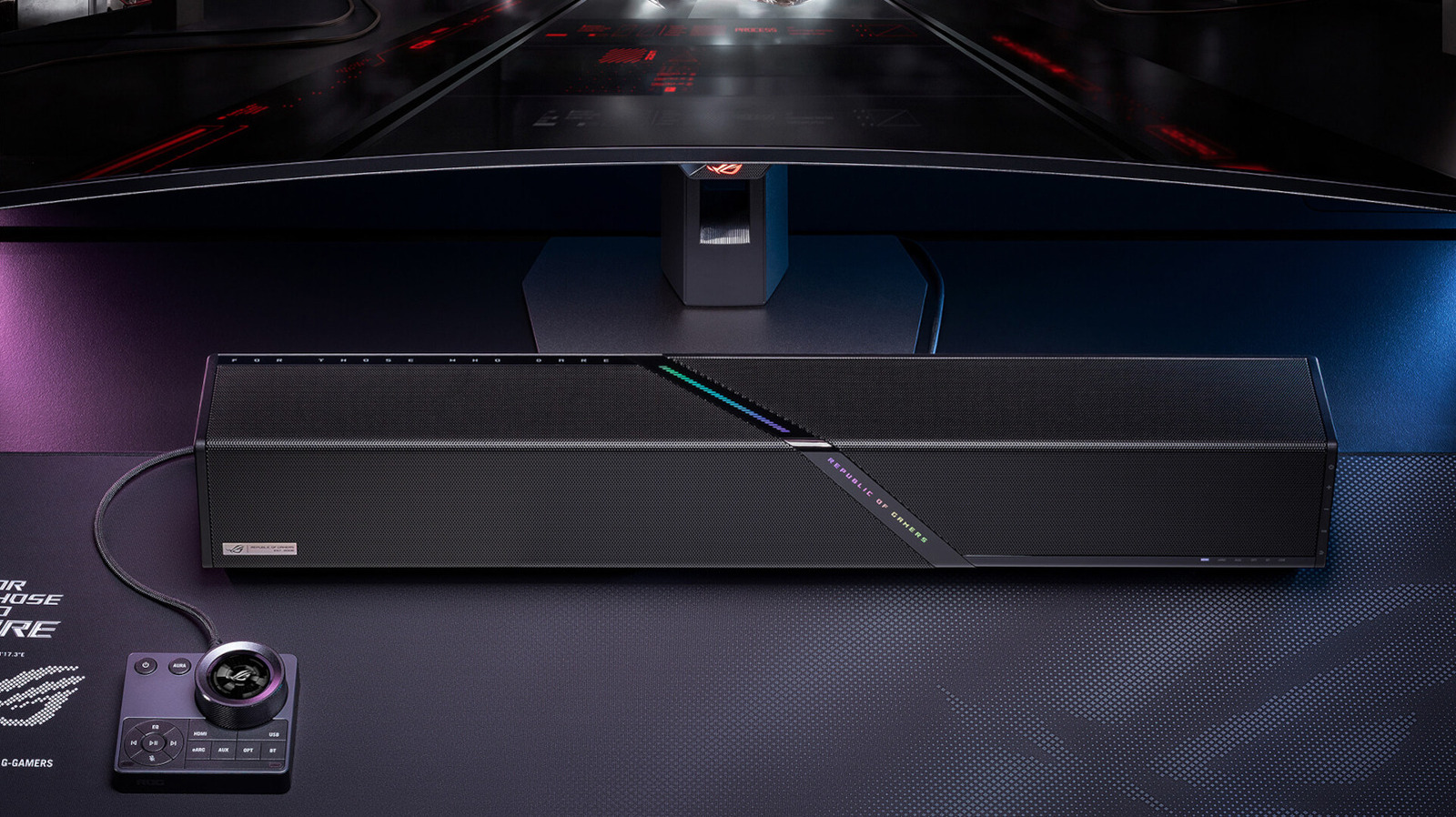
The hub houses integrated microphones backed by proprietary ASUS voice-filtering technology. According to the manufacturer, the system is sophisticated enough to intelligently filter out your teammates’ overlapping voices, background environmental noise (such as mechanical keyboard clatter or PC fan hums), and thunderous in-game explosions. This creates a clean, isolated voice stream, enabling "headset-free communication without sacrificing voice clarity."
Furthermore, the control hub features a built-in LCD display. Users can glance at this screen to manage volume levels, cycle through playback controls, select active input sources, and toggle custom Equalizer (EQ) profiles tailored for specific game genres (e.g., FPS tactical modes versus open-world cinematic immersion).
4. Comprehensive Connectivity
Flexibility is paramount for modern gamers who frequently jump between custom gaming rigs, laptops, consoles, and mobile devices. The ROG Gjallar provides a versatile array of connection options:
- USB-C and USB Type-A: Allows for direct PC/Mac integration, alongside two extra Type-A ports designated for wireless peripheral dongles and accessories.
- HDMI 2.1 with eARC: Ensures uncompromised, high-bandwidth audio passthrough when connected to modern gaming monitors and living room televisions.
- Optical & 3.5mm AUX: Guarantees legacy compatibility with older audio sources and consoles.
- Bluetooth 5.3: Enables seamless wireless streaming from smartphones, tablets, and mobile gaming handhelds.
With this expansive I/O suite, the Gjallar functions effortlessly across gaming PCs, Macs, PlayStation consoles, Xbox systems, the Nintendo Switch, and smart TVs.
Supporting Context & Market Metrics
To fully appreciate the significance of the ROG Gjallar, one must examine the broader trends shaping the gaming hardware market.
The Rise of Multi-Platform Gaming Stations
Modern gamers are less likely to be siloed into a single platform than they were a decade ago. A typical enthusiast might game on a high-end desktop PC during the day, switch to a PlayStation 5 or Xbox Series X in the evening, and stream mobile titles or use a Nintendo Switch on the couch. Peripherals that demand proprietary, single-platform ecosystems face growing consumer resistance. By building universal compatibility—encompassing Windows, macOS, consoles, and mobile via Bluetooth 5.3 and HDMI 2.1—ASUS has positioned the Gjallar as a centralized home-audio command center.
Premium Pricing and Peripheral Investment
The $600 price point places the Gjallar in elite company. Historically, soundbars in this price bracket were reserved for high-end home theater setups meant for cinematic viewing. However, the gaming peripheral market has experienced significant premiumization. Gamers routinely spend $200–$300 on keyboards, $150–$250 on mice, and $300+ on wireless headsets.
As multi-hour gaming sessions and work-from-home setups merge into single desk spaces, consumers are increasingly willing to invest heavily in comfort-driven, high-performance desk audio. The elimination of headset fatigue is a powerful selling point for streamers, remote professionals, and marathon gamers alike.
Official Statements and Industry Reception
While ASUS has heavily promoted the architectural marvel of the Gjallar through its official channels, early reception from the tech community highlights both the excitement and the skepticism surrounding the product.
In its official product announcements, ASUS emphasized the cultural shift toward untethered communication:
"The ROG Gjallar was designed from the ground up to solve a fundamental compromise in multiplayer gaming: choosing between the immersive power of external speakers and the clear, noise-isolated communication of a dedicated headset. With our advanced voice-filtering technology and dedicated control hub, players can finally experience true headset-free communication without sacrificing voice clarity or spatial awareness."
Industry analysts note that while the $600 price tag positions the Gjallar as a niche luxury item rather than an impulse buy, it establishes ASUS as an innovator willing to explore untapped categories. Reviewers and early adopters monitoring listings on Best Buy and the ASUS webstore have expressed eagerness to test whether the desktop control hub’s microphone array can genuinely replace a high-end boom mic in loud gaming environments—a feat that has traditionally challenged speaker-phone and soundbar designs.
Future Outlook: What the Gjallar Means for Desktop Audio
The launch of the ASUS ROG Gjallar is more than just a single product rollout; it could very well serve as a bellwether for the entire gaming audio industry.
Will Competitors Follow Suit?
Historically, when ASUS ROG introduces a category-defining product—such as specialized dual-screen gaming laptops, OLED desktop monitors, or modular mechanical keyboards—rival brands like Razer, Corsair, and SteelSeries closely monitor market adoption before developing competing offerings. If the ROG Gjallar proves commercially successful and validates the concept of "headset-free multiplayer communication via smart soundbars," expect a wave of competing desktop soundbars equipped with advanced AI noise cancellation and dedicated control pods to flood the market over the next 12 to 24 months.
The Evolution of Spatial Audio and AI Noise Suppression
As artificial intelligence and machine learning continue to bleed into hardware design, the software running behind the scenes on devices like the Gjallar will become increasingly vital. Future iterations of desktop soundbars will likely leverage localized neural processors to distinguish user voices from ambient background noise with absolute precision, potentially rendering standalone boom microphones obsolete for casual and semi-competitive multiplayer gamers alike.
Conclusion
ASUS has taken a calculated gamble with the ROG Gjallar. By merging home-theater-grade 5.1.2 Dolby Atmos spatial audio with purpose-built multiplayer features—such as the wireless subwoofer, universal connectivity, and the ingenious desktop control hub with smart beamforming microphones—the company has created a product category all its own.
At $600, it is an investment aimed squarely at enthusiasts who demand uncompromising audio fidelity and long-term ergonomic comfort. As initial stock units make their way into American homes and battle stations, the true test of the Gjallar will be whether it successfully coaxes competitive gamers out of their headsets and into a new era of open-air acoustic immersion.