Executive Overview
In an ambitious step forward at the intersection of artificial intelligence and climate science, Google has officially open-sourced WeatherNext, a state-of-the-art predictive weather model engineered by researchers across Google DeepMind and Google Research. Developed in strategic collaboration with premier global meteorological institutions—including the National Hurricane Center (NHC), the Cooperative Institute for Research in the Atmosphere (CIRA), and the UK Met Office—WeatherNext represents a paradigm shift in how humanity anticipates and prepares for extreme tropical cyclone activity.
Tropical cyclones, universally referred to as hurricanes or typhoons depending on their geographical basin, have historically vexed meteorologists due to a complex scientific duality. Accurately plotting a storm’s trajectory requires analyzing massive, coarse global atmospheric currents, whereas determining a storm’s rapid intensification relies on hyper-localized thermodynamic processes churning within its core. Traditionally, forecasters had to stitch together disparate global and regional models to form a cohesive picture.
WeatherNext shatters this operational barrier. By ingesting nearly 20 terabytes of global atmospheric data alongside historical records from the International Best Track Archive for Climate Stewardship (IBTrACS), the model successfully predicts both a cyclone’s precise track and its destructive intensity within a single unified framework. Capable of generating comprehensive 15-day forecasts in under a minute using Google’s proprietary Tensor Processing Units (TPUs), WeatherNext empowers meteorologists to assess low-probability, high-consequence tail risks with unprecedented speed. By making both the model code and its underlying weights publicly available on GitHub, Google has signaled a collaborative new era in meteorological research, providing scientists worldwide with a powerful tool to save lives and mitigate property damage from increasingly severe climate events.
Detailed Chronology: The Evolution of Google’s Meteorological AI
The journey toward WeatherNext did not happen in a vacuum; it is the culmination of years of iterative research, computational scaling, and institutional collaboration between tech giants and atmospheric scientists. Understanding the genesis of WeatherNext requires examining the timeline of Google’s deeper push into AI-driven meteorology.
The Foundation: Early Explorations in Machine Learning Weather
For decades, traditional numerical weather prediction (NWP) has relied on physics-based equations computed on massive supercomputers. While effective, these models demand immense computational power and time, often limiting resolution or ensemble sizing. Recognizing machine learning’s capacity to bypass slow iterative computations, Google’s DeepMind and Research teams began experimenting with data-driven weather forecasting architectures.
The Second-Generation Breakthrough
Building upon preliminary neural network architectures, Google introduced the second generation of its advanced weather prediction models. These early iterations demonstrated that machine learning could match or exceed the performance of traditional medium-range forecasts in a fraction of the time. However, predicting extreme, rapidly evolving events like tropical cyclones remained an elusive frontier. Standard global models lacked the granular resolution needed to capture inner-core hurricane dynamics, while local models lacked the macro-scale atmospheric context.
Collaborative Development and Validation
To bridge this gap, Google DeepMind and Google Research initiated deep partnerships with global weather authorities. The National Hurricane Center, CIRA, and the UK Met Office provided domain-specific expertise, rigorous validation metrics, and historical baselines to train the model on real-world forecasting challenges. This cross-sectoral effort culminated in a comprehensive scientific evaluation, the findings of which were formally published in the prestigious journal Nature.
Simultaneously, Google prepared the infrastructure for public deployment. Rather than keeping the technology proprietary, leadership decided to open-source the model weights and codebase via GitHub. This milestone allows national meteorological services, academic institutions, and independent researchers to integrate WeatherNext into their operational workflows, ensuring that the technology can be stress-tested, fine-tuned, and deployed globally ahead of future storm seasons.
Supporting Context & Metrics: Inside the Technology of WeatherNext
To fully comprehend the magnitude of WeatherNext, one must examine the specific technical hurdles it overcomes and the rigorous data architecture powering its predictions.
The Duality of Tropical Cyclone Forecasting
Forecasting a hurricane involves solving two distinct meteorological problems simultaneously:
- The Macro-Scale Track: Governed by planetary-scale atmospheric currents, jet streams, and pressure systems. These are best captured by coarse global models that track the broad movement of air masses.
- The Micro-Scale Intensity: Governed by ocean heat content, air-sea interactions, moisture convergence, and inner-core eyewall thermodynamics. These require high-resolution local models capable of simulating violent energy exchanges within a restricted spatial domain.
Historically, forecasters relied on an ensemble of different models optimized for one or the other, often leading to conflicting forecasts during critical decision-making windows. WeatherNext resolves this tension by utilizing a unified deep-learning architecture trained on massive multimodal datasets.
The Data Diet and Computational Powerhouse
WeatherNext’s training regimen is staggering in scale. The model digested:
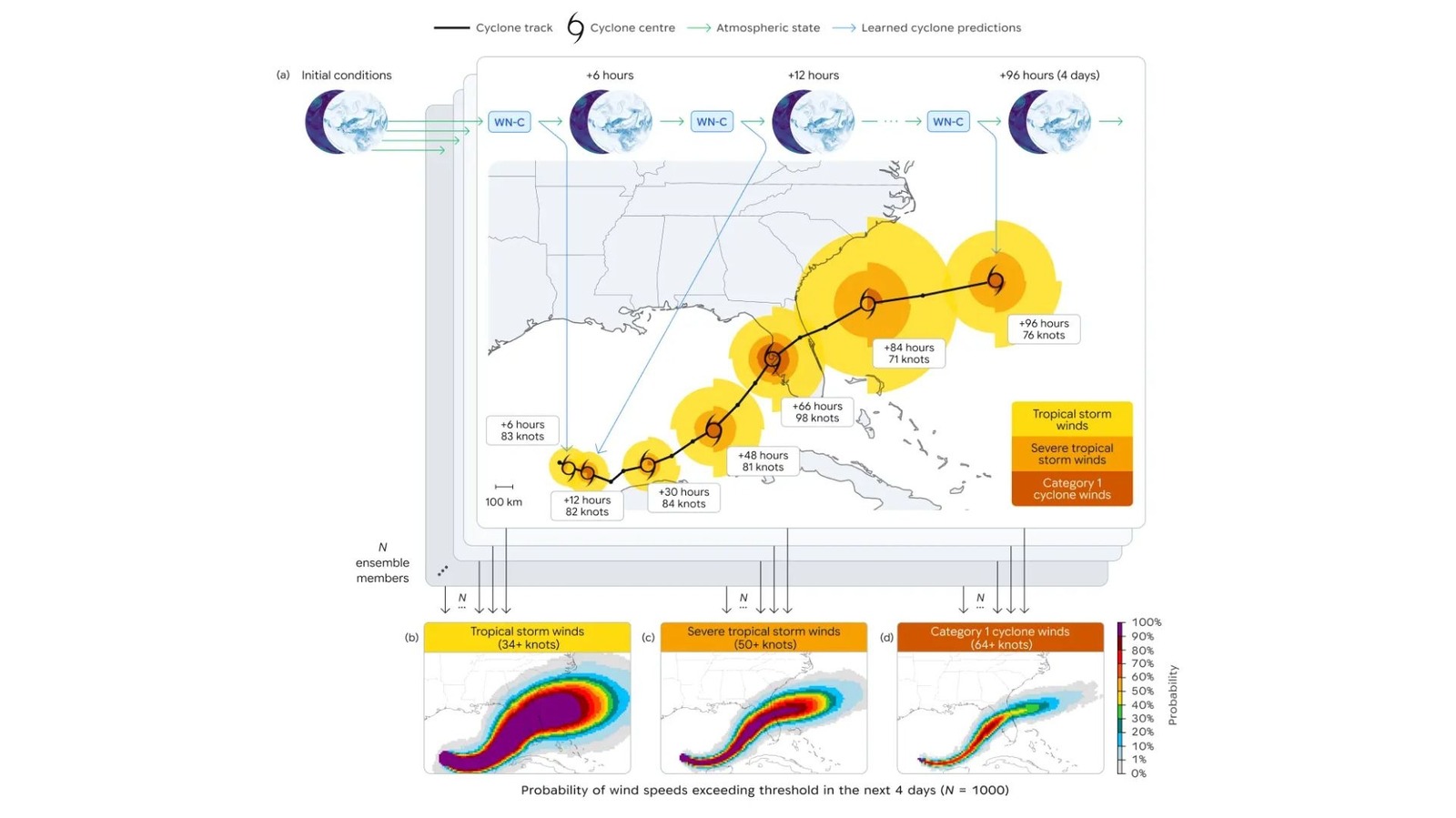
- Nearly 20 Terabytes of global atmospheric data, encompassing historical reanalysis datasets that capture decades of atmospheric conditions (temperature, pressure, wind velocity, humidity, and geopotential heights).
- Historical cyclone archives curated by the International Best Track Archive for Climate Stewardship (IBTrACS), providing the model with decades of storm lifecycles, erratic trajectories, and rapid intensification events.
Crucially, the computational efficiency of WeatherNext is set to revolutionize operational forecasting. According to the research team:
"We can now generate a single 15-day forecast in less than a minute on a TPU, empowering forecasters to quickly evaluate the probability distribution of potentially devastating tail-risks."
By executing complex 15-day projections in seconds rather than hours, operational centers can run massive ensemble forecasts—generating dozens of predictive scenarios instantly—to map out the full probability cone of a storm’s path and intensity.
Official Statements and Academic Insights
The publication of the WeatherNext study in Nature and the concurrent release of Google DeepMind’s whitepapers have drawn widespread praise and critical analysis from the global scientific community.
Researchers emphasized that the model’s ability to capture "tail-risks"—low-probability, high-impact outcomes such as explosive, unexpected hurricane intensification right before landfall—addresses one of the most dangerous blind spots in emergency management. When a storm rapidly intensifies overnight, coastal communities often lack sufficient evacuation time. WeatherNext’s rapid ensemble generation provides early warnings that could buy emergency managers critical hours.
Furthermore, representatives from collaborating bodies like the UK Met Office and the National Hurricane Center have highlighted the value of open-sourcing. By removing commercial and proprietary barriers, the global meteorological community can audit the model’s decision-making pathways, ensuring transparency and reliability before issuing life-or-death evacuation orders.
Google’s broader AI climate initiatives also contextualize this release. Beyond tropical cyclones, Google has actively developed flash-flood prediction models utilizing advanced large language models (such as Gemini) combined with historical streamgauge data and news reports. WeatherNext represents the crown jewel of this suite, targeting the most violent atmospheric phenomena on Earth.
Future Outlook: The Road Ahead for AI-Driven Meteorology
As WeatherNext enters the public domain via GitHub, its real-world impact is poised to unfold across several key vectors:
1. Operational Integration by National Weather Services
National agencies are expected to begin testing WeatherNext alongside traditional numerical weather prediction models (such as the ECMWF’s IFS and NOAA’s GFS). While meteorologists emphasize that AI models will complement—rather than instantly replace—traditional physics-based models, the speed and accuracy of WeatherNext will likely make it a foundational pillar of modern forecasting desks.
2. Democratization of Advanced Forecasting
In many developing nations prone to devastating tropical cyclones, access to high-performance supercomputing infrastructure is severely limited. By open-sourcing WeatherNext, Google is leveling the playing field. Meteorological offices in vulnerable regions across the Caribbean, Southeast Asia, and the Pacific Islands can now leverage cutting-edge AI predictions without needing multimillion-dollar supercomputer installations.
3. Continued Iteration and Community Refinement
With thousands of developers and climate scientists now able to inspect the GitHub repository, WeatherNext will undoubtedly undergo rapid community-driven refinement. Researchers can fine-tune the model weights for regional idiosyncrasies, integrate real-time satellite feeds, and adapt the architecture to track other extreme weather phenomena, such as atmospheric rivers, severe convective storms, and winter nor’easters.
Conclusion
Google’s release of WeatherNext marks a transformative milestone in humanity’s ongoing battle against extreme weather. By bridging the gap between macro-scale atmospheric tracking and micro-scale intensity prediction, and by making this technology universally accessible, WeatherNext offers a beacon of hope. As climate change continues to fuel warmer oceans and more volatile storm systems, tools like WeatherNext will be essential in providing earlier warnings, protecting vulnerable coastlines, and ultimately saving countless lives.