Executive Overview
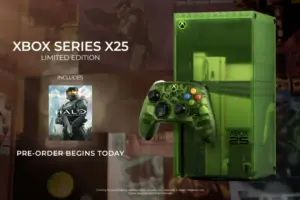
Two and a half decades after Microsoft disrupted the traditional console market with a massive, heavy, black-and-green monolith known simply as the Xbox, the brand is returning to its roots—with a translucent twist. To commemorate its monumental 25th anniversary, Xbox has officially opened preorders for a strictly limited-edition Xbox 25th Anniversary Collection bundle, anchoring the celebration around a striking, see-through green console and matching peripheral.
Priced at a staggering $900, the bundle includes a translucent green Xbox Series X, a similarly styled wireless controller featuring a unique Xbox 25 logo, and a digital copy of Halo: Campaign Evolved. While the sticker shock is immediate, a closer look at the current economic realities of the hardware market—including surging component costs and a persistent global RAM shortage—reveals a calculated pricing strategy rather than a simple cash grab. Standard Series X configurations currently command a baseline of $800 before factoring in custom colorways or bundled software.
For the most die-hard collectors, the appeal extends far beyond the hardware itself. Each console features a laser-etched, individually numbered engraving, transforming the device from a standard gaming machine into a numbered artifact of interactive entertainment history.
However, securing one of these rare units will not be easy. The initial wave of preorders has been restricted exclusively to the franchise’s most dedicated fans via targeted email invitations, with a broader public preorder window opening shortly thereafter. For gamers priced out of the $900 ecosystem, Microsoft is also offering standalone anniversary controllers and a suite of third-party celebratory accessories. Yet, the release has also ignited playful debate among gaming historians regarding Microsoft’s color palette choice, contrasting the modern translucent aesthetic with the pitch-black exterior of the original 2001 launch hardware. As shipping day approaches—slated strategically for November 15, exactly 25 years to the day since the original console’s debut—the industry is watching closely to see how nostalgia drives hardware sales in an era of unprecedented production expenses.
Detailed Chronology: From the Original Titan to the 25th Anniversary Edition
To truly appreciate the significance of the Xbox 25th Anniversary Collection, one must trace the timeline of Microsoft’s hardware evolution. The journey from a daring software giant’s hardware gamble to a multi-generational gaming powerhouse is marked by pivotal milestones, design shifts, and rare collector’s items.
[November 15, 2001] -> Original Xbox Launch (Black & Green accents)
       │
[2004]               -> Release of the Rare Translucent Green Special Edition Console
       │
[2026 (August)]      -> Xbox 25th Anniversary Collection Announced & Preorders Open
       │
[November 15, 2026]  -> Official Shipping Date (25th Anniversary to the Day)
November 15, 2001: The Genesis
The original Xbox launched in North America on November 15, 2001. Equipped with a built-in hard drive, an Ethernet port, and graphics capabilities that shocked industry veterans, the console was a physical heavyweight. Clad in matte black with a massive, glowing green ‘X’ jewel at its center, it established the brand’s signature color identity. The accompanying "Duke" controller was famously oversized, setting the stage for decades of ergonomic revisions.
The Evolution of Special Editions (2004)
While the launch model was undeniably black, the translucent green aesthetic that defines the new 25th Anniversary Collection actually traces its lineage back to a rare 2004 special edition release. During the twilight years of the original Xbox lifecycle, Microsoft released limited translucent green variants to stimulate late-generation sales and reward collectors. Furthermore, industry lore notes that members of the original 2001 hardware design team were gifted translucent green debugging and retail units bearing the signature of Microsoft co-founder Bill Gates. By adopting this specific hue for the 25th-anniversary hardware, Microsoft is nodding not to the retail launch day machine, but to an elusive, highly coveted piece of internal company lore.
The Modern Era and the Series X
Fast forward through the Xbox 360’s red ring trials, the multimedia ambitions of the Xbox One, and into the current generation, Microsoft has steadily refined its hardware philosophy. The Xbox Series X was designed as a quiet, powerful tower optimized for high-fidelity performance. However, macroeconomic pressures—specifically an ongoing, grueling RAM crisis—have forced hardware prices upward across the entire consumer electronics sector.
Against this backdrop, Microsoft’s announcement of the 25th Anniversary Collection arrives as both a celebration and a luxury offering. Preorders went live on August 26, 2026, rolling out in waves. The initial allocation was tightly gatekept, sent directly to select, long-term Xbox ecosystem participants via email invitations. A public preorder phase followed on August 27 at 10:00 AM ET. True to historical symmetry, the consoles are scheduled to land on doorsteps on November 15, 2026—marking 25 years to the exact calendar day since fans first unboxed the original console.
Supporting Context & Metrics: Navigating the $900 Price Tag and Component Crisis
A $900 price point for a current-generation video game console inevitably raises eyebrows. To understand how Microsoft arrived at this figure—and why consumers are still expected to line up for it—analysts must examine the broader economic landscape governing consumer technology manufacturing in 2026.
The RAM Crisis and Hardware Inflation
The semiconductor and memory markets have faced relentless headwinds over the past several years. Supply chain bottlenecks, fluctuating raw material costs, and extreme enterprise demand for high-end AI processing components have heavily squeezed the global supply of dynamic random-access memory (DRAM). Because modern consoles rely heavily on advanced high-speed memory modules to stream assets and maintain stable frame rates, the cost of goods sold (COGS) for devices like the Xbox Series X has risen dramatically.
| Hardware Tier / Item | Retail Price (USD) | Key Inclusions & Features |
|---|---|---|
| Standard Xbox Series X | $800 | Base hardware configuration (subject to recent component-driven price hikes) |
| 25th Anniversary Collection Bundle | $900 | Translucent green console, numbered engraving, matching controller, Halo: Campaign Evolved digital download |
| Standalone Anniversary Controller | $80 | Limited edition translucent green design, Xbox 25 branding |
When evaluating the $900 bundle price, market analysts point out that a standard Series X configuration currently retails around $800 due to these ongoing component inflation pressures. Factoring in that the baseline console does not include bundled software, specialized collector’s tooling, custom molds for translucent plastic shells, or individualized laser-etched numbering, the $100 premium for the anniversary edition begins to look remarkably restrained.
The Collector’s Economy
Beyond raw manufacturing costs, the $900 price tag leverages the lucrative collector’s economy. In an era where digital distribution dominates and physical ownership is increasingly fleeting, tangible, serialized items hold immense value for enthusiasts. Each console in the 25th Anniversary Collection is individually numbered via precision engraving, guaranteeing its authenticity and rarity. For dedicated collectors, this transforms the Series X from an aging piece of hardware into a secure investment piece destined for the secondary market display shelves of tomorrow.
Official Statements and Industry Insights
The rollout of the Xbox 25th Anniversary Collection has generated widespread commentary from corporate executives, hardware designers, and community leaders alike. While marketing materials emphasize the joyous nature of the milestone, behind-the-scenes insights reveal a careful balancing act between honoring heritage and navigating tough economic realities.
Honoring the Legacy While Embracing Modern Manufacturing
In promotional materials accompanying the launch, Xbox leadership emphasized that the 25th-anniversary hardware is a love letter to the community that sustained the brand through its turbulent early years.
"Building a brand that endures for a quarter of a century requires passion from both the creators inside the building and the millions of players logging in every single day," noted an internal Xbox communications brief. "This collection is designed to capture the adventurous spirit of our early days while showcasing the advanced manufacturing capabilities of today. Every translucent shell and engraved serial number tells the story of our shared journey."
The Historical Debate: Black vs. Green
Curiously, the choice of a translucent green colorway has sparked good-natured debate among design historians and veteran fans. As industry commentators have frequently noted, the original 2001 Xbox launched with a notoriously pitch-black aesthetic, accented only by the iridescent green of the ‘X’ jewel and the startup animation’s green matrix code.
The full translucent green look was never a mass-market retail reality at launch, but rather an evolution born from internal developer kits, limited-edition late-lifecycle variants, and modding culture. By leaning into the see-through green aesthetic, Microsoft is actually honoring the mythos and aesthetic rebellion of early 2000s hardware modification culture—where clear plastic shells allowing users to gaze upon printed circuit boards were the ultimate status symbol—rather than strictly mirroring the literal 2001 retail box.
Future Outlook: What the 25th Anniversary Signifies for Xbox’s Next Era
As Microsoft prepares to ship the 25th Anniversary Collection on November 15, 2026, industry watchers are looking past the celebration to decipher what this milestone means for the future of the Xbox brand.
Bridging Hardware Heritage and a Software-First Future
Microsoft has spent recent years aggressively expanding its footprint as a cross-platform publisher and cloud-gaming pioneer. Services like Xbox Game Pass, PC integrations, and streaming initiatives have largely decentralized the console box as the sole gateway to the Xbox ecosystem. In this context, the release of an ultra-premium, highly physical, $900 collector’s item serves a dual purpose:
- Appeasing the Hardcore Base: By catering directly to legacy hardware enthusiasts with a numbered, tactile product, Microsoft reassures its most dedicated traditionalists that dedicated hardware remains a core pillar of the brand.
- Establishing Luxury Collectibility: By pricing the unit at a luxury tier and restricting initial access, Xbox is positioning its hardware not as a commodity utility device, but as a high-end cultural artifact akin to designer streetwear or vintage timepieces.
The Road Ahead
Whether the $900 price point deters mainstream buyers is ultimately secondary to the product’s primary function: generating cultural cachet and celebrating a quarter-century of gaming memories. With the anniversary controller available standalone for $80, alongside a robust ecosystem of third-party celebratory accessories, fans of all budget levels are invited to participate in the milestone.
As the boxes ship this November, they will carry not just the components of a high-performance gaming console, but 25 years of digital history, community evolution, and industrial design heritage. For Xbox, the translucent green shell offers a literal and figurative window into the past—proving that even as the industry looks toward an increasingly cloud-based, software-driven future, the foundation built in November 2001 remains solid enough to shine brightly through green glass.