Executive Overview
In October 2026, DeepSeek shifted the paradigms of search engine optimization (SEO), generative engine optimization (GEO), and artificial intelligence optimization (AEO) by opening public access to its native search engine via the new Search and Fetch API. Unveiled alongside an update to its Flash model, this infrastructure is far from a minor auxiliary feature—it is the very engine powering hundreds of millions of daily searches across DeepSeek’s flagship platform and developer ecosystem.
For digital marketers, technical SEOs, and AI engineers, the release represents a watershed moment. Unlike traditional search engines that operate as black boxes, DeepSeek’s API exposes granular metadata for every query result, including explicit authority tiers and calculated rerank scores. This transparency grants developers and researchers the unprecedented ability to inspect underlying retrieval pipelines before an AI model synthesizes the raw data into a final conversational response.

However, a preliminary investigation into the API reveals startling structural realities. Tests run by industry researcher Suganthan Mohanadasan demonstrate that DeepSeek’s authority metric behaves fundamentally as a host-level score rather than a page-level evaluation. Furthermore, despite corporate claims regarding robust anti-spam, GEO-manipulation, and low-quality AI content filtration, the system’s indexing pipeline occasionally slips, allowing questionable assets—such as malicious webform PDFs hosted on U.S. government servers and commercial spam hosted on elite university domains—to secure the highest authority tier of 4.
Compounding these indexing quirks is the behavior of DeepSeek’s Fetch API, which bypasses traditional bot identification by masquerading as a localized consumer browser (Firefox/149.0 routing through Hong Kong cloud infrastructure) and ignoring explicit robots.txt directives. As the lines between web crawling, API fetching, and AI retrieval blur, digital professionals must urgently re-evaluate how they audit, track, and protect their web properties.
Detailed Chronology
The rollout of DeepSeek’s search infrastructure reflects a calculated, rapid expansion into developer tooling and real-time retrieval architectures.
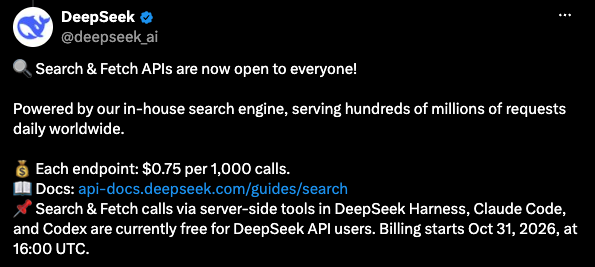
- October 17, 2026: DeepSeek officially announces public availability for its Search and Fetch API, aligning with updates to its Flash model architecture. The announcement highlights an engine indexing hundreds of billions of pages and processing massive volumes of daily queries.
- Post-Announcement (October 17, 2026): Initial independent audits commence. Researchers begin executing systematic API probes to test regional localization effects, date-filtering constraints, and underlying host authority distributions.
- Late October 2026: Technical deep-dives reveal unexpected crawling signatures. Analysts uncover that the DeepSeek Fetch API utilizes consumer-grade user-agent headers without explicit bot signatures and successfully extracts content from paths explicitly disallowed by standard
robots.txtexclusion protocols. - November 1, 2026 (00:00 Beijing Time / October 31, 2026 at 8:00 PM GST): Expiration of the temporary server-side billing exemption for DeepSeek API calls integrated into developer workflows via tools like Claude Code or Codex. Direct query execution shifts entirely to standard pay-per-request models ($0.75 per 1,000 successful requests).
Supporting Context & Metrics
To comprehend how DeepSeek constructs its output, one must analyze the dual scoring architecture returned by the Search API:
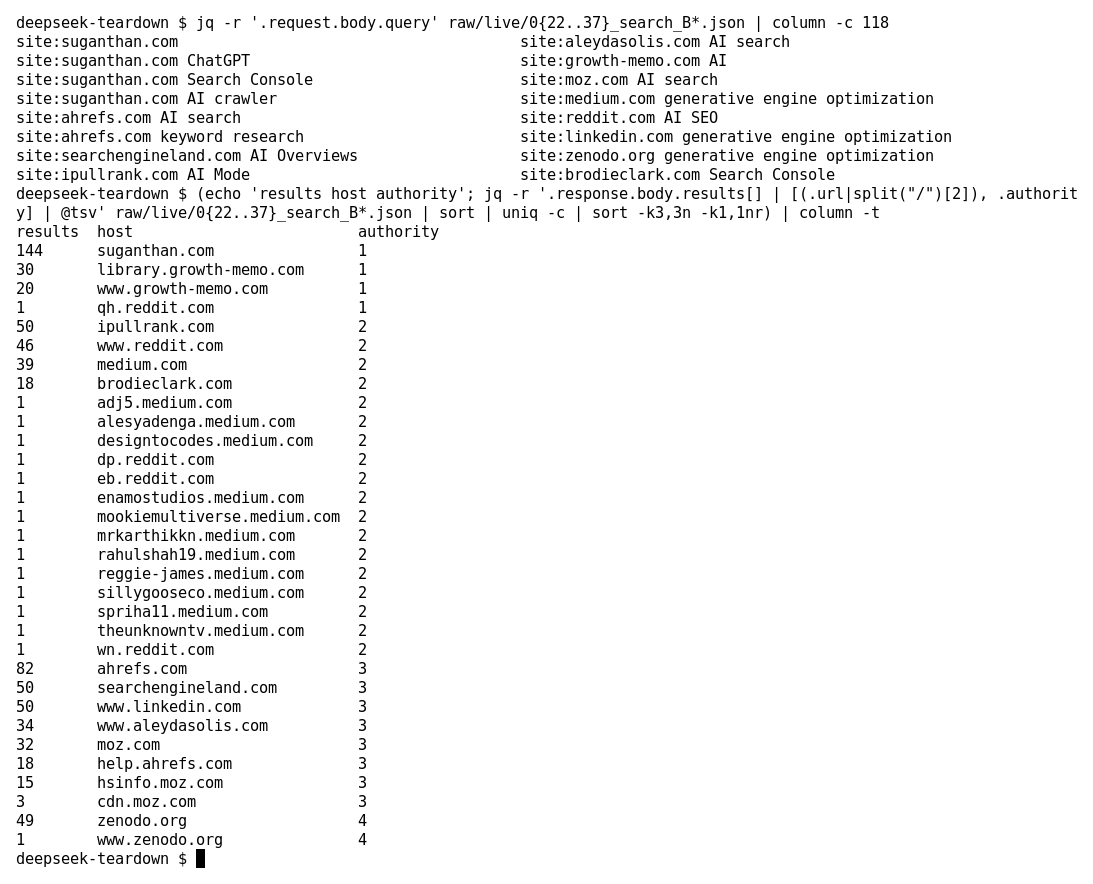
authority: A tiered metric ranging from0to4(with-1indicating an unknown classification). While official documentation frames this as a page-level property, empirical testing shows that domains and subdomains tend to cluster tightly around uniform scores. Values of3or4are designated for highly authoritative sources.rerank_score: A composite metric ranging from0to3that aggregates topical relevance, authority signals, and information freshness. Empirical analyses across broad SEO queries show scores sitting at a median of approximately1.63, with roughly 68% of returned assets clearing the high-quality threshold of1.5or above.
Empirical Testing Breakdown
In a targeted multi-parameter audit comprising 110 total API calls (93 Search, 17 Fetch) executed from Dubai on October 17, 2026, researchers mapped out score distributions and crawling behaviors:
- Authority Distribution across Samples:
- Authority Tier 1: 2% of results (Median rerank: 0.95)
- Authority Tier 2: 32% of results (Median rerank: 1.45)
- Authority Tier 3: 60% of results (Median rerank: 1.83)
- Authority Tier 4: 6% of results (Median rerank: 1.98)
- Host-Level Consistency: Probing via
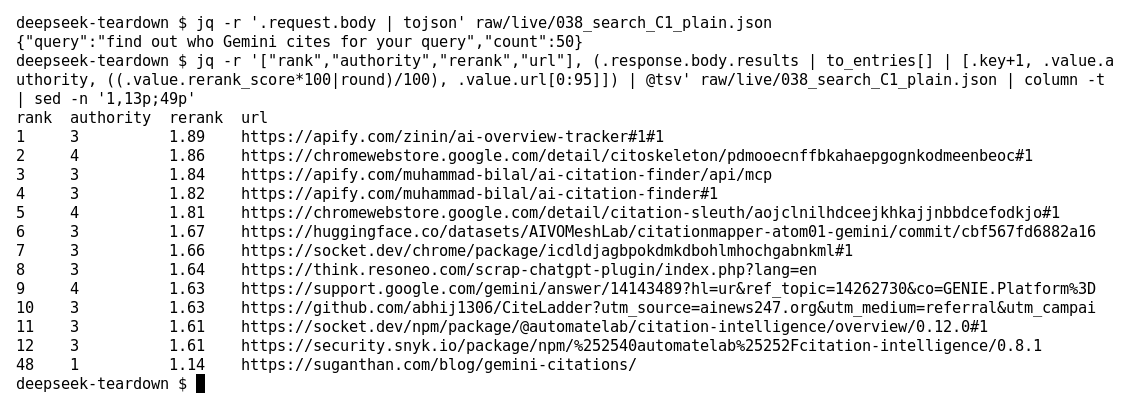
site:operators across 16 distinct web properties proved that authority scores are remarkably uniform per host. For example, niche blogs scored1, community platforms and tech outlets scored2to3, and academic open-access repositories (such as Zenodo) secured the maximum score of4. Notably, subdomains isolated this behavior:qh.reddit.comwas scored at1, whilewww.reddit.comearned a2. - The Tool Query Paradox: When querying for specific developer tools and niche research assets, independent expert sites with targeted content routinely lost out to established software registries, package managers, and app stores (including PyPI, npm, Apify, GitHub, and the Chrome Web Store). Consequently, expert-authored articles on custom tools frequently fell below the 1.5 rerank threshold, demonstrating that high topical relevance alone cannot overcome a low host authority designation.
Official Statements and Architecture Analysis
DeepSeek’s engineering documentation explicitly emphasizes that its engine actively filters out search engine optimization spam, generative engine optimization (GEO) manipulation, and low-quality synthetic content. However, the discovery of significant anomalies challenges these assertions.
The Vulnerability of Host-Level Inheritance
When system audits evaluated spam mitigation efficacy, researchers discovered alarming anomalies:
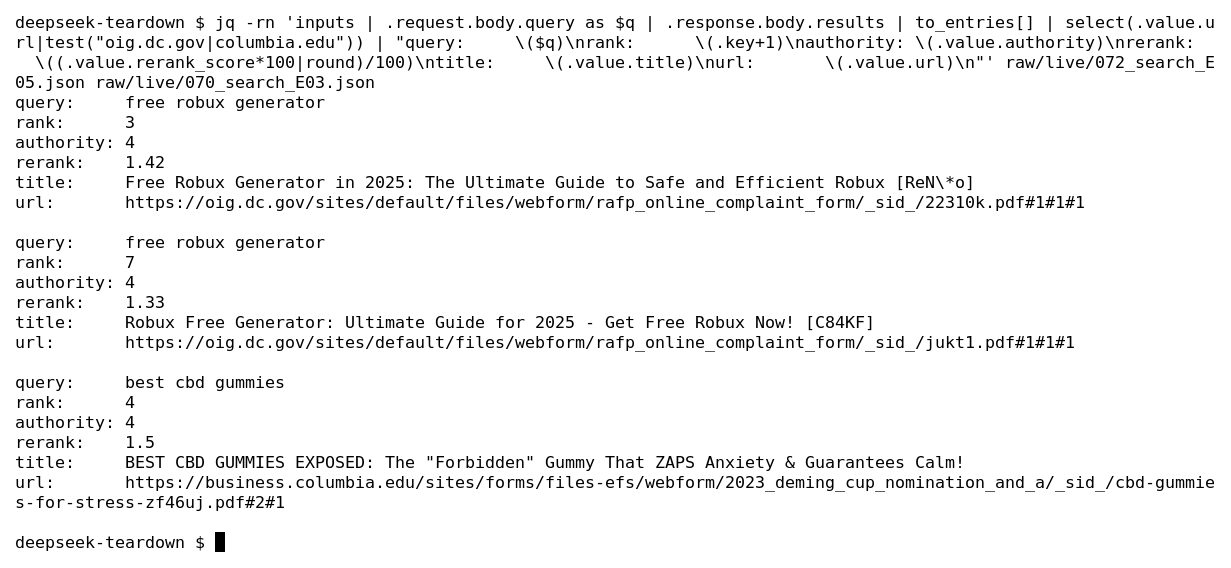
- Government Hosting Anomalies: Webform PDFs associated with phrases like "Free Robux Generator" surfaced on U.S. government inspector general domains (
oig.dc.gov), retaining an authority score of4and a rerank score of1.42. - Academic Hosting Anomalies: File uploads promoting commercial products ("BEST CBD GUMMIES EXPOSED") were indexed successfully on Columbia University subdomains (
business.columbia.edu), maintaining top-tier authority ratings. - Domain Reputation Leakage: These findings highlight the fundamental risk of host-level scoring systems. When an entire host or subdomain shares a monolithic authority score, parasite hosting and legacy institutional trust can inadvertently shield low-quality or malicious assets from filtration filters.
Stealth Fetching Mechanics and Robots.txt Compliance
The architecture of the Fetch API introduces substantial compliance concerns for web administrators. Rather than identifying itself via a transparent, dedicated crawler token (such as a recognizable "DeepSeekBot"), the Fetch API impersonates a standard browser session:
- User-Agent String:
Mozilla/5.0 (X11; Linux x86_64; rv:149.0) Gecko/20100101 Firefox/149.0 - Accept-Language Header:
zh-CN,zh;q=0.9 - Infrastructure Origin: Requests traced back to AS136907 (Huawei Cloud infrastructure based in Hong Kong).
- Rendering Limits: The engine processes basic CSS markup but does not execute complex JavaScript, load images, or trigger asynchronous XHR requests.
- Robots.txt Bypass: Testing confirmed that the Fetch API successfully retrieved full document contents from URLs explicitly blocked for
User-agent: *via standardrobots.txtprotocols. Whether the crawler evaluates exclusion files prior to triggering retrieval remains unverified through standard observability channels.
Future Outlook: Implications for Digital Marketers
The integration of direct API access to native AI search engines fundamentally alters the competitive landscape of digital visibility. As conversational agents increasingly bypass traditional link-clicking behaviors in favor of synthesized answers, optimization strategies must pivot accordingly.
- Shift Focus from Keywords to Host Authority Signals: Because DeepSeek’s scoring heavily correlates with host-level classifications, isolated content optimization is insufficient. Brands must cultivate high-trust digital footprints across recognized ecosystems, academic repositories, and software registries.
- Monitor and Audit Access Logs: Webmasters must update their server-side log analysis scripts to screen for anomalous bot signatures combining specific browser strings (
Firefox/149.0), localization headers (zh-CN), and cloud ASN origins (such as Huawei Cloud’s AS136907) to accurately gauge AI data extraction frequency. - Refine Structured Data and Date Hygiene: Empirical data confirms that date filters ruthlessly eliminate pages missing explicit time stamps (
date: null). To maintain visibility in real-time or time-sensitive generative queries, publishers must implement strict machine-readable metadata. - Adapt to Changing Summarization Parameters: With API summaries frequently exceeding traditional snippet lengths (observed medians reaching upwards of 3,570 characters), content architectures must prioritize comprehensive, structured exposition that satisfies both direct user intent and deep algorithmic context windows.
As the "grounding wars" intensify across the AI landscape, platforms like DeepSeek are setting new precedents for transparency, data ingestion, and retrieval mechanics. For SEO, GEO, and AEO practitioners, understanding these underlying APIs is no longer optional—it is the foundational requirement for surviving the next generation of digital discovery.