Executive Overview
Indonesia’s creative economy is standing at a historic crossroads. Bolstered by a surging domestic box office—where local productions captured an impressive 67% market share last year—the nation’s film sector is aggressively pivoting from a domestic powerhouse into an internationally competitive powerhouse. At the epicenter of this transformation is a dual-pronged national and municipal strategy: Jakarta’s ambitious bid to model itself after South Korea’s Busan as a regional film hub, and a comprehensive legislative overhaul spearheaded by the Indonesian Film Agency (BPI) to reshape the country’s statutory powers and unlock institutional investment.
With global streaming giants like Netflix heavily investing in local infrastructure—currently housing four major titles in production via the newly minted "Filming in Jakarta" service—the Indonesian capital is rapidly upgrading its physical and regulatory landscape. However, structural bottlenecks remain. From the absence of a unified national film commission equivalent to France’s CNC or South Korea’s KOFIC, to a lack of banking frameworks that accept Intellectual Property (IP) as collateral, Indonesia’s industry leaders are moving past good intentions to build a permanent, institutionalized ecosystem. With an eye toward 2030, key stakeholders are rewriting laws, forging international co-production treaties, and solving the systemic gaps that have historically kept local stories from crossing borders.
Detailed Chronology & Regulatory Evolution
The current momentum driving Indonesia’s film sector forward is the result of a deliberate, step-by-step evolution across municipal administration and national policy over recent years.
- Late 2022: The Indonesian government passes Government Regulation No. 24 of 2022, laying the legal groundwork for creative economy financing using Intellectual Property (IP) as an asset class. However, practical implementation stalls due to a lack of technical guidelines.
- Late 2024 (JAFF Market): Indonesia signs its first-ever bilateral audiovisual co-production agreement with the Netherlands, marking a crucial milestone in shifting local production toward international collaboration.
- Mid-2025 (Cannes Film Festival): Discussions formally intensify regarding a revised Film Law. Fauzan Zidni, chair of the Indonesian Film Agency (BPI), begins drafting the foundational text alongside the Ministry of Culture, aiming to secure statutory authority and ring-fenced funding for BPI.
- June 2025: The Jakarta Film Commission officially launches alongside "Filming in Jakarta," a newly established one-stop service designed to streamline permitting, logistics, and location scouting for international and domestic production houses. Production companies from Malaysia and India quickly utilize the service to shoot features and series.
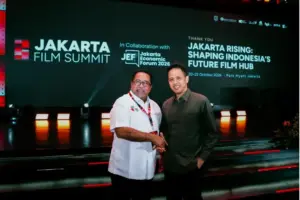
- Inaugural Jakarta Film Summit (Late 2025/Early 2026): Jakarta Governor Pramono Anung and Vice Governor Rano Karno orchestrate a high-stakes summit bringing together the Financial Services Authority (OJK), the Ministry of Creative Economy, the Directorate General of Intellectual Property (DJKI), major commercial banks, and the Indonesian Appraisers Association. The goal: establish a standardized IP valuation method and pilot financing schemes. Simultaneously, a landmark Memorandum of Understanding (MoU) is signed with Netflix, committing the streamer to expanding local production (including Tygo, a spinoff of Extraction) and investing heavily in local talent development.
- Post-Summit & Lumière Summit Milestones: The Ministry of Culture announces a new international co-production fund developed with the support of France’s CNC, running alongside existing government-backed matching funds designed to incentivize international partnerships. Active talks for a bilateral co-production treaty with France also gain traction.
Supporting Context & Metrics
While Indonesia boasts a vibrant cultural output and enthusiastic audiences, the operational metrics of the industry reveal a complex landscape of unprecedented success tempered by structural vulnerability.
Box Office and Market Realities
- 67% Domestic Share: Local films commanded roughly two-thirds of the total box office revenue in Indonesia last year, proving that domestic audiences deeply connect with homegrown narratives.
- The 2026 Growth Correction: Following years of explosive post-pandemic expansion, 2026 is tracking at a slower growth rate due to broader global economic pressures.
- The Distribution Gap: Despite strong local box office figures, Indonesia has historically struggled to export its content. As BPI Chair Fauzan Zidni bluntly notes, the industry has built compelling stories but failed to construct the bridges necessary to carry them outward into regional and global markets.
Talent Pipeline Bottlenecks
- 1,200 Graduates Annually: Film arts and media production programs across 27 university campuses and specialized schools churn out approximately 1,200 graduates every year.
- 60% Industry Attrition: Despite the sheer volume of emerging talent, the formal sector absorbs only a fraction of these graduates. Annual turnover runs at an alarming 60%, largely driven by a lack of sustainable career infrastructure, unstable freelance markets, and a disconnect between academic training and commercial production needs.
Financial and Infrastructural Incentives
- 50% Fee Reductions: The Jakarta administration has slashed specific municipal location fees by 50% to lure local and international productions.
- Tax Concessions: A 50% tax concession on cinema admissions has been introduced for qualifying Indonesian films.
- The Physical Deficit: Post-production facilities, large-scale soundstages, and modern studios remain the industry’s most glaring physical gaps. The municipal government has set a strict 3-to-5-year timeline to bridge these deficits and mirror the physical infrastructure found in Busan.
Official Statements & Industry Perspectives
The path toward transforming Indonesia into an international cinematic heavyweight has elicited candid commentary from the architects of its new policy framework.
On Legislative Reform and Institutional Power:
"It is still in discussion, and I will say more when the moment is right, but the direction is right and the momentum is there." — Fauzan Zidni, Chair of the Indonesian Film Agency (BPI)
Zidni has been vocally transparent about the institutional limitations of BPI, which currently lacks the statutory teeth, regulatory independence, and independent funding mechanisms of international counterparts like France’s CNC or South Korea’s KOFIC. Addressing the historical oversight split between two separate ministries, Zidni emphasizes that solving coordination issues is as much a political challenge as an institutional one, though he praises the current Minister of Culture for offering the strongest support the sector has seen in years.
On Jakarta’s Ambitions as a Regional Hub:
"We’re very happy to say that Netflix now is doing [four] titles… through Filming in Jakarta." — Rano Karno, Vice Governor of Jakarta
Karno, a veteran actor, filmmaker, and foundational architect of Jakarta’s modern film policies, points to the city’s rapid ascent as a destination for regional producers. Having spent over five decades navigating the structural flaws of the Indonesian entertainment sector, Karno stresses that the city has only "scratched the surface" of what is possible with production incentives. By officially joining AFCNet (the Asian Film Commissions Network) with the guidance of the Busan Film Commission, Jakarta is aggressively staking its claim as Southeast Asia’s future cinematic capital.
On Mitigating Streamer Dependency:
"A platform can change its content strategy, exit a market, or deprioritize Indonesian content, and we have no recourse." — Fauzan Zidni
Reflecting on his tenure at Disney and observing the erratic pullback of global streamers from Southeast Asian original content post-2023, Zidni underscores the extreme vulnerability of relying solely on multinational SVOD (Subscription Video on Demand) platforms. To insulate local creators, BPI is aggressively building direct ties with international sales agents, fostering regional distribution networks across Southeast Asia, and encouraging domestic producers to forge a unified international market presence.
Future Outlook (Looking Toward 2030)
As BPI Chair Fauzan Zidni’s current mandate runs toward 2030, the overarching goal for Indonesia’s creative economy is clear: transition the film industry from a sector defined by sporadic, heroic individual efforts to one driven by a reliable, institutionalized, and self-sustaining system.
Key Milestones for the 2030 Horizon:
- Resolution of IP-Based Financing: The ongoing collaboration between the Financial Services Authority (OJK), the Ministry of Creative Economy, and banking stakeholders aims to successfully amend OJK Regulation No. 40 of 2019. By establishing standardized valuation methods for copyright, distribution rights, and broadcast licenses, local banks will finally be able to accept film IP as legitimate collateral, unlocking institutional debt financing for independent production houses.
- Expansion of International Treaties: Following the Netherlands co-production agreement and ongoing talks with France, Indonesia plans to sign at least two major bilateral co-production treaties, solidifying its standing as an active, equal partner in global prestige filmmaking.
- Physical and Economic Infrastructure: Over the next three to five years, Jakarta intends to bridge its severe deficit in soundstages and post-production facilities, while expanding outreach initiatives like the Jaksinema program—which brings affordable cinema access to public markets—ensuring that economic growth benefits lower- and middle-income domestic audiences alike.
- Global Market Integration: Moving beyond reliance on matching funds that require pre-existing overseas contacts, Indonesian producers are being trained and positioned to attend major international markets as permanent, self-sufficient regulars.
As Karno and Zidni work to solidify the ecosystem from financing and production to distribution and talent retention, Indonesia is shedding its history as a passive consumer of media. By building institutional permanence, Jakarta is steadily transforming into the undisputed cinematic heartbeat of Southeast Asia.