Executive Overview
In the rapidly evolving landscape of contemporary auteur-driven horror, few filmmakers possess the distinct, hyper-stylized vernacular of Jane Schoenbrun. Following the uncanny, internet-obsessed resonance of I Saw the TV Glow, Schoenbrun returns with an even more audacious and conceptually layered project: Teenage Sex and Death at Camp Miasma. Released via Mubi, the film operates simultaneously as a meta-textual slasher, an exploration of queer cinephilia, and an interrogation of the horror genre’s complex relationship with the "Other."
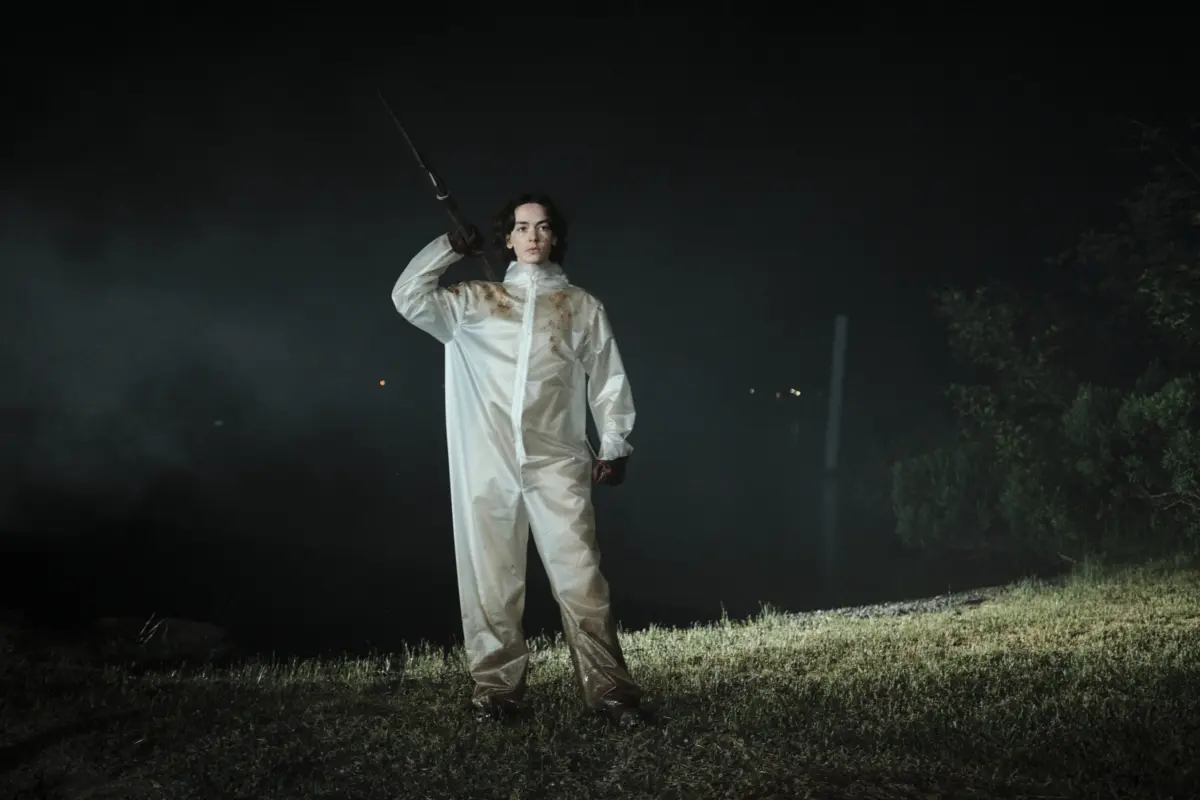
At the heart of the movie lies a bravura set-piece: a bloody, meticulously choreographed, single-take massacre sequence occurring precisely at the film’s midpoint. Set to Counting Crows’ 1996 alternative-rock ballad “A Long December,” the sequence bridges disparate locations from a summer camp shoreline to a counselor’s lounge, shifting the narrative perspective entirely to the franchise’s masked villain, Little Death.
By blending DIY indie aesthetics with high-end digital compositing and pop-culture recontextualization, Schoenbrun—alongside cinematographer Eric Yue, editor Graham Mason, and star Jack Haven—has constructed a cinematic centerpiece that challenges traditional audience sympathies. This article explores the grueling physical training, technical engineering, and thematic ambitions behind Camp Miasma, offering a comprehensive look at how one of the most talked-about sequences of the cinematic year was brought to life.
Detailed Chronology: From Concept to Execution
The Genesis of the "Oner"
The blueprint for Teenage Sex and Death at Camp Miasma is anchored in a fictional 45-year-old slasher franchise reminiscent of the Friday the 13th series. The narrative kicks into motion when a young queer filmmaker, played by Hannah Einbinder, tracks down a reclusive movie star, portrayed by Gillian Anderson. Einbinder’s character aims to convince Anderson to revitalize her career by starring in a modern reboot of the Camp Miasma universe.
Approximately forty-five minutes into the runtime, the film abruptly pivots. Up until this point, the movie utilizes a weathered, nostalgic visual texture—what cinematographer Eric Yue describes as a "filthy old print look." But as the narrative transitions into the perspective of the killer, Little Death (played by Jack Haven), the aesthetic transforms dramatically.
Inspired by the slick, heightened, and kinetic pacing of a Michael Bay or Zack Snyder film, the sequence breaks free from the prior historical framing. "That’s the one part of the movie where it doesn’t have a filthy old print look to it," Yue explains. "It should feel cool and not in another era’s language."
Choreographing the Carnage
To pull off the sequence as a seamless single take ("oner"), the production relied heavily on spatial mapping, iPhone Steadicam pre-visualizations, and intensive storyboarding. Because Schoenbrun secured the rights to Counting Crows’ “A Long December” early in the production cycle, the crew had the luxury of time to build the choreography directly into the song’s rhythm and lyrical structure.
Every stabbing and kill was mathematically synchronized to the track. Most notably, Little Death delivers fatal blows precisely as the vocals land on the word “Hollywood.”

The sequence required an intricate ballet of practical stunts and hidden cuts, merging three distinct environments:
- The camp shoreline
- Exterior pathways and wooded transitions
- The interior counselor’s lounge
Stunt coordinator Maja Aro designed a tightly wound physical ecosystem where stunt performers hurled themselves against walls and collapsed to the floor right as the camera’s panning motion masked a hidden cut.
Physicality and Performance Under the Helmet
For lead performer Jack Haven, portraying Little Death was an exercise in extreme physical endurance. To achieve the first-person perspective, Haven wore a specialized rigging system supporting a compact 35mm camera directly attached to their body.
"Every single time we did a take, we’d have to reload, and that was physically taxing on Jack," Yue notes, adding that it took seven to eight strenuous takes to lock down the sequence.
To cultivate Little Death’s intimidating presence—despite Haven’s smaller stature—the actor modeled the killer’s movement after an immovable cinematic hybrid. "It ended up being a Michael Myers and Terminator cross of stillness with an immovable force," Haven explains.
The sequence culminates with a signature Schoenbrun flourish: a sudden, intimate close-up on Little Death’s eyes, accompanied by the character sensually smearing blood across their own face.
Supporting Context & Metrics: Crafting the World of Camp Miasma
Technical Specifications & VFX Integration
While the choreography was intensely practical, the gore relied on sophisticated digital enhancements. The North Vancouver-based visual effects studio Niche was brought in to elevate the violence, ensuring it matched Schoenbrun’s precise aesthetic tone.
The blood was not designed to evoke gritty, stomach-churning realism. Instead, Yue recalls Schoenbrun invoking Zack Snyder’s 300 as a stylistic touchstone. The bloodshed, much like the stylized, unrealistic snow falling throughout the scene, was designed to be playful, heightened, and visually arresting rather than purely grotesque.

The Bookends: 16mm Lifts and R.E.M. Title Sequences
The transition into the chaos is preceded by a deliberate tactile shift. The only 16mm shot in the entire feature is a lingering close-up of Gillian Anderson’s character, Billy, staring directly into the camera lens before the film frame flares out. Rented explicitly for this "lift," a vintage Bolex camera was used to create a psychological reset right before the audience plunges into Little Death’s rampage.
Conversely, the film’s opening title sequence establishes the 45-year-old lore of the franchise through ephemera rather than exposition. Set to an R.E.M. cover of “Night Swimming” and filmed on the final day of production, the sequence crams decades of fictional history into a single montage.
Editor Graham Mason notes that the script explicitly declared: "This movie will have an awesome opening title sequence!" The montage features:
- Newspaper clippings and vintage reviews detailing Billy’s rise and retreat into seclusion.
- Fake TMZ digital articles charting the fictional industry discourse.
- Fully functional board games, arcade cabinets featuring Little Death Easter eggs, and canonical merchandise.
Official Statements & Creative Perspectives
The collaborative alchemy between Schoenbrun, Yue, Mason, and Haven was essential in balancing the film’s high-concept meta-narrative with its raw emotional core.
- Editor Graham Mason on Schoenbrun’s style: "Jane is definitely a master of pop culture recontextualizations and cool, jarring combinations with a very deep-cut cinephile thing… The opening title sequence tells the rise and fall of this horror movie franchise through all this ephemera. It’s ambitious and asks a lot of the viewer right off the bat. It’s sort of saying, ‘Pay closer attention. This movie will reward your attentiveness.’"
- Cinematographer Eric Yue on audience empathy: "That is a concrete example where we watch Little Death, we kind of go into his helmet, now we’re becoming the POV of Little Death and then we come out of the body and watch. At the end, we almost feel like the camera is getting stabbed in some way… There is a component where we also feel and empathize with Little Death in a way. Sometimes the killer in these horror films, we actually don’t understand their perspective. There’s this catharsis here."
- Actor Jack Haven on transformation: "Jane knows that I am really transformative as a performer and I can change my body to a character. We say that I’m a creature that they can morph… They knew that I could represent this very specific experience of a character, which is someone who lives outside of the human but is this pure expression."
Future Outlook and Critical Legacy
Teenage Sex and Death at Camp Miasma represents a bold step forward for Jane Schoenbrun. By deconstructing the slasher genre through a queer, analytical lens, the film bridges the gap between mainstream cinematic spectacle and independent outsider art.
The film’s central sequence—a symphony of synchronized violence, Counting Crows lyricism, and technical daring—demonstrates how modern horror can subvert audience expectations by forcing viewers to inhabit the psyche of the monster. As the film continues its theatrical run via Mubi, its intricate world-building, exhaustive Easter eggs, and fearless tonal shifts ensure it will be dissected by cinephiles and horror scholars for years to come. Ultimately, Schoenbrun has not merely recreated a slasher film; they have expanded the vocabulary of what independent genre cinema can achieve.