Executive Overview
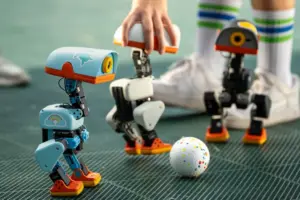
In an era increasingly defined by the existential anxieties surrounding artificial intelligence and the sobering reality of escalating global cybersecurity threats, a surprising, waddling disruptor has emerged to capture the public imagination. During his keynote address at the GTC Berlin conference this past week, Nvidia CEO Jensen Huang unveiled the "Microduck"—a palm-sized, open-source robotic companion that has rapidly evolved from a niche tech demonstration into a cultural phenomenon.
Within hours of the demonstration, where these autonomous, R2-D2-chirping robots performed complex somersaults and synchronized "naps" on command, preorders surged past the 20,000-unit mark. As Hugging Face’s Clem Delangue noted, the Microduck is not merely a toy; it represents a significant shift in how robotics companies are democratizing high-end AI interaction. By leveraging Nvidia’s robust simulation architecture and Pollen Robotics’ refined hardware, the Microduck is poised to become the definitive consumer electronics gift of the 2026 holiday season.
Detailed Chronology: From GTC Berlin to Viral Stardom
The trajectory of the Microduck serves as a masterclass in modern product marketing, albeit one that appears largely organic.
October 23, 2026: During the keynote at GTC Berlin, Jensen Huang stepped onto the stage, not with a massive industrial arm or a server rack, but with a flock of small, yellow-and-white robotic ducks. The audience, accustomed to dense technical specifications regarding H200 chips and AI-driven data center cooling, was visibly taken aback. The robots, displaying impressive balance and reactive intelligence, performed a series of voice-activated maneuvers that felt less like programmed scripts and more like sentient play.
The "Viral Catalyst": By the afternoon of the keynote, social media platforms were flooded with clips of the Microducks. The "cute factor"—often a neglected metric in the hyper-serious world of robotics—proved to be the deciding factor in the product’s immediate market penetration.
The Surge: By the following morning, Clem Delangue of Hugging Face confirmed that the initial manufacturing run of 20,000 units had been exhausted via preorder. This velocity is unprecedented for a consumer robotics startup, particularly one operating under the umbrella of a massive hardware incumbent like Nvidia.
Supporting Context: The Hugging Face and Nvidia Synergy
The existence of the Microduck is the product of a seismic shift in the AI hardware landscape. Following Nvidia’s acquisition of Hugging Face in September 2026, the industry has been watching closely to see how the GPU giant would integrate the community-driven ethos of the open-source platform with its own bottom-line-driven hardware goals.
The Pollen Robotics Integration
Pollen Robotics, the creators of the Reachy Mini, brought a legacy of modular, open-source robotics to the table. When Hugging Face acquired the company in 2025, it signaled a move toward "embodied AI." The Microduck is the second iteration of this vision. Unlike its predecessor, the Reachy Mini, which served as a research platform, the Microduck is designed for mass-market consumption, prioritizing durability, affordability, and the "social" aspect of robotics.
Training via Simulation
The intelligence powering the Microduck is not native to the onboard chip alone; it is a product of Nvidia’s Omniverse-adjacent simulation stack. These robots were trained in virtual environments where they learned physics-based locomotion and obstacle navigation. This allowed the developers to deploy a device that ships with "pre-installed personality." Because the platform is open-source, the company is betting on a "community-contributed" model where users can upload new behaviors—ranging from complex dances to home-security alerts—directly to their devices.
The Cultural Impact: Why Are Adults Buying Toys?
While the Microduck is certainly accessible to children, market data from the initial preorder phase indicates a heavy skew toward adults. This phenomenon is indicative of a broader trend in the "Companion Robotics" sector.
Sociologists suggest that as AI becomes more integrated into our professional lives, the desire for "non-utilitarian" technology—devices that serve no purpose other than to be present, responsive, and amusing—is skyrocketing. The Microduck fulfills a psychological need for "calm tech." In a week where the headlines were dominated by reports of AI-driven cybersecurity breaches and the potential destabilization of global digital infrastructure, the sight of a small robot "falling down dead" for a nap provides a necessary, albeit surreal, psychological palate cleanser.
Official Statements and Market Outlook
Industry analysts have been quick to draw parallels between the Microduck’s launch and the early days of iconic robotic pets like Sony’s Aibo, though they note that the Microduck has a distinct advantage: the open-source community.
"The difference here is the ecosystem," says one industry observer. "With the Microduck, you aren’t just buying a plastic bird. You are buying an entry point into a massive, Nvidia-backed development community. If you don’t like how your duck acts, you don’t have to wait for an OTA (over-the-air) update from the manufacturer. You can code the update yourself."
Hugging Face has remained relatively quiet regarding the exact production capacity for the post-holiday period, but industry insiders suggest that Nvidia is reallocating supply chain resources to ensure that the "duck shortage" does not become a recurring theme in the new year.
Future Outlook: A New Paradigm for Consumer AI?
The success of the Microduck raises a critical question for the industry: Is the future of AI not in the cloud, but on our coffee tables?
By physicalizing AI, Nvidia and Hugging Face have successfully moved the conversation away from the abstract, often terrifying implications of Large Language Models and toward something tangible. However, this raises long-term concerns regarding data privacy and the integration of cameras and microphones in household settings. As these robots become "smarter" and more capable of interacting with their environment, the privacy protocols surrounding the data they collect will inevitably come under intense scrutiny from regulators.
For now, however, the public is far more interested in the "kickabout." With units expected to ship by Christmas, the Microduck is on track to dominate the end-of-year sales charts. Whether this is merely a holiday fad or the first step toward a future where every home has a fleet of small, autonomous assistants remains to be seen.
One thing is certain: Nvidia has successfully pivoted the narrative of AI from "scary and existential" to "adorable and accessible." Whether that change in perception is enough to mitigate the long-term concerns surrounding the rapid acceleration of AI is a question that will persist long after the last Microduck is unboxed.
Disclaimer: This report contains links to external retail platforms. TechCrunch may earn a small commission on purchases made through these links. This arrangement is strictly managed to ensure the maintenance of our editorial independence and does not influence the content or tone of our reporting.