Executive Overview
The digital marketing landscape has spent the better part of the last few years fixated on a singular, glittering objective: Generative Engine Optimization (GEO). Across conference stages, marketing agencies, and executive boardrooms, the prevailing narrative dictates that the future of web visibility belongs to those who successfully engineer their content to be cited by large language models (LLMs) like ChatGPT, Claude, and Perplexity.
However, comprehensive empirical data tells a vastly different, sobering story.
A landmark 12-month cross-sectional study analyzing Google Analytics 4 (GA4) data across 100 diverse websites—encompassing over 145 million user sessions—reveals that direct referral traffic from standalone LLM tools like ChatGPT amounts to a paltry 0.62% of the volume driven by traditional Google Organic search. Even when all other competing LLMs are aggregated into the dataset, the combined traffic share crawls up to a negligible 0.73%.
While the digital ecosystem is undeniably undergoing a seismic transformation, industry analysts are looking in the wrong direction. The data indicates that exponential growth in standalone ChatGPT referral traffic quietly plateaued following the rollout of GPT-5 in August 2025, entering a period of steady decline. Meanwhile, the true agent of AI search disruption is not an external conversational interface, but Google itself. Through integrated features like AI Overviews, AI Mode, and deep-learning-driven core ranking systems, Google continues to command the lion’s share of user discovery and conversion intent.
As the web shifts from a passive library of blue links to an active, transaction-ready "agentic web," businesses that continue to chase isolated AI chatbot citations are burning capital on a vanishing horizon. Surviving and thriving in this new era requires pivoting away from superficial machine optimization and preparing for a future defined by autonomous shopping protocols, interactive machine-to-machine APIs, and ambient hardware computing.

Detailed Chronology: The Rise, Plateau, and Reality Check of LLM Referrals
When conversational AI first captured the public imagination following the launch of OpenAI’s ChatGPT, digital strategists tracked initial referral clicks with bated breath. Early telemetry showed a sharp, upward trajectory. Month-over-month increases led many forecasters to extrapolate that if exponential adoption curves held true, decentralized LLM tools would eventually bypass legacy search engines, rendering traditional SEO obsolete.
This predictive model, however, failed to account for changing user behaviors and ecosystem economics.
The August 2025 Inflection Point
By evaluating 100 distinct properties over a rolling 12-month window, researchers uncovered a definitive turning point. In August 2025, coinciding directly with the commercial deployment of GPT-5, the exponential growth curve of ChatGPT referral sessions flatlined. Rather than continuing its vertical climb, referral traffic entered a plateau before slowly reversing direction. Today, external LLMs are sending fewer, not more, visitors to traditional publisher sites.
Users increasingly utilize LLMs to synthesize answers, summarize articles, and resolve queries within the chat interface itself, bypassing the need to click outbound links entirely. Consequently, optimizing content solely to win a citation link in a chat output yields diminishing returns for the vast majority of web properties.
Supporting Context & Metrics: Unpacking the GA4 Dataset
To grasp the true scale of the disparity between LLM traffic and legacy search engines, one must examine the hard metrics captured across the 100-site GA4 study.
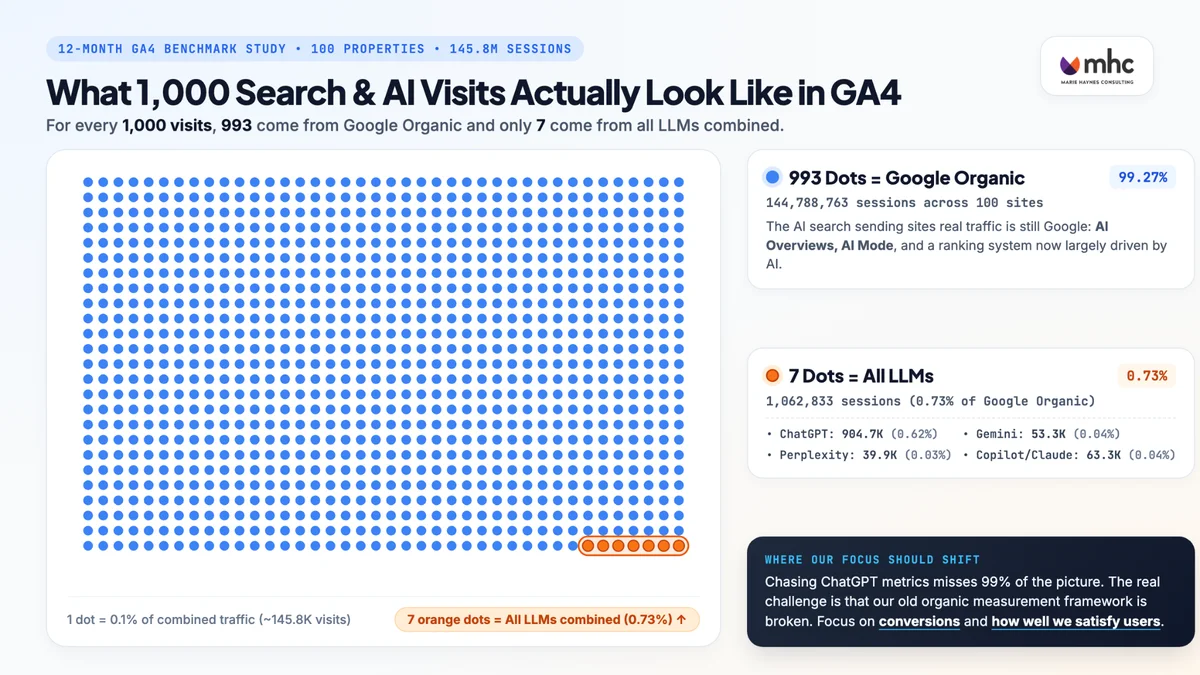
- Traffic Volume Disparity: Google Organic search continues to dominate web acquisition, driving roughly 99.27% of aggregated traffic in the study. Standalone ChatGPT sessions represented just 0.62%, while all LLMs combined accounted for a mere 0.73%.
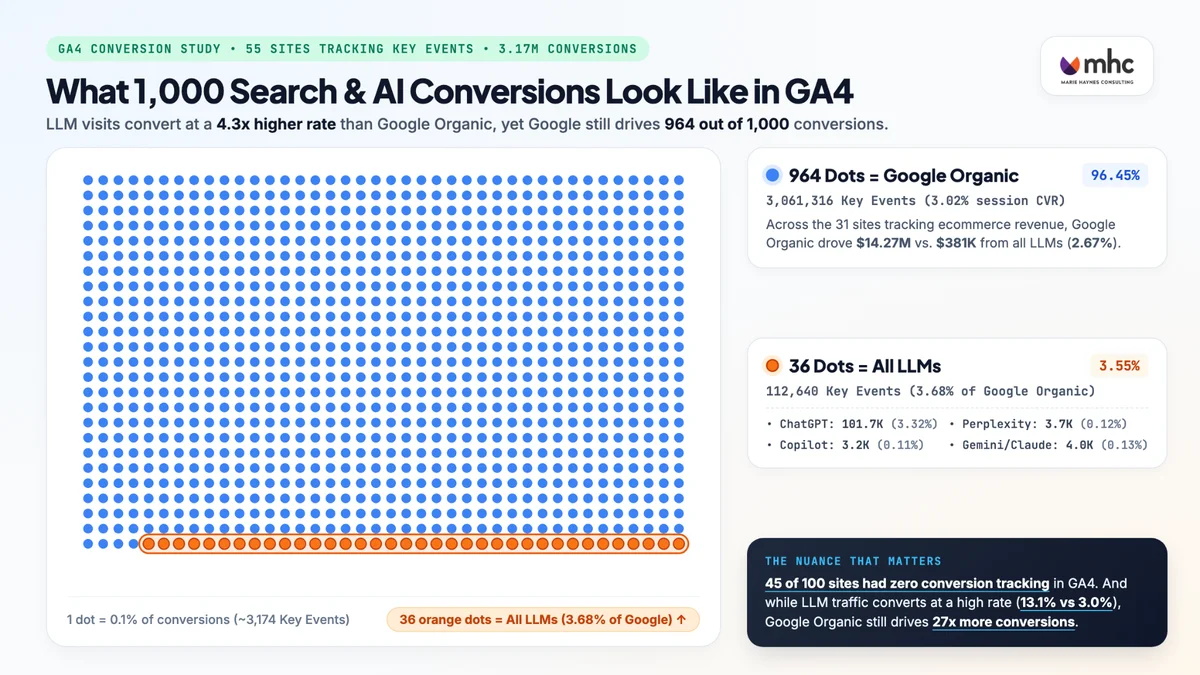
- The Conversion Paradox: Proponents of GEO often argue that while LLM traffic volume is low, user intent is exceptionally high. The study confirmed this hypothesis in part: among the 55 sites in the dataset actively tracking key events and conversions in GA4, visitors arriving from ChatGPT converted at a rate more than 4.5 times higher than standard Google organic visitors.
- The Aggregate Conversion Reality: Despite this elevated conversion rate, volume dictates outcome. Because Google Organic delivered such a massive scale of raw visitors, it still accounted for 96.5% of total conversions across the analyzed channels. In absolute terms, Google organic search drove 27 times more conversions than all generative LLMs combined.
[Traffic Share Comparison]
Google Organic:  [████████████████████████████████████████] 99.27%
Combined LLMs:   [░] 0.73%

[Conversion Share Comparison]
Google Organic:  [████████████████████████████████████████] 96.5%
Combined LLMs:   [█] 3.5%
These metrics underline an uncomfortable truth: while high-intent micro-segments occasionally convert via AI chatbot citations, building a growth strategy around these channels ignores where the vast majority of commercial intent actually manifests.
Official Statements and Industry Perspectives: Rethinking Search Infrastructure
Industry leaders and search executives have repeatedly signaled that the traditional paradigm of typing a query and browsing ten blue links is dead. However, the mechanism of change is deeply integrated into established search portals rather than displaced by standalone chat windows.
Google CEO Sundar Pichai has noted that search is systematically evolving into an "agent manager." In this new framework, search engines no longer act as passive indexers of information; instead, they serve as active work coordinators that execute complex, multi-step tasks on behalf of the user.
Reflecting on this transformation at industry tech summits, prominent technology pioneers have emphasized the unpredictability of the next decade. During a discussion on the ten-year outlook of the internet, Google co-founder Sergey Brin admitted, "I don’t think we really know what the world looks like in 10 years."
Adding to this perspective, Demis Hassabis, CEO of Google DeepMind, highlighted the foundational shift toward machine-first architecture:

"The web is going to change quite a lot if you think about an agent-first web, like it doesn’t necessarily need to see renders and things like we do as humans using the web. So I think things will be pretty different in a few years."
This shift invalidates old-school metrics like traditional rank tracking and superficial Search Console monitoring. Because modern Google ranking systems rely heavily on deep-learning algorithms designed to predict human helpfulness, marketers must pivot away from machine-tricking keywords and focus intensely on deep user satisfaction and structured data integrity.
Future Outlook: Navigating the Agentic Web and Commerce Protocols
As we look toward the horizon of digital marketing, the battleground is shifting away from simple informational queries toward transactional, agentic capabilities. Four major technological pillars are redefining how consumers interact with businesses online:
1. Google’s Universal Cart
Google’s Universal Cart aggregates products from fragmented retail inventories into a centralized checkout workflow housed within Google Wallet. The system autonomously monitors dynamic price adjustments, promotional discounts, and live inventory restocks. Consumers can bundle items from competing vendors into a single cart and check out seamlessly without ever navigating to individual merchant storefronts.
- The Opportunity: Mastery of Google Merchant Center and its built-in AI assistant is no longer optional. Accurate, real-time product feed data ensures that automated shopping algorithms can easily index, bundle, and recommend products at the exact point of user intent.
2. Universal Commerce Protocol (UCP)
Governed collaboratively by industry giants including Google, Shopify, and Stripe, UCP provides an open discovery layer that enables autonomous AI agents to compare cross-merchant inventory and execute native purchases while keeping the brand listed as the merchant of record.
- The Opportunity: Technical SEO must expand to encompass agentic discovery endpoints. Specialists must understand server configurations like
/.well-known/ucpand how product variations are exposed through Merchant Center. Optimization will increasingly rely on superior product quality, competitive pricing, and frictionless customer service rather than keyword stuffing.
3. WebMCP (Model Context Protocol)
WebMCP allows websites to expose their interactive functions—such as dynamic calculators, complex booking schedulers, and customer support diagnostic forms—directly to AI agents through declarative markup and imperative APIs.
- The Opportunity: While enterprise-wide adoption is still maturing, progressive brands are beginning to experiment with agent-accessible tools. Businesses should audit their digital properties to determine what self-service utilities an autonomous agent would want to invoke on a user’s behalf.
4. Intelligent Eyewear
Moving beyond experimental "AI glasses," the rollout of Android XR hardware—ranging from lightweight audio frames developed with fashion brands like Warby Parker and Gentle Monster to micro-LED visual display glasses—promises to bring ambient computing into daily life.
- The Opportunity: Ambient search expands digital interaction from flat screens to physical surroundings. Whether it is a culinary assistant guiding a home chef step-by-step or a visual shopping prompt ("Hey Gemini, find me that jacket in my size and buy it"), intelligent eyewear opens up entirely new paradigms of contextual commerce.
Conclusion
The obsession with GEO and standalone LLM chat citations represents a costly distraction for modern digital marketers. While artificial intelligence is fundamentally rewriting how the internet functions, the empirical evidence demonstrates that Google remains the undisputed titan of search-driven discovery and conversion.
To remain competitive, organizations must stop chasing the statistical noise of minor referral channels. Instead, marketing teams must embrace the agentic web by hardening their structured data, optimizing product feeds for Universal Commerce Protocols, building agent-accessible tools via WebMCP, and aligning their core offerings with the deep learning systems that dictate modern visibility. The future belongs not to those who optimize for machines, but to those who build frictionless, highly satisfying digital experiences ready to be managed by the AI agents of tomorrow.