Executive Overview
The digital marketing industry is currently undergoing a crisis of focus. For the past two years, search professionals have been captivated by the rise of Generative Engine Optimization (GEO)—a frantic attempt to optimize content for visibility within large language models (LLMs) like ChatGPT, Claude, and Perplexity. However, a comprehensive analysis of 100 websites and over 145 million sessions reveals a sobering truth: the obsession with LLM-driven traffic is a distraction.
Data suggests that while AI is fundamentally reshaping the internet, its role as a direct traffic driver is negligible compared to the enduring dominance of Google Search. As we transition from the "Information Web" to the "Agentic Web," the goal for businesses is no longer just to rank for keywords; it is to prepare for a future where search engines function as automated task managers. The competitive landscape is shifting away from blue links toward a landscape of Universal Carts, Model Context Protocols, and intelligent, multimodal hardware.
Detailed Chronology: The Rise and Plateau of AI Referrals
When ChatGPT first entered the public consciousness, many industry analysts predicted a paradigm shift in web traffic. The hypothesis was simple: as users flocked to conversational interfaces, referral traffic from traditional search engines would plummet, replaced by direct citations from LLMs.
Early trends seemed to support this, with a modest, upward trajectory in referral traffic from AI tools. However, looking at 12 months of GA4 data across a diverse portfolio of 100 websites, the narrative has shifted.
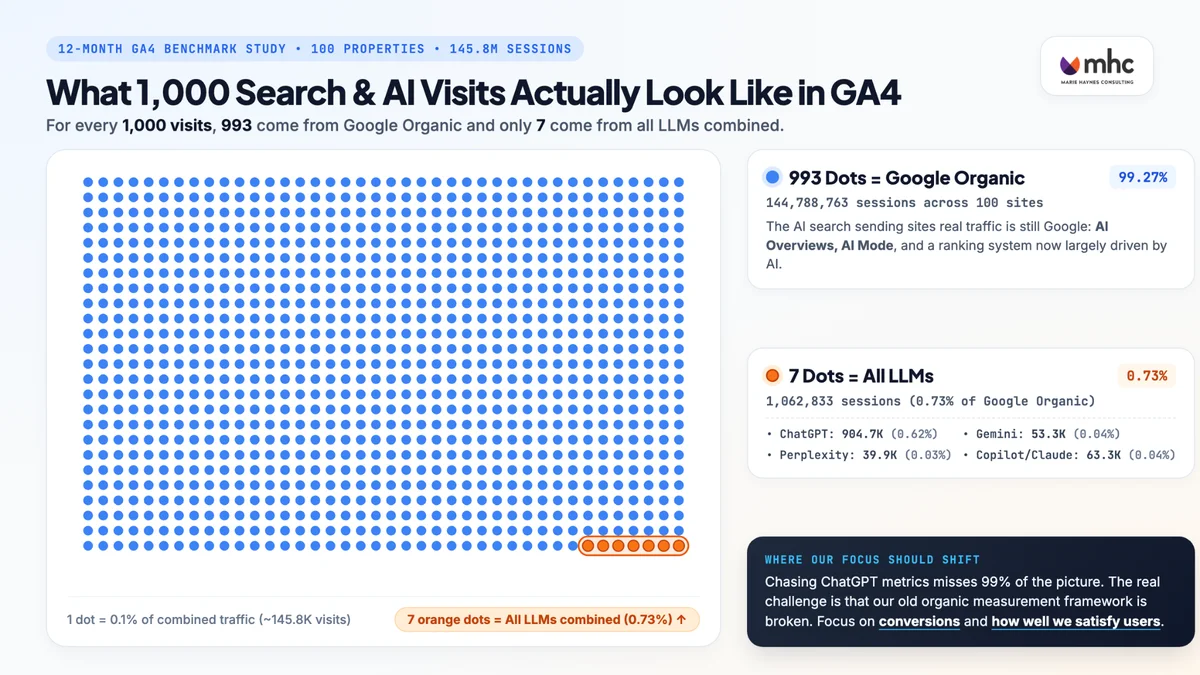
The exponential growth in ChatGPT sessions observed in 2024 and early 2025 hit a significant plateau following the release of GPT-5 in August 2025. Since that turning point, the volume of referral traffic from LLMs has not only stalled—it has begun to decline. In this dataset, sessions from ChatGPT accounted for a mere 0.62% of the volume driven by Google Organic. When all other LLMs were aggregated, the total rose to only 0.73%.

This data provides a stark reality check: for the vast majority of businesses, the "AI traffic" they are chasing is a rounding error compared to the volume still funneled through Google.
Supporting Context & Metrics: Conversions Over Clicks
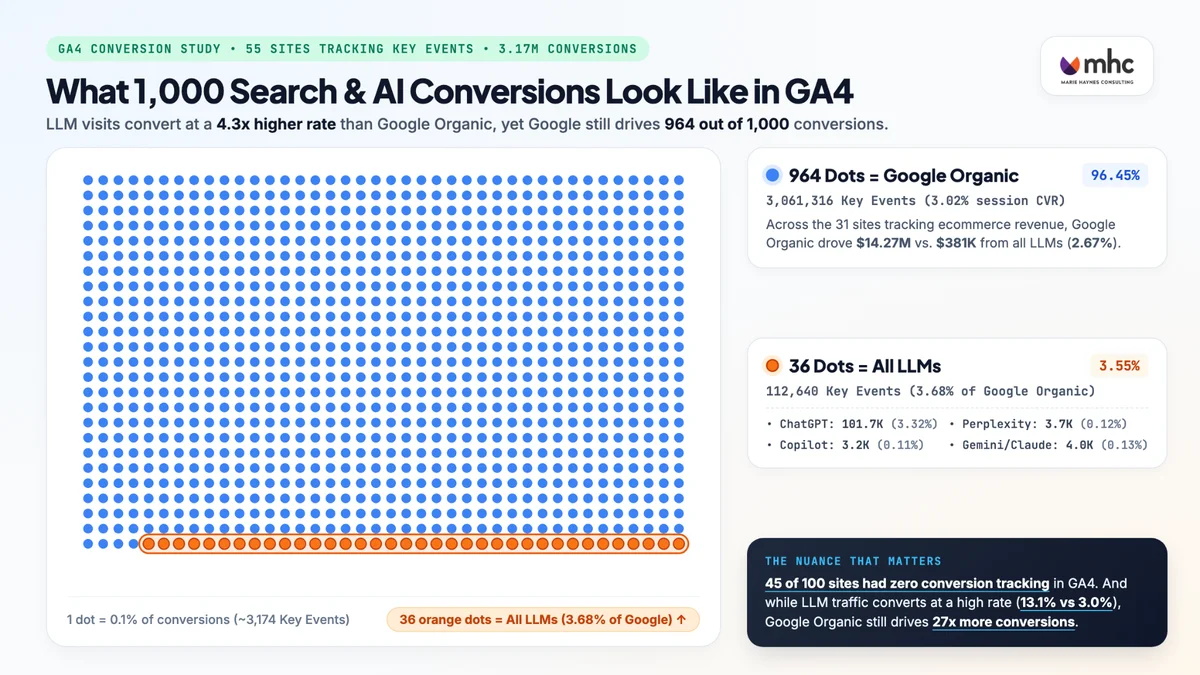
A common argument for optimizing for LLM visibility is that the quality of traffic—even if lower in volume—is superior. My analysis confirms that ChatGPT users do indeed exhibit higher engagement rates, converting at more than 4.5 times the rate of Google organic visitors.
However, volume still dictates impact. Despite the higher conversion rate of the AI segment, Google Organic still commanded 96.5% of total conversions across the analyzed channels. In raw numbers, Google drove 27 times more conversions than all LLMs combined.
The takeaway is not that AI traffic is "bad," but that it is currently insignificant in the context of a business’s bottom line. The industry’s fixation on GEO has led to a massive misallocation of resources. Millions of dollars are being poured into tracking AI mentions and LLM citations, while fundamental conversion tracking—the bedrock of digital ROI—is being neglected. Strikingly, 45% of the sites sampled in this study lacked basic key event tracking, leaving them blind to how their users are actually interacting with their brand.
Official Statements and Industry Vision
The pivot toward an "agentic" future is not merely an industry theory; it is the stated roadmap of the tech giants themselves. During recent discussions on the future of search, Google CEO Sundar Pichai noted that search is evolving into an "agent manager."
This transition represents a move away from the passive retrieval of links toward the active coordination of work. During a session at Google I/O, DeepMind’s Demis Hassabis echoed this sentiment, noting that the web will look vastly different as it adapts to an agent-first paradigm. "The web is going to change quite a lot," Hassabis remarked. "It doesn’t necessarily need to see renders and things like we do as humans using the web."
This vision suggests that the future of the web will be dictated by machine-to-machine communication, where the "user" is not a person clicking a link, but an AI agent executing a transaction on the user’s behalf.
Future Outlook: The Three Pillars of the Agentic Web
As we move into 2027 and beyond, the definition of "SEO" will be forced to expand. Businesses that want to remain relevant must look past keyword ranking and toward the following three pillars of agentic discovery:
1. The Era of Universal Commerce
Google is rapidly implementing its "Universal Cart" system, which allows users to bundle products from various retailers and complete a purchase within the Google ecosystem. This effectively turns Google into a decentralized marketplace. To compete here, companies must move beyond simple product feeds and master the complexities of the Google Merchant Center. The goal is to provide the data granularity required for Google’s algorithms to trust your site as a reliable, automated fulfillment partner.
2. WebMCP and the Interoperable Web
The Model Context Protocol (WebMCP) is perhaps the most significant shift for technical SEOs. It allows websites to expose interactive functions—such as booking engines, calculators, and complex forms—directly to AI agents. By utilizing declarative markup, businesses can allow an AI to "use" their website, performing tasks for the user without the user ever seeing a traditional landing page. This is the ultimate "headless" experience, requiring a shift in how we build and expose site functionality.

3. Intelligent Eyewear and Ambient Search
The launch of "Intelligent Eyewear" marks the return of ambient computing. These devices, which rely on multimodal inputs (audio and visual), will allow users to query the world around them. When a user asks their glasses to "find me a plumber for this specific leak" or "buy me this shirt," the successful brands will be those that have integrated their service APIs into the local search graph. Optimization for these devices will require a deep understanding of local intent, real-time availability, and the ability to handle high-intent, immediate-action queries.
Conclusion: Refocusing for the Future
The obsession with "optimizing for ChatGPT" is a symptom of a broader, more dangerous trend: the industry’s tendency to chase the "new" at the expense of the "effective."
Google remains the most powerful search engine in the world, and its internal AI systems—AI Overviews, AI Mode, and advanced deep learning—are the real forces changing the internet. Rather than lamenting the decline of traditional informational clicks, marketers should double down on user satisfaction and data-driven conversion tracking.
The web is not disappearing; it is becoming more automated, more integrated, and more intelligent. The SEO of tomorrow will not be about ranking for "best pizza in New York." It will be about ensuring your business is the one an agent selects when a hungry user asks their glasses to "order dinner."
A Strategic Framework for Your Business
To navigate this shift, I encourage you to deploy the following prompt to your internal AI or strategy teams to identify where your business stands in the agentic landscape:
"Act as an AI Search and Agentic Commerce Strategist. Analyze my business model [Insert URL/Description] and provide a roadmap for: 1) Optimizing for Universal Cart and automated shopping systems. 2) Developing WebMCP tools that allow AI agents to interact with our site. 3) Preparing for ‘See it, Solve it, or Buy it’ scenarios on smart eyewear. 4) Defining two low-lift experiments for the next quarter that move us beyond standard blue-link optimization."
The transition is underway. The winners will be those who stop trying to influence the LLMs of today and start building the infrastructure for the agents of tomorrow.