Executive Overview
The landscape of paid search advertising is undergoing its most profound structural transformation in over a decade. Google Ads is systematically phasing out legacy Search campaign functionality, consolidating traditional features into AI Max—a heavily automated system designed to take a commanding role in how ads are matched, written, and delivered.
While Google frames these automated upgrades as seamless transitions meant to preserve existing campaign intent, the reality for Pay-Per-Click (PPC) managers, digital marketing directors, and enterprise brands is far more nuanced. Features like campaign-level broad match settings and automatically created assets have already begun transitioning, with the mandatory migration of Dynamic Search Ads (DSAs) scheduled for February 2027.
These updates grant Google’s artificial intelligence deeper access to user intent, dynamic text generation, and landing page selection. For some brands, this automation unlocks unprecedented scale and efficiency. For others, it introduces unexpected traffic leaks, compliance risks, and inflated customer acquisition costs (CAC).
To successfully navigate this shift, advertisers cannot afford a passive "set-it-and-forget-it" approach. A rigorous, multi-layered audit of existing accounts is essential to identify what automated features are active, evaluate their impact on traffic quality, and establish precise boundaries where necessary. This guide breaks down the essential audit framework PPC managers must execute to retain control over their ad spend in the age of AI Max.
Detailed Chronology: The Rollout of AI Max
Understanding the timeline of Google’s automation rollout is critical for operational planning. The transition from legacy Search campaign features to AI Max is not happening overnight; rather, it is occurring in distinct waves that require proactive management rather than reactive scrambling.
September 2026: The Initial Wave
The transition kicked off in earnest in September 2026. Campaigns utilizing automatically created assets and campaign-level broad match settings began their automated migration into the AI Max framework. During this phase, Google began mapping existing configurations into the new infrastructure, aiming to preserve legacy parameters while unlocking backend algorithmic flexibility. Advertisers who failed to audit their accounts during this window quickly found that Google’s machine learning models had begun expanding keyword footprints and dynamically altering ad text without explicit re-authorization.
February 2027: The Dynamic Search Ads (DSA) Deadline
The next critical milestone on the horizon is February 2027, when Dynamic Search Ads officially transition into the AI Max ecosystem. According to Google’s documentation, this migration will convert existing dynamic ad groups into standard ad groups, preserving supported legacy settings and data where possible. However, unsupported legacy DSA targets run the risk of becoming read-only.
For enterprise brands managing massive catalogs or complex service structures, this deadline necessitates an immediate review of website architecture, dynamic targets, and URL exclusions. Waiting until the transition occurs automatically risks relinquishing control over which pages Google indexes and promotes.
Supporting Context & Metrics: Uncovering the True Impact of AI Max
As Google’s AI Max takes a more aggressive role in search term matching and ad delivery, independent researchers and enterprise marketers have begun evaluating the empirical impact of these automated features. The results paint a complex picture of efficiency gains weighed against rising costs and traffic dilution.
The Scale of Keyword Expansion
One of the most immediate shifts under AI Max is the aggressive blurring of boundaries between exact match, phrase match, and broad match. By leveraging keywordless matching technology, AI Max identifies additional searches based on existing keywords, ad creative, and landing page content.
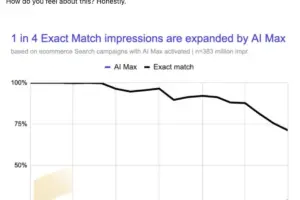
An eye-opening analysis by Mike Ryan at Smarter Ecommerce (SMEC) highlighted the sheer scale of this expansion. Examining over 383 million impressions across AI Max-enabled Search campaigns, Ryan discovered that more than 25% of impressions attributed to exact match keywords actually entered the funnel via AI Max search term matching.
While this does not automatically mean those searches were irrelevant, it completely shatters the assumption that exact match keywords act as a rigid fence around a campaign’s target audience. Furthermore, SMEC’s research documented instances where competitor searches accounted for an alarming 69% of total search impressions within a single account, demonstrating how heavily traffic mixes can lean away from original targeting parameters.
Performance Realities: Conversion Volume vs. Cost Efficiency
Google’s internal 2026 data for non-retail advertisers suggests that organizations utilizing the full AI Max feature suite see an average of 7% more conversions or conversion value at a similar Cost Per Acquisition (CPA) or Return on Ad Spend (ROAS) compared to relying solely on traditional search term matching.
However, independent data urges caution. In a March 2026 analysis of more than 250 campaigns conducted by SMEC, findings revealed that while AI Max generated a median 13% increase in conversion value relative to baseline revenue, those gains came at a heavy price: a median CPA that was 16% higher than the campaign baseline.

Furthermore, ROAS results fluctuated wildly. While the median difference sat at 0%, individual campaign performance swung dramatically—ranging from 42% above baseline to 35% below it. These observational figures underscore a vital truth: while AI Max can successfully drive incremental volume, that volume frequently comes at an elevated cost, requiring careful segmentation and stringent guardrails.
Official Statements and Platform Mechanics
Google maintains that AI Max is built to empower, not alienate, advertisers. Official documentation emphasizes that the automatic upgrades are designed to preserve existing campaign settings while offering optional, advanced optimization controls that advertisers can toggle on or off.
Key mechanical components of AI Max include:
- Search Term Matching: Controlled primarily at the ad group level, utilizing broad match and keywordless algorithms.
- Text Customization: A campaign-level setting allowing Google to dynamically generate additional headlines and descriptions using landing page content and existing assets.
- Final URL Expansion: A campaign-level capability enabling Google to dynamically select alternative landing pages from the advertiser’s domain based on the user’s live search query.
Google also provides specialized reporting fields, optimized asset metrics, and experiment creation tools designed to help marketers measure the incremental lift of these features. Nevertheless, platform-provided metrics must be cross-verified against internal business KPIs, lead quality data, and bottom-line revenue to determine true profitability.
Future Outlook: A 6-Step Audit Framework for PPC Managers
Given the rapid deployment of AI Max, PPC managers must adopt a proactive auditing methodology. Rather than blindly accepting automated defaults or outright rejecting automation, advertisers should methodically review six core areas of their Google Ads accounts.
1. Map Out What is Already Enabled
Google’s migration path is not uniform; settings vary based on what legacy features a campaign previously utilized.
- Review AI Max configurations at both the campaign and ad group levels.
- Check whether search term matching, text customization, and Final URL expansion are actively running.
- Identify any anomalies in newly created or migrated campaigns to establish an accurate performance baseline before implementing further changes.
2. Audit Search Term Matching and Traffic Quality
Because AI Max aggressively expands keyword reach, deep dives into the Search Terms Report are non-negotiable.
- Analyze the proportion of traffic originating from exact match keywords versus AI Max algorithmic matching.
- Screen for excessive competitor traffic or purely informational, top-of-funnel queries that drain budgets without driving intent.
- Deploy negative keywords, brand controls, and location-of-interest parameters to prune unwanted traffic streams.
3. Review AI-Generated Ad Copy and Creative Safeguards
Text customization empowers Google to spin up new headlines and descriptions on the fly.
- Audit optimized asset reporting to evaluate spend, impressions, and conversions tied to AI-generated variations.
- Check for brand compliance, ensuring generated copy aligns with legal, regulatory, and partner messaging guidelines.
- Verify Pinning Rules: Be aware that when Final URL expansion is active, responsive search ad (RSA) pinning is frequently bypassed to match destination pages. If strict disclaimers or pricing disclosures are mandatory, turn off Final URL expansion to preserve pinned assets.
4. Scrutinize Final URL Expansion Destinations
Allowing Google to dynamically route users to different pages on your website can streamline navigation, but it can also send high-intent budget to blog posts, support documentation, or irrelevant service pages.
- Review landing page performance reports to identify which URLs are capturing traffic via AI Max.
- For lead generation campaigns, track leads past the initial form submission to ensure AI-driven traffic results in qualified sales opportunities rather than junk contacts.
- Utilize campaign-level URL exclusions and ad group-level URL inclusions to fence in automated routing.
5. Evaluate Quality Conversions via Controlled Experiments
Do not judge AI Max success purely on raw conversion volume.
- Compare lead quality and ecommerce margins against historical benchmarks to see if the higher CPAs associated with AI Max are justified by superior customer lifetime value (LTV).
- Leverage Google’s newly expanded AI Max experimentation tools to test features incrementally. Isolate variables—such as testing broad matching or URL expansion independently—rather than toggling everything on at once.
6. Prepare Legacy Dynamic Search Ads for February 2027
With the mandatory DSA transition fast approaching, time is of the essence.
- Audit existing dynamic targets, outdated exclusions, and legacy URL structures.
- Clean up complex website inventories now to ensure that Google’s automated migration maps your site architecture correctly, preventing valuable pages from turning read-only or falling out of rotation.
Conclusion
The expansion of AI Max marks a definitive shift toward AI-driven search marketing. While the technology offers undeniable advantages in scale, reach, and algorithmic learning, it also shifts the balance of power from human strategists to machine learning black boxes.
Success in this new era does not belong to advertisers who completely reject automation, nor does it belong to those who surrender total control to Google. It belongs to the meticulous PPC managers who audit their accounts relentlessly, establish clear structural guardrails, and continuously measure performance against genuine business outcomes. By prioritizing rigorous data analysis and proactive optimization today, brands can harness the power of AI Max without sacrificing their bottom line.