As search engine optimization (SEO) professionals increasingly pivot toward Generative Engine Optimization (GEO) and AI visibility tracking, a familiar panic often sets in when a brand’s citation vanishes from an AI-generated response. Whether reporting to internal stakeholders or high-paying clients, a lost link in platforms like ChatGPT, Google Gemini, Microsoft Copilot, or Google AI Overviews is frequently treated as an immediate emergency—a clear sign that a page has been outcompeted, penalized, or rendered irrelevant.
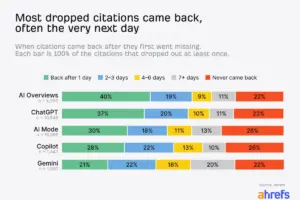
However, groundbreaking new research from Ahrefs suggests that digital marketers should take a deep breath before rewriting their content. According to a comprehensive 20-day study tracking approximately 37,500 first-day citations across five major AI products, roughly three in four AI citation drops are entirely temporary.
This finding fundamentally challenges how digital marketers interpret daily fluctuations in AI visibility. Rather than reacting impulsively to every dip in referral traffic or brand mentions, SEO teams must understand the mechanics of AI citation volatility to avoid making unnecessary, and potentially counterproductive, edits to their website architecture.
Executive Overview: The Myth of the Permanent AI Citation Drop
The pressure to maintain visibility in conversational search engines and AI answer engines has intensified over the last two years. As traditional blue links yield real estate to synthesized overviews and conversational chats, brand citations have become the new holy grail of digital authority.
When a website drops out of an AI-generated response, the knee-jerk reaction is often to overhaul the underlying web page. Yet, Ahrefs’ empirical tracking reveals that AI citation volatility is an inherent feature of large language models (LLMs) rather than a definitive indictment of a page’s quality.
The study, spearheaded by Ahrefs marketing educator Mateusz Makosiewicz and data specialist Xibeijia Guan, monitored thousands of citations day-by-day across Google AI Overviews, Google AI Mode, ChatGPT, Gemini, and Copilot. The data uncovered a striking reality: LLMs dynamically regenerate responses, shuffle sources, and experience fluctuating contextual weights on a daily—and sometimes hourly—basis.
For digital marketing agencies and in-house SEO teams, the core takeaway is clear: Do not panic over a single-day drop. A missing citation is often just algorithmic noise. To navigate these turbulent waters, professionals need a structured investigative framework before touching a single line of code or rewriting a piece of content.
Detailed Chronology: Tracking the Life and Death of AI Citations Over 20 Days
To understand the lifecycle of an AI citation, the Ahrefs team executed a rigorous tracking methodology. Xibeijia Guan collected a baseline dataset of websites cited on "Day 1" across a designated group of industry questions fed daily into the five target AI products. These specific references were then traced consecutively through to "Day 20."
The Day Two Drop-Off
The volatility manifested almost immediately. By Day 2—just 24 hours after the initial capture—approximately half of all references tracked in Google AI Overviews had already vanished. The drop-off rates for other AI tools were even more pronounced.
Despite this precipitous early decline, the vast majority of these missing citations did not stay gone. Ahrefs discovered that across all five tools, about half of the citations that dropped out returned within just three days. By the conclusion of the 20-day window, roughly 75% of total dropped citations had reappeared at least once.
A similar stabilizing pattern was observed in Brand Radar—an internal citation-tracking tool sold by Ahrefs—where roughly two-thirds of all disappeared citations ultimately made a comeback.
Limitations in the Data
While the study offers unprecedented visibility into AI search behavior, the researchers acknowledge certain methodological boundaries. Because the study tracked the aggregate presence of websites rather than specific URLs, it cannot definitively prove whether the exact same webpage returned when a citation reappeared. Furthermore, because citations that dropped out near the end of the study window had less time to stage a comeback, the true return rate may actually be higher than recorded.
Supporting Context & Metrics: Four Crucial Checks Before Editing Your Pages
Before greenlighting a content overhaul or adjusting on-page SEO parameters based on a missing AI citation, the Ahrefs study recommends conducting a rigorous four-part diagnostic check.
Check 1: Did the AI Tool Cite Anyone at All?
Not all AI tools behave the same way. When a citation loss was registered on Google Gemini or Microsoft Copilot, it frequently pointed to a structural quirk in the AI’s response generation rather than a competitive loss:
- Gemini produced responses completely devoid of citations roughly 64% of the time in the study’s dataset.
- Copilot generated answers without any citations approximately 53% of the time.
When an LLM outputs an answer with zero citations, any site previously tracked there will automatically register as a "loss." Many of the subsequent comebacks on Gemini and Copilot were simply instances of the tool resuming source citations in later queries.
Conversely, Google AI Overviews, Google AI Mode, and ChatGPT rarely left answers unreferenced. Fewer than 1% of their answers lacked citations altogether. On these platforms, a lost citation almost invariably meant another competitor took the spot. Therefore, marketers must first inspect the raw AI output: if there are no links, it is an LLM behavioral artifact; if a competitor’s link has replaced yours, it is a genuine competitive shift.
Check 2: How Long Had the Citation Lasted? (The History Factor)
A citation’s historical stability is a far better predictor of its long-term viability than its status on any single day. The study categorized citations by their historical lifespan prior to their first disappearance:
- Short-lived citations (those that lasted only one day before dropping) failed to return 34% to 41% of the time during the study window.
- Long-standing citations (those that remained active for 8 to 14 days before disappearing) had a permanent drop rate of 4% or less.
This disparity highlights why standard sporadic check-in reports can mislead marketing teams. A site cited only once looks identical in a single-day snapshot to a site with 10 days of continuous visibility. To gain an accurate picture, teams should adopt a seven-day rolling frequency count—measuring how many of the last seven days a site appeared as a referenced source for a given prompt.
Check 3: Is the Brand Still Named in the Text?
A critical distinction in AI optimization is the difference between a citation (a clickable link to your website) and a mention (the textual appearance of your brand name within the answer, with or without a hyperlink).
The Ahrefs data revealed that brand mentions are significantly more stable than hyperlinks. While 50% to 70% of cited websites appeared on only one day, only about one in five named brands exhibited that level of volatility.
Consequently, an automated tracking report might sound the alarm over a "lost citation," even though the AI is still actively naming and recommending the company in the body text. Before panicking over a broken link, SEOs should verify whether the brand name is still being referenced under alternate phrasings or abbreviations, as AI models frequently vary the length and formatting of brand names across prompts.
Check 4: Does the Page Rank for the Question in Traditional Search?
For Google-powered ecosystems (AI Overviews and AI Mode), the study uncovered a clear correlation between traditional search performance and AI citation longevity.
Pages that already ranked organically within Google’s standard search engine results pages (SERPs) for a specific question maintained their AI citations significantly longer—often holding positions for a week or more. However, ranking supremacy is not an absolute prerequisite; the majority of pages cited by AI Mode and ChatGPT did not actually rank on page one of Google’s traditional results for that specific prompt.
When a citation remains missing for multiple weeks, the optimal diagnostic starting point is to evaluate the page’s traditional search rankings and its direct semantic relevance to the user’s query.
Official Statements and Industry Perspectives: The Danger of False Attribution
The trap of false causality is one of the most perilous hazards in modern SEO. When a digital marketer edits a page after noticing a dropped AI citation, and the citation subsequently reappears a day or two later, human psychology immediately credits the edit.
Mateusz Makosiewicz strongly warns against this logical fallacy, asserting: "Don’t credit a page edit for a single comeback."
Given that 50% or more of dropped citations naturally recover within 48 to 72 hours without any human intervention, attributing a spontaneous algorithmic fluctuation to a recent content tweak is fundamentally flawed. Conversely, concluding that an edit damaged a page because a citation vanished the next day is equally baseless, given the rampant day-to-day volatility inherent in LLMs.
Instead of reactionary micro-management, industry leaders advocate for macro-level tracking. By establishing internal daily logs of high-value queries and monitoring rolling seven-day citation frequencies, brands can present management with authoritative trends rather than knee-jerk anomalies.
Future Outlook: Mastering Generative Engine Optimization (GEO)
As search engines continue their rapid evolution toward hybrid AI and conversational models, the metrics governing digital visibility will continue to shift. The days of treating search visibility as a binary, static science are over.
Future optimization strategies must account for the fluid nature of large language models. As underlying model weights update and prompt engineering parameters shift across platforms, citation stability will remain a moving target.
The primary directive for digital marketers moving forward is patience rooted in data. When an AI citation drops:
- Wait it out: Allow a window of 48 to 72 hours before sounding alarms, as the vast majority of drops are self-correcting.
- Audit the output: Confirm whether the AI dropped all citations entirely (common in Gemini and Copilot) or replaced you with a competitor.
- Analyze historical frequency: Evaluate whether the lost citation was a fleeting one-day wonder or a historically stable asset with a multi-week track record.
- Check brand mentions: Ensure your company name isn’t still being actively recommended in the text even if the hyperlink is momentarily absent.
- Hold off on premature edits: Refrain from rewriting content based on a single comeback, reserving structural page optimizations for citations that remain missing after two to three weeks.
By shifting from reactive panic to disciplined, longitudinal tracking, SEO professionals can separate transient algorithmic noise from true strategic decline, ensuring their brands maintain a resilient, authoritative presence in the age of AI-driven search.