By Investigative Tech Desk
Published: November 2026
Executive Overview
The WordPress ecosystem has long relied on search engine optimization (SEO) plugins to bridge the gap between content management and search visibility. Among these tools, Rank Math has enjoyed meteoric growth, emerging as a powerhouse favored by millions of site administrators globally for its feature-rich interface and AI-driven capabilities. However, a troubling milestone achieved throughout 2026 has sent shockwaves through the WordPress security community.
Data compiled from security advisories, notably telemetry and intelligence reports from Wordfence, reveals that Rank Math accumulated an unprecedented 16 vulnerabilities over the course of the year. This figure sets a sobering record, outstripping every other major SEO plugin in the WordPress repository by a wide margin.
The security flaws discovered in Rank Math span a dangerous spectrum. They include potential pathways to full website takeover, exposure of protected and sensitive proprietary information, and unauthorized alterations to WordPress configurations, databases, and core content. Beyond the immediate threat of site compromise, these vulnerabilities carry collateral damage: successful exploits can directly harm a site’s search engine optimization, undoing years of organic growth overnight.
While industry insiders acknowledge that the broader software development landscape is seeing an increase in vulnerability disclosures—partly fueled by automated analysis and AI-assisted auditing tools—the sheer volume of issues plaguing Rank Math stands out. For comparison, its primary legacy competitor, Yoast SEO, weathered the same year with a fraction of the exposure: the free version of Yoast SEO recorded just four vulnerabilities in 2026, while its premium counterpart registered only two.
This vast disparity has ignited urgent conversations across the WordPress community. Developers, site owners, and security researchers are now asking hard questions regarding Rank Math’s internal coding practices, rigorousness of code reviews, and overall quality assurance lifecycle. As the dust settles on a turbulent year for the plugin, this investigative report examines the chronology, severity, underlying architectural weaknesses, and broader industry implications of Rank Math’s 2026 security crisis.
Detailed Chronology: Anatomy of a Security Storm
The security vulnerabilities affecting Rank Math did not trickle in at a steady pace throughout 2026; rather, they arrived in concentrated, highly volatile waves. A granular review of the disclosure timeline reveals periods of intense vulnerability discovery that strained the plugin’s development and patching pipeline.
The Late-Summer Surge (August – September)
The most critical phase of the year’s security events occurred in a compressed window between August 27 and October 14, 2026. During this seven-week window, an alarming 11 out of the total 16 vulnerabilities were officially brought to light.
The crisis hit an initial fever pitch in late August. Between August 27 and September 3—an astonishingly brief span of just eight days—security researchers disclosed eight distinct vulnerabilities. This rapid-fire succession of disclosures caught many web administrators off guard, forcing emergency updates and highlighting potential systemic flaws within specific build versions of the plugin. Multiple vulnerabilities were found to affect overlapping versions of Rank Math, indicating that individual software releases shipped with compounding security debts.
The October Extensions
The momentum of disclosures did not subside as autumn progressed. October brought another five vulnerabilities into the public sphere. On October 8, 2026, three separate security flaws were disclosed simultaneously, followed by subsequent disclosures culminating in the latest report on October 27, 2026.
This relentless cadence meant that Rank Math’s development team was locked in a nearly continuous cycle of remediation, testing, and deployment, struggling to patch holes faster than researchers could identify them.
Severity Breakdown: The Most Dangerous Exploits
While all 16 vulnerabilities present distinct risks, security analysts categorize the threats based on their potential impact on site integrity, confidentiality, and availability. The most critical vulnerabilities discovered in Rank Math during 2026 can be categorized into three primary vectors: Website Takeover, Data and Content Exposure, and Unauthorized Site Modifications.
1. Vulnerabilities That Could Lead to Website Takeover
The most severe class of vulnerabilities involves those that grant attackers administrative control over the underlying server or the WordPress dashboard.
- Remote Code Execution (RCE) — CVSS 8.8:
Two separate vulnerabilities were discovered featuring a high Common Vulnerability Scoring System (CVSS) severity score of 8.8. These critical flaws could enable malicious actors with low-privilege access—specifically Contributor or Author-level accounts—to execute arbitrary system code directly on the host server. Successfully exploiting an RCE vulnerability typically results in a complete website compromise, allowing attackers to deploy backdoors, pivot to internal networks, or harvest database credentials. - Arbitrary File Upload — CVE-2026-104752 (CVSS 7.2):
Disclosed on October 8, 2026, this vulnerability carried a CVSS rating of 7.2 (High). It presented a potential pathway to site takeover via malicious file uploads. Although this specific exploit required Administrator-level access or higher to trigger, it represented a dangerous privilege-abuse vector, potentially allowing compromised admin accounts to install executable shell scripts disguised as media uploads. - Stored Cross-Site Scripting (XSS) — CVE-2026-66702 (CVSS 7.2):
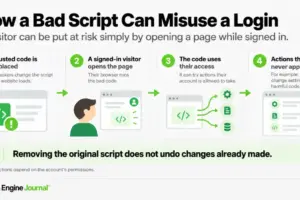
Disclosed on July 31, 2026, this unauthenticated Stored XSS vulnerability allowed an attacker without any prior credentials to inject malicious JavaScript into contexts viewed by a site Administrator. When the administrator loaded the affected page, the malicious script executed in their browser session. Depending on the environment, this opened the door to privileged actions, such as creating new rogue administrator accounts or hijacking the active session entirely. Because multiple entries pointed to this vulnerability vector, it represented a recurring blind spot in how Rank Math sanitized user-supplied input.
2. Vulnerabilities That Could Expose Protected Content and Data
Unlike RCE or XSS, which allow active manipulation of code and scripts, information-exposure vulnerabilities focus on confidentiality. Several flaws discovered in 2026 allowed unauthorized actors to query restricted database tables, view sensitive internal configurations, or read protected content without proper authorization checks. While these vulnerabilities did not always allow direct site modification, they paved the way for targeted attacks by leaking intellectual property, user metadata, and proprietary SEO strategies. Furthermore, isolated instances of SQL injection vulnerabilities discovered during the period could have allowed attackers to read and manipulate underlying database contents directly.
3. Vulnerabilities Enabling Unauthorized Website Changes
A significant portion of Rank Math’s 2026 security advisories centered on unauthorized modifications. These flaws allowed malicious actors—ranging from unauthenticated visitors to low-level subscribers—to bypass permission checks and alter critical website elements.
Impacted areas included:
- Modifying core content-related data and metadata.
- Altering homepage settings and global redirection tables.
- Deleting or corrupting critical SEO information (such as schema markup, canonical tags, and robots.txt directives), which can instantly sabotage search engine rankings.
Recurring Security Weaknesses: A Pattern of Flaws
A deeper dive into the technical anatomy of Rank Math’s 2026 record reveals that these vulnerabilities were not isolated, freak incidents of bad luck. Instead, they pointed to recurring, systemic weaknesses in how the plugin handled access control and data sanitization.
The Missing Authorization Crisis
By far the most frequently identified vulnerability category was Missing Authorization (often referred to in security taxonomies as broken access control). Out of the 16 recorded entries, seven explicitly cited inadequate permission checks.
This recurring issue demonstrates that the plugin’s codebase frequently failed to verify whether a user attempting a specific action possessed the requisite role or capabilities. Consequently, actions intended strictly for site administrators could be triggered by authenticated users with minimal privileges (such as Contributors), or in severe cases, by completely unauthenticated visitors over the web.
Unauthenticated Attack Vectors
Five of the 16 disclosures explicitly identified vulnerabilities that could be exploited without registering an account or logging in. In a standard WordPress environment, unauthenticated endpoints are prime targets for automated botnets scanning the web for zero-day and unpatched exploits. The presence of multiple unauthenticated entry points in an SEO plugin—software that typically handles complex background queries and XML parsing—underscores the critical need for strict input validation at the perimeter.
A Broad Spectrum of Coding Lapses
Security analysts noted that Rank Math’s 2026 vulnerabilities did not stem from a single, isolated software engineering error. Rather, the bugs represented a diverse tapestry of coding lapses:
- Cross-Site Scripting (XSS) due to improper output encoding.
- SQL Injection (SQLi) stemming from unescaped database queries.
- Arbitrary File Uploads via loose MIME-type validations.
- Remote Code Execution via insecure function handling.
- Broken Access Control due to absent permission verification hooks.
This diversity suggests that the codebase suffered from systemic quality control issues rather than a localized defect in a single module.
Supporting Context & Comparative Metrics
To understand the true scale of Rank Math’s 2026 security data, it is essential to contextualize the findings against broader WordPress plugin security trends and industry benchmarks.
| Metric / Indicator | Rank Math SEO (2026) | Yoast SEO Free (2026) | Yoast SEO Premium (2026) |
|---|---|---|---|
| Total Vulnerabilities Disclosed | 16 | 4 | 2 |
| Highest CVSS Severity Score | 8.8 (Critical / High) | Moderate | Moderate |
| Unauthenticated Exploits | Multiple | Rare / None | None |
| Primary Weakness Category | Missing Authorization / RCE | Low-severity issues | Low-severity issues |
| Concentration Window | 11 issues in 7 weeks | Distributed | Distributed |
As illustrated above, Rank Math’s vulnerability count is an outlier. While the overall volume of reported WordPress vulnerabilities has climbed across the board—driven in part by automated security auditing, bug bounty programs, and AI-assisted discovery tools—competitors like Yoast SEO maintained a significantly lower profile. Yoast’s tally of four vulnerabilities in the free tier and two in the paid tier highlights a stark contrast in stability and security posture between the two market leaders.
Official Statements and Industry Response
As word of the record-breaking vulnerability count spread through cybersecurity publications and WordPress developer forums, pressure mounted on Rank Math’s leadership and development teams to address the community’s concerns.
In response to the disclosures, Rank Math’s engineering team moved swiftly to issue patches for each identified CVE, working in tandem with platforms like Wordfence to ensure that automated update notifications reached site administrators. Representatives from the plugin’s development camp emphasized their ongoing commitment to user safety, pointing out that rapid patch deployment minimized the window of exposure for active sites.
However, security firms and independent developers have called for deeper structural reforms. Industry commentators argue that patching individual CVEs after the fact is no longer sufficient for plugins operating at this scale. Recommendations from the security community include:
- Mandatory Third-Party Code Audits: Engaging independent, reputable cybersecurity firms to conduct comprehensive white-box penetration testing prior to major feature releases.
- Automated Security Testing Integration: Implementing Static Application Security Testing (SAST) and Dynamic Application Security Testing (DAST) directly into the Continuous Integration/Continuous Deployment (CI/CD) pipeline.
- Strict Capability Enforcement: Overhauling internal API endpoints to ensure that every AJAX handler and REST API route explicitly validates user nonces and capability checks by default.
Future Outlook: Lessons for WordPress Developers and Site Owners
The events of 2026 serve as a watershed moment for Rank Math and a cautionary tale for the broader WordPress plugin economy. As plugins grow increasingly complex—incorporating advanced AI features, cloud integrations, and heavy database interactions—the attack surface expands exponentially.
For Rank Math, the path forward requires an aggressive rehabilitation of its reputation for code hygiene and quality control. Rebuilding trust will necessitate transparency regarding how these systemic authorization flaws occurred and what preventative measures are being implemented to ensure they do not recur in future product cycles.
For WordPress Site Administrators, the 2026 crisis underscores several non-negotiable operational best practices:
- Prioritize Automated Updates: Given the speed at which vulnerabilities were discovered and exploited in 2026 (such as the cluster of eight vulnerabilities in an eight-day window), relying on manual updates is a high-stakes gamble. Auto-updates for security patches are essential.
- Implement Web Application Firewalls (WAF): Utilizing robust firewall solutions (such as Wordfence, Cloudflare, or Sucuri) can mitigate zero-day exploit attempts even before official plugin patches are applied.
- Audit Plugin Dependencies: Regularly review installed plugins, deactivate unused tools, and evaluate the security track record of third-party software vendors before deploying them on production environments.
As the digital landscape continues to evolve, the security of the world’s most popular content management system rests on the vigilance of its developers and the proactive defenses of its users. The full, comprehensive list of Rank Math vulnerabilities, complete with detailed technical descriptions and patch version tracking, remains publicly accessible via the Wordfence Threat Intelligence Database.