Executive Overview
In a chilling reminder of the vulnerabilities inherent in modern web supply chains, the Real User Monitoring (RUM) and Core Web Vitals tool DebugBear became the vector for a sophisticated cyberattack. Hackers successfully hijacked DebugBear’s Domain Name System (DNS) records through its domain registrar, redirecting traffic to serve malicious JavaScript payloads directly to unsuspecting web users.
Widely utilized by SEO experts, web developers, and major enterprise platforms to monitor performance metrics, DebugBear’s unexpected compromise has triggered an urgent industry-wide response. Security researchers, development teams, and site owners are scrambling to mitigate the fallout.
The incident blew wide open on October 29, when cybersecurity analysis revealed that high-profile platforms—most notably the decentralized prediction market Polymarket—had inadvertently served malicious code via DebugBear’s script URLs. The attackers weaponized the third-party script to hijack active user sessions, executing unauthorized trades and draining funds from browser-based wallets.
While DebugBear has scrambled to secure its infrastructure and urge customers to instantly purge its monitoring scripts, the incident highlights a terrifying reality of modern web architecture: trusting third-party scripts can weaponize a site’s own visitor trust against them. This comprehensive report breaks down the chronology of the attack, the mechanics of the exploit, the precise risks to website owners, and the urgent steps required to secure affected web properties.
Detailed Chronology of the DebugBear DNS Attack
The sequence of events unfolded rapidly over a 48-hour window in late October, catching both platform administrators and cybersecurity firms off guard.
October 29: The Breach and Initial Discovery
The alarm was sounded when unusual behavior was detected across several high-traffic web properties utilizing DebugBear’s RUM script. According to independent investigations by cybersecurity firm Hudson Rock, malicious JavaScript was discovered embedded within the standard DebugBear script URLs.
Instead of delivering benign performance-monitoring functions designed to track Core Web Vitals, the injected script began scanning for active, logged-in user sessions.
Realizing the severity of the situation, DebugBear issued an emergency security directive via LinkedIn on October 29, explicitly instructing all customers to immediately remove its monitoring scripts from their web applications.
The DNS Hijack Vector
In a subsequent update issued as investigations deepened, DebugBear confirmed the nature of the breach: attackers had bypassed or compromised the company’s DNS records at the level of its domain registrar. By hijacking the DNS settings, the threat actors effectively redirected requests for DebugBear’s Content Delivery Network (CDN) files to rogue servers controlled by the attackers, allowing them to dynamically swap legitimate JavaScript files with malicious payloads.
Compounding communication difficulties during the crisis, DebugBear reported that the DNS tampering temporarily incapacitated its corporate email infrastructure, cutting off standard customer support channels and forcing the company to rely on social media platforms like X (formerly Twitter) and LinkedIn to broadcast critical updates.
The Polymarket Incident
The most devastating real-world consequence of the DNS hijack materialized on Polymarket. Cybersecurity analysts traced the malicious payload directly to the platform’s deployment of DebugBear’s script.
Because Polymarket users rely on browser-based trading clients and Web3 integrations, the injected script leveraged existing session permissions. Without needing user passwords or explicit multi-factor authentication approvals, the script autonomously sold positions and transferred funds out of victim wallets. Polymarket subsequently confirmed the breach in an October 30 incident report, detailing an emergency service outage and trading freeze while containment measures were enacted.
The Anatomy of the Exploit: How Third-Party Scripts Threaten Site Security
The DebugBear incident serves as a textbook example of supply chain compromise within the web development and SEO ecosystems. To understand why this attack was so dangerous, one must examine how modern websites interact with third-party tools.

The Trust Paradox of Third-Party Scripts
Websites routinely load dozens of external scripts: analytics platforms, heat-mapping tools, tag managers, advertising SDKs, and performance monitors like DebugBear. Developers embed these scripts directly into the HTML header or footer, typically using tags that look similar to this:
<script
  async
  src="https://cdn.debugbear.com/YOUR_SCRIPT_ID.js"
></script>
By executing this code, web administrators grant third-party servers immense power. The script runs with the same Document Object Model (DOM) access as the host website itself. If the third-party provider is secure, this architecture functions smoothly. However, if the provider’s infrastructure—or in DebugBear’s case, its domain registrar and DNS settings—is compromised, malicious actors gain the exact same execution privileges.
Leveraging Active User Sessions
The most insidious aspect of the DebugBear attack was its ability to bypass traditional credential-stealing methods. Rather than attempting to phish passwords or brute-force logins, the malicious JavaScript acted locally within the browser of already authenticated users.
If a visitor was logged into an account, a trading platform, or a SaaS dashboard, the rogue script could interface directly with active session cookies, browser storage tokens, and browser-based extensions (such as crypto wallets).
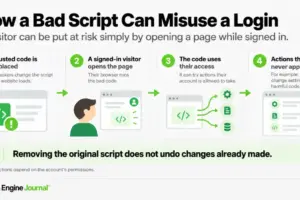
- Passive Execution: The user visits a legitimate website that embeds the compromised DebugBear script.
- Permission Inheritance: The script executes silently in the background, inheriting the security context and session permissions of the logged-in user.
- Automated Abuse: Exploiting these ambient permissions, the script executes unauthorized API calls—such as executing trades, transferring assets, or exfiltrating sensitive data—without alerting the user via traditional pop-ups or password prompts.
- Concealment: The script finishes its payload execution without disrupting the primary visual elements of the website, leaving the victim entirely unaware until financial or data loss is discovered.
What Site Owners and SEO Teams Must Do Immediately
If your website, agency clients, or corporate platforms utilize DebugBear for Core Web Vitals monitoring or Real User Monitoring, immediate remediation is required. Simply removing the script is only the first step in a comprehensive security audit.
Step 1: Purge the Script Immediately
Development teams must scrub all instances of the DebugBear RUM script from production codebases, content management systems (CMS), tag manager containers (such as Google Tag Manager), and template files.
- Locate and delete any script references matching
https://cdn.debugbear.com/*.js. - Clear all server-side caches, CDN edge caches, and plugin caches to ensure the malicious URL is no longer served to visitors.
Step 2: Audit Access Logs and Unauthorized Changes
Because the compromised script was active on affected sites for an undetermined window of time, web administrators must conduct deep forensic audits:
- Review User Accounts: Check database logs for unauthorized administrative accounts created during the breach window.
- Inspect Code Integrity: Scan server files for unexpected modifications, backdoors, or unauthorized file injections.
- Monitor API Logs: Check backend application logs for unusual API requests, unauthorized data exports, or abnormal transaction spikes originating from authenticated user sessions.
Step 3: Implement Content Security Policy (CSP) Hardening
To prevent future supply chain attacks from turning third-party scripts into weapons, organizations must implement robust Content Security Policies.
- Explicitly define trusted domains for script execution via
script-srcdirectives. - Utilize cryptographic nonces or hashes for inline scripts to ensure that unauthorized code injections are automatically blocked by modern web browsers, even if a CDN or DNS record is successfully hijacked.
Official Statements and Industry Context
The cybersecurity community has responded to the DebugBear incident with heightened warnings regarding third-party script management.
Security analysts emphasize that RUM tools and performance monitoring platforms represent high-value targets for attackers. Because these tools are embedded across thousands of high-traffic domains—often enjoying privileged placement within the header tags of major media outlets, e-commerce giants, and financial portals—they offer malicious actors a high-leverage distribution channel.
In its official updates via LinkedIn and X, DebugBear reiterated that its internal application servers and databases remained uncompromised, isolating the vector specifically to external DNS management at the domain registrar level. Nonetheless, the reputational and operational fallout has been swift, prompting enterprise security teams to re-evaluate their reliance on third-party JavaScript dependencies.
This incident follows a growing trend of supply chain attacks targeting marketing and SEO infrastructure. As search engine optimization and site performance metrics increasingly rely on heavy client-side tracking scripts, the attack surface for enterprise websites has expanded beyond traditional server vulnerabilities straight into the browser.
Future Outlook: Securing the Web Performance Ecosystem
The DebugBear DNS hijacking incident marks a watershed moment for web performance monitoring and SEO technology integration. Moving forward, the industry must adapt to a landscape where third-party scripts are treated with zero trust.
Key Takeaways for the Future:
- Stricter Vetting of Vendors: SEO professionals and developers can no longer treat performance scripts as harmless performance utilities. Vendors must demonstrate robust zero-trust security postures, including multi-factor authentication lockouts on domain registrars and DNS management consoles.
- Subresource Integrity (SRI): While dynamic RUM scripts often update too frequently to easily implement SRI hashes, enterprise sites will increasingly demand cryptographically signed scripts or move performance monitoring to server-side telemetry where possible.
- Proactive Monitoring: Security operations centers (SOCs) must incorporate continuous client-side monitoring solutions that instantly flag unauthorized JavaScript modifications or anomalous outbound network requests originating from browser scripts.
As digital infrastructure grows increasingly interconnected, the compromise of a single performance monitoring tool demonstrates how quickly minor administrative chinks can cascade into systemic security crises. For webmasters, developers, and SEO leaders, vigilance, rapid incident response, and aggressive script auditing are no longer optional—they are the price of admission on the modern web.