Executive Overview
For over two decades, the playbook for digital marketing and search engine optimization (SEO) has remained relatively consistent. Marketers optimized their web pages for keywords, tracked rankings on search engine results pages (SERPs), measured clickstream analytics, and used UTM parameters to attribute inbound leads to specific campaigns. Today, that foundational paradigm is rapidly breaking down.
With the explosive rise of generative artificial intelligence (GenAI) and large language models (LLMs)—ranging from ChatGPT and Google AI Mode to Claude, Gemini, Perplexity, and Copilot—the nature of discovery has fundamentally shifted. LLMs are zero-click environments by design. When a prospective buyer asks ChatGPT a complex question about enterprise software or consumer goods, the model synthesizes an answer directly within the chat interface. Users rarely click through to external websites for initial research. Instead, they absorb the information, formulate their intent, and eventually navigate directly to a brand’s URL or execute a branded search.
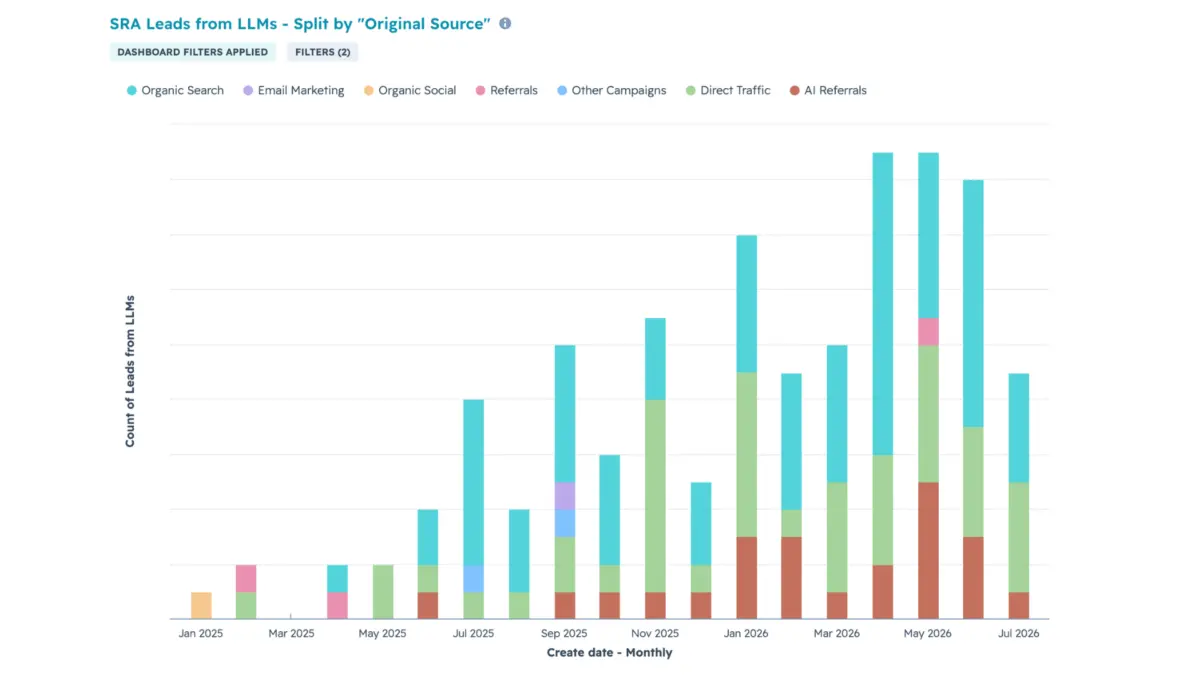
As a result, traditional web analytics and CRM tools like Google Analytics and HubSpot are failing to accurately map user journeys. Between 80% and 90% of inbound leads originating from AI platforms are routinely misclassified as “organic search” or “direct traffic.”
Amid this data blind spot, marketing leaders are increasingly confused by conflicting advice proliferating across social media. Many operators are tracking the wrong prompts, obsessing over vanity metrics like citation shares, or misinterpreting sentiment analyses.
This report provides a definitive framework for cutting through the noise. By shifting away from unreliable clickstream data and vanity metrics, growth leaders can establish actionable key performance indicators (KPIs)—specifically targeting high-value prompts, cross-model AI visibility, and self-reported attribution—to directly tie AI optimization efforts to pipeline and closed revenue.
Detailed Chronology: The Evolution of Search and the Attribution Crisis
To understand how modern marketing measurement broke, it is necessary to examine how search behavior and platform architecture evolved over the past decade and a half.
- 2011 (The First Blindspot): Google’s transition to encrypted search (“Not Provided”) blinded marketers to the exact organic keywords driving traffic, forcing an industry-wide reliance on aggregated data and proxy metrics.
- 2023–2024 (The GenAI Explosion): The public rollout of ChatGPT, Google Search Generative Experience (SGE, later evolving into AI Mode), and Microsoft Copilot transformed search from a list of blue links into conversational, synthesized answers.
- 2025 (The Volatility Crisis): Major LLM providers began frequently altering how they displayed citations. For instance, OpenAI drastically reduced the number of external links cited in ChatGPT search outputs, causing sudden, alarming drops in referral traffic for many web publishers, only to reverse course a month later and increase citations. This proved that LLM referral traffic was entirely too volatile to serve as a reliable KPI.
- 2026 (The Current Paradigm): Enterprise adoption of specialized models like Anthropic’s Claude (skews business/enterprise) versus OpenAI’s ChatGPT (skews consumer) reached maturity. Marketers realized that standard web analytics packages were entirely blind to zero-click buyer journeys, necessitating a fundamental overhaul of attribution modeling.
Supporting Context & Metrics: Unpacking What to Track vs. What to Monitor
Navigating the AI visibility landscape requires distinguishing between true key performance indicators (metrics you can control and tie to revenue) and diagnostic monitoring metrics (indicators influenced by external factors).
+--------------------------------------------------------------------------+
                  THE AI MEASUREMENT FRAMEWORK
+--------------------------------------------------------------------------+
|  TRUE KPIs (Actionable & Revenue-Linked)                                 |
|   ├── Target Prompts (Sourced from Voice-of-Customer research)           |
|   ├── Cross-Model AI Visibility (ChatGPT, Claude, Gemini, AI Mode)       |
|   └── Self-Reported Attribution (Direct buyer feedback on lead forms)    |
+--------------------------------------------------------------------------+
|  MONITORING METRICS (Diagnostic Only - Do Not Use as KPIs)              |
|   ├── Citations (Off-page earned media vs. owned site citations)        |
|   ├── Sentiment (Market perception shaped by overall customer experience)|
|   └── LLM Referral Traffic (Volatile and frequently stripped in GA/CRM)   |
+--------------------------------------------------------------------------+
1. Target Prompts: The First Domino
What you choose to measure directly dictates your marketing behavior. Unfortunately, many teams rely on automated AI visibility tools (such as Profound, Peec, or AirOps) that automatically recommend prompts based on an automated audit of existing website pages.
This approach is fundamentally flawed. These tools assume that the pages currently published on your site are the ones that should be cited. In reality, most companies fail to appear for their desired queries precisely because their content strategy is misaligned with buyer intent. Tracking the wrong prompts creates a domino effect of mismeasurement, rendering subsequent data on citation shares and brand visibility entirely meaningless.
2. Cross-Model AI Visibility
Marketers cannot rely on a single LLM. Different models serve distinct audience demographics and use cases:

- ChatGPT: Skews heavily toward consumer queries and general exploration.
- Claude: Skews toward business and enterprise use. While Claude commands a smaller overall user base than ChatGPT, its users frequently query business-critical use cases during work hours, making its visibility immensely valuable for B2B enterprises.
- Google AI Mode: Deeply integrated into Chrome’s dominant market share, ensuring default visibility for millions of everyday users.
- Perplexity, Gemini, and Copilot: Each platform relies on distinct search partners (e.g., Claude’s use of Brave versus ChatGPT’s use of Bing) and varied source-selection algorithms, including proprietary media partnerships.
Tracking each model separately allows growth teams to identify whether a shift in visibility is isolated to a single platform or represents an industry-wide trend.
3. Self-Reported Attribution: Uncovering the Zero-Click Journey
Because LLMs do not require users to click outbound links, traditional analytics platforms categorize subsequent direct visits or branded Google searches as "Organic" or "Direct" traffic. Internal dashboard data from advanced marketing agencies reveals a staggering statistic: 80% to 90% of inbound leads originating from AI platforms are misattributed as organic or direct traffic.
The most reliable antidote to this blind spot is self-reported attribution. By introducing a simple, open-ended or dropdown field on consultation and lead forms—such as "How did you hear about us?" or "What specific AI prompt or conversation led you here?"—companies capture direct buyer testimony. When integrated into a CRM, this data bridges the gap between AI visibility and closed-won revenue.
Official Perspectives and Industry Insights
Industry leaders emphasize that chasing vanity metrics in the age of AI is a tactical error. Growth directors and CMOs are continually urged to look past simple brand mentions.
Research into LLM citation behaviors demonstrates that off-page sources dominate visibility across every stage of the marketing funnel. Studies examining bottom-funnel and branded queries reveal that:
- 48% of cited sources originate from earned media (PR, reviews, third-party publications).
- 30% come from commercial content hosted on external competitor or aggregator sites.
- Only 22% stem from a brand’s owned website.
Furthermore, industry experts caution that a citation does not equal a recommendation. A model may cite a brand’s website merely as a reference point while actively recommending a competitor in the synthesized text.
Regarding brand sentiment, analysts note that the tone an LLM adopts toward a brand is not a reflection of internal marketing spin; rather, it is an aggregate reflection of overall market perception. Sentiment is driven by real-world product experiences, sales interactions, and customer support quality. Consequently, sentiment should be treated as operational feedback rather than a marketing KPI.
Future Outlook: Focus on What Pays the Bills
In paid marketing, measuring success strictly by impressions is universally discouraged because impressions do not pay the bills; Return on Ad Spend (ROAS) does. The same financial logic must now be applied to AI optimization.
As traditional search engine results pages continue to yield real estate to conversational AI interfaces, growth and marketing teams must abandon the comforting familiarity of clickstream metrics and keyword rankings.
Strategic Recommendations for the Road Ahead:
- Mine the Voice of Customer (VoC): Replace guesswork with real language. Harvest sales call recordings, customer onboarding transcripts, and support chats to identify the exact prompts prospects are feeding into AI models. Review and update these target prompts quarterly.
- Implement Robust Self-Reported Attribution: Add qualitative attribution fields to all primary conversion forms. Empower sales teams to inquire about discovery paths during initial discovery calls.
- Tie AI Visibility to CRM Revenue: Track self-reported AI leads through the full funnel—from initial form submission to marketing-qualified lead (MQL), sales-qualified lead (SQL), pipeline generation, and closed-won revenue.
Ultimately, the future of SEO and AI visibility does not belong to those who hoard the most keyword rankings or passive citations. It belongs to the organizations that successfully map their brand’s presence across diverse conversational platforms and connect that visibility directly to measurable business outcomes.