Executive Overview
Content Management Systems (CMS) have long promised to democratize digital publishing, offering streamlined pathways from content creation to global distribution. Yet, for Search Engine Optimization (SEO) professionals, developers, and digital strategists, working within a CMS often feels like navigating a rigid, artificially constrained framework governed by the unyielding philosophy of "this is how a website should work."
The core issue lies in a fundamental contradiction: SEO has never been a black-and-white discipline. Effective search optimization is highly dynamic, depending heavily on the unique architecture of an individual website, the demands of its specific industry, and the brand identity of the publisher. Structural requirements for indexing, content delivery, and technical infrastructure must remain flexible to accommodate these variables. Instead, many platforms enforce rigid, one-size-fits-all configurations.
Drawing from years of collective experience across in-house SEO roles, agency consultancies, and web development pipelines, a persistent industry-wide frustration emerges. Despite iterative improvements across major software-as-a-service (SaaS) and open-source platforms, numerous CMS solutions still fail to satisfy the baseline technical requirements mandated by modern search engines and AI agents. Consequently, SEO teams find themselves trapped in an endless loop of ticket generation—submitting the exact same foundational requests for fixes, workarounds, and infrastructure updates across platform after platform.
This comprehensive analysis investigates the structural shortcomings of modern content management systems, establishes the non-negotiable baseline requirements every platform must satisfy, explores advanced automation frameworks that transcend traditional limitations, and outlines strategic pathways for overcoming systemic technical debt.
Detailed Chronology: The Evolution and Persistence of CMS Technical Gaps
The tension between content management platforms and search engine optimization is not new; it is a friction point that has evolved alongside the web itself.
The Legacy of Basic Configuration Gaps
Historically, web publishing platforms prioritized visual design and user-friendly text editors over the hidden mechanisms that search engine crawlers rely upon. In the early days of search marketing, basic configurations—such as editing a robots.txt file, generating clean XML sitemaps, or applying canonical tags—required direct file-transfer protocol (FTP) access or custom server scripting.
As search algorithms matured throughout the 2010s, search engine giants like Google, Microsoft, and Yahoo began collaborating to standardize web architecture. Notably, in February 2009, these major search entities jointly announced the introduction of the canonical tag to combat rampant duplicate content issues. Yet, over a decade and a half later, digital practitioners still encounter prominent CMS platforms that lack out-of-the-box canonical configuration, requiring engineering teams to custom-code solutions for a standard introduced fifteen years ago.

The Rise of Bloatware and Plugin Dependencies
As open-source platforms like WordPress gained dominant market share, a secondary industry emerged: the plugin ecosystem. Because core platforms routinely failed to provide out-of-the-box controls for fundamental SEO elements—such as individual page noindex tags, sitemap exclusions, or basic metadata management—publishers were forced to rely on third-party plugins.
While these plugins bridged the gap, they introduced new vulnerabilities: site bloat, security risks, plugin conflicts, and a fragmented technical standard dictated by third-party developers rather than core platform maintainers or foundational web standards.
The Contemporary Era: JavaScript Rendering and AI Crawlers
Today, the technical landscape has grown exponentially more complex. Modern web frameworks heavily rely on client-side JavaScript rendering, creating profound challenges for discovery. While Google queues pages for rendering, AI-driven scrapers and large language model (LLM) crawlers—such as those deployed by OpenAI and Anthropic—frequently fail to execute JavaScript entirely.
Furthermore, the rapid emergence of Model Context Protocols (MCPs), Command Line Interface (CLI) integrations, and automated AI agents means that a CMS can no longer simply be a repository for human-authored text; it must act as a structured, programmatic API capable of communicating seamlessly with autonomous digital systems. Unfortunately, many legacy and modern platforms remain ill-equipped for this paradigm shift.
Supporting Context & Metrics: The Bare Minimum Requirements for Modern SEO
To evaluate whether a content management system is fit for modern search environments, technical auditors divide platform capabilities into two distinct categories: baseline necessities and advanced automations. When well-known platforms routinely omit baseline functionalities, it forces an unsustainable reliance on developer intervention.
The Core Baseline Requirements Checklist
Every CMS that aspires to be fully crawlable, indexable, and accessible by both traditional search bots and emerging AI agents must integrate the following eleven core requirements natively:
| Requirement | Technical Details & Industry Implications |
|---|---|
| 1. Clean Semantic HTML | Search engines and LLM crawlers thrive on well-structured markup that utilizes correct semantic elements (<table>, <ul>, <aside>). Proper semantics simultaneously improve screen-reader accessibility for visually impaired users and allow for cleaner, more maintainable CSS style sheets. |
| 2. Server-Side Rendered Content | Content must be fully rendered in the server response. Because many AI crawlers do not execute JavaScript, content generated dynamically via client-side scripts risks remaining completely invisible to discovery bots. |
| 3. Sitemaps with Deep Controls | XML sitemaps are vital for discovery, but platforms must allow granular administrative control—such as the ability to exclude specific folders, individual pages, or manage localized hreflang sitemaps without systemic roadblocks. |
| 4. Editable Robots.txt | Approximately 15% of web requests for robots.txt fail to return a valid file. Every CMS must provide a natively accessible, easily editable robots.txt interface to grant precise path-level crawler control. |
| 5. Native Canonical Tags | Without out-of-the-box canonicalization defaulted to self-referencing URLs, platforms inevitably breed duplicate content crises that dilute ranking equity across search engines. |
| 6. Advanced Meta Robots Control | Publishers require granular control over indexing directives, including advanced parameters such as nosnippet, indexifembedded, and max-snippet declarations. |
| 7. Built-in Meta Data & OG Tags | Page titles, meta descriptions, and Open Graph (OG) tags for social sharing must be natively editable without requiring auxiliary plugins or developer code insertions. |
| 8. Customizable, Accurate Error Pages | 404, 410, and 5xx error templates must be fully customizable and strictly return their corresponding HTTP status codes. A "Not Found" visual template returning a 200 OK status code routinely causes search engines to index broken error pages. |
| 9. Single Host Enforcement | Automated, native 301 redirection enforcing a single domain variant (HTTPS, strictly enforcing either www or non-www) without generating inefficient redirect chains. |
| 10. Trailing Slash & Capitalization Redirection | Consistent automated redirection forcing lowercase paths and standardized trailing slash rules to prevent bots from wasting crawl budget on non-canonical URL variations. |
| 11. Customizable URL Structure | Absolute freedom in information architecture design, allowing clean, logical directory nesting without forced folder constraints or rigid template-locked URL patterns. |
Official Statements and Industry Insights
Industry veterans and technical analysts frequently emphasize that overcoming technical debt requires a shift from reactive firefighting to proactive architectural automation.
The Hidden Danger of Redirect Chains and Regex Errors
One of the most perilous areas of technical SEO management lies within redirect managers and regular expression (regex) rules. Infrastructure mistakes can have catastrophic consequences for digital visibility. For instance, a single misplaced character—such as an accidental pipe (|) operator within a regex redirect rule—can inadvertently match every single URL on a domain and funnel the entire site’s traffic into a single landing page.
To mitigate these risks, advanced platforms must incorporate automated testing environments within their redirect managers. Testing rules against a randomized sample of existing URLs before deployment is an essential safeguard that prevents site-wide outages.
Flattening Internal Redirect Chains
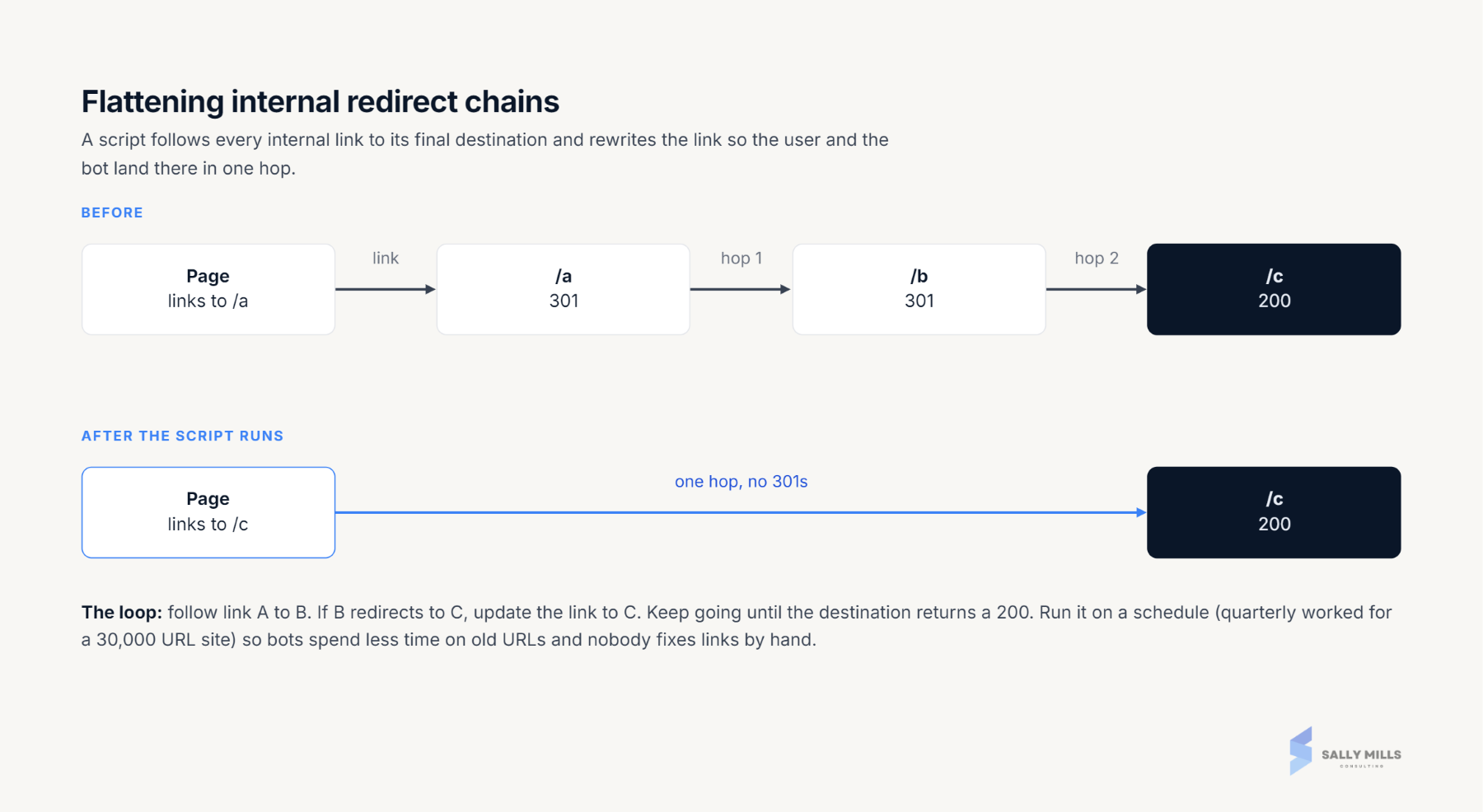
Large-scale enterprise migrations—such as transitioning tens of thousands of URLs from legacy .NET architecture to a modern cloud-based CMS—frequently leave behind a decaying web of internal links. When internal hyperlinks continue pointing to historical URLs that subsequently 301-redirect to new destinations, search engines waste valuable crawl budget navigating unnecessary hops, while users experience sluggish page-load times.
To solve this at scale without exhausting human resources, advanced technical teams deploy automated API-driven scripts (such as Python routines running against the CMS API) that systematically trace internal links to their ultimate destinations and rewrite them directly. Integrating this automation natively into content management platforms represents the next frontier of enterprise SEO efficiency.
Advanced CMS Functionality: Going Above and Beyond
Beyond baseline requirements, elite content management systems incorporate high-level automation that slashes manual workloads, accelerates speed-to-market, and optimizes crawl efficiency.
Automated Jump Links and Tables of Contents
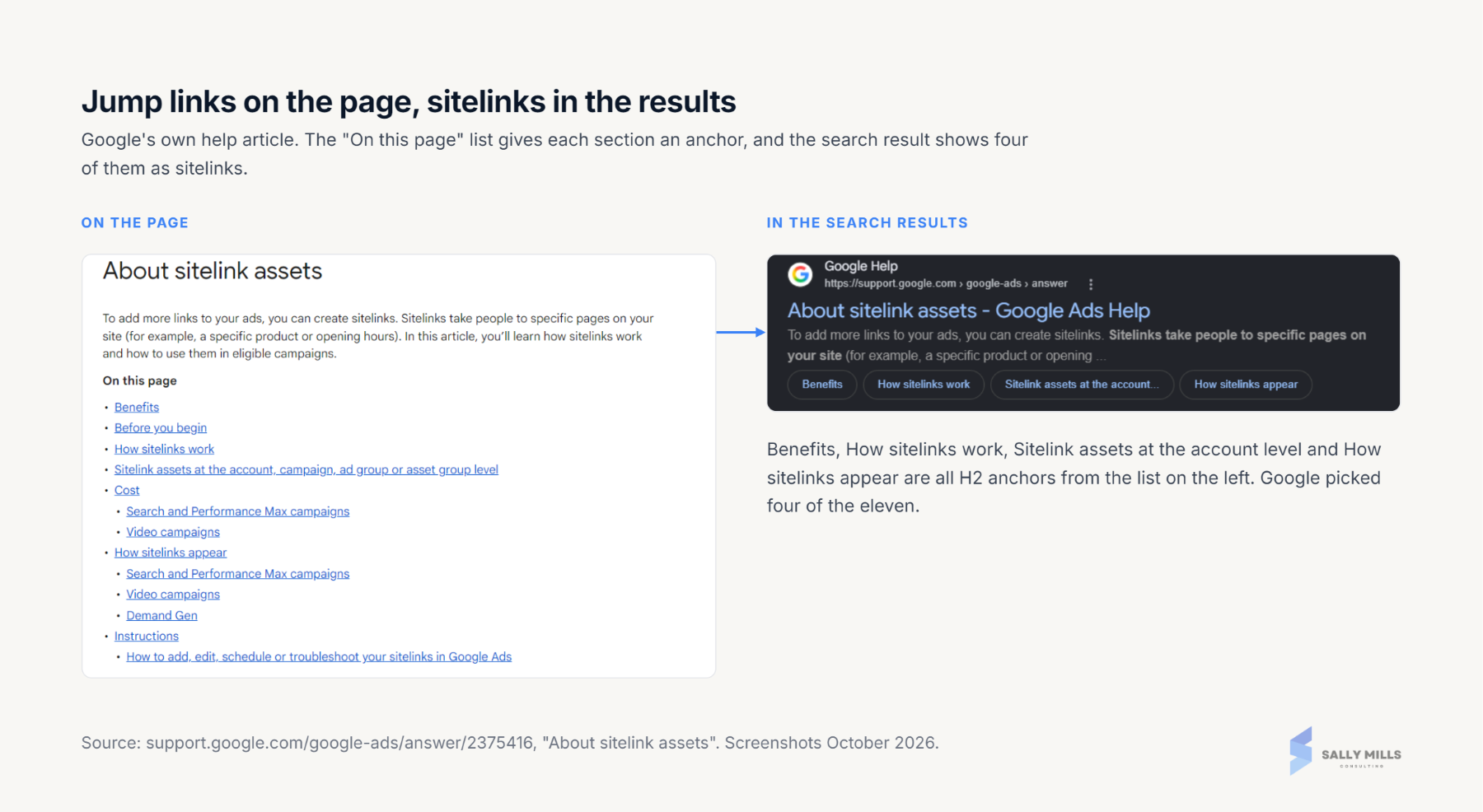
Content readability and user experience are heavily enhanced by clear internal navigation structures, which also serve as eligibility criteria for rich sitelinks within search engine result pages (SERPs). While many platforms relegate table-of-contents generation to manual markdown creation or third-party plugins, an advanced CMS automates this entirely. By dynamically parsing page headings (<h2>, <h3>), the system should generate structured jump links natively, while allowing editors the discretion to include or exclude specific sections.
Intelligent 404, 301, and 410 Status Code Management
Maintenance tasks consume a disproportionate percentage of an SEO professional’s working hours. Modern platforms should alleviate this burden through several automated mechanisms:
- Automated URL Change Redirection: When an editor modifies a page slug, the CMS should automatically generate a 301 redirect from the legacy URL to the new destination while prompting a background script to update internal references.
- Internal Link Auditing Reports: Rather than relying exclusively on external crawler tools, native reporting dashboards should highlight broken internal links and permit bulk-editing workflows.
- Native 410 Support: Providing native administrative options to assign a
410 GoneHTTP status code to retired URLs or entire defunct folders, signaling search engines to de-index the content permanently and rapidly.
Sophisticated Image Optimization Frameworks
Image assets remain one of the most common vectors for site bloat and duplicate URL generation. Out of the box, an enterprise-grade CMS should automate modern image compression, serve next-gen formats (such as WebP and AVIF), embed responsive srcset attributes, and enforce strict canonicalization for media files. Preventing the generation of multiple unique URLs for a single underlying image asset is vital for protecting image search performance.
CLI, API, and MCP Integration for AI Workflows
As artificial intelligence fundamentally reshapes digital operations, the traditional browser-based graphical user interface (GUI) is no longer the sole vector for content management. Platforms that provide robust Command Line Interface (CLI) connections, API endpoints, and Model Context Protocol (MCP) integrations allow technical teams and AI agents (such as Claude Code) to execute content updates, development deployments, and optimization tasks programmatically. This technological evolution transforms the CMS from a static publishing tool into an intelligent, programmable hub.
Future Outlook
As the digital ecosystem continues to fracture across traditional search engines, conversational AI assistants, autonomous agents, and localized market variations, the demands placed on content management systems will only intensify.
The era of relying on bloated plugin ecosystems to patch fundamental technical deficiencies is drawing to a close. Content management systems that refuse to adopt clean semantic HTML, robust server-side rendering, granular sitemap controls, and advanced programmatic APIs will increasingly find themselves abandoned by forward-thinking digital enterprises.
For SEO professionals and developers navigating this landscape, the path forward requires rigorous problem-solving, strategic automation, and close collaboration with engineering stakeholders. By identifying recurring technical bottlenecks and building scalable, automated workflows, organizations can future-proof their digital infrastructure against the ever-evolving demands of the modern web.