Executive Overview
In a decisive move to reclaim control over its consumer ecosystem, electronics giant LG Electronics USA has announced plans to purge its webOS app store of any applications that transform users’ smart televisions into always-on residential proxy nodes. This policy shift arrives in the wake of an alarming industry investigation.
Security researchers discovered that more than 42 percent of applications available on the LG webOS platform—ranging from casual video games to utility screensavers—harbored software development kits (SDKs) capable of quietly routing third-party internet traffic through unsuspecting households.
The inclusion of these Software Development Kits (SDKs) essentially turns everyday home appliances into commercial exit nodes for proxy networks. While app developers utilize these integrations to monetize otherwise free software, security analysts warn that burying consent prompts inside television applications fundamentally undermines digital hygiene. Furthermore, it exposes household networks to unforeseen liabilities.
As regulatory scrutiny intensifies over the unregulated monetization of consumer bandwidth, LG’s crackdown marks a watershed moment for smart-device governance. However, the appliance manufacturer faces broader questions regarding its software distribution practices amidst concurrent controversies surrounding bundled promotional utilities on its high-end displays.
Detailed Chronology: From Discovery to Enforcement
The Spur.us Revelations
The catalyst for LG’s policy reversal began on July 2, when threat-intelligence and security firm Spur published a sweeping empirical analysis examining the prevalence of residential proxy SDKs embedded within smart television applications. Spur’s telemetry and application-auditing tools cast a wide net across dominant living-room ecosystems, capturing a stark picture of how aggressively developers monetize consumer hardware.
According to Spur’s findings, a staggering 42 percent of evaluated applications on LG’s webOS store contained built-in proxy components that could indefinitely conscript a television into a proxy node. Samsung’s competing Tizen operating system fared only marginally better: researchers found residential proxy SDKs bundled inside more than a quarter of its analyzed app catalog.
These toolkits turn televisions—devices historically viewed as isolated, single-purpose media appliances—into active conduits for external data traffic. Once an application containing a proxy SDK is launched and its terms are accepted, the underlying device begins channeling outside web traffic, utilizing the homeowner’s residential IP address to mask commercial web-scraping, ad-verification, and data-harvesting operations.
LG’s Swift Response and Policy Pivot
Confronted with Spur’s findings by independent security journalist Brian Krebs, LG Electronics acted swiftly to distance its hardware platform from the proxyware market. John Taylor, Senior Vice President at LG Electronics USA, issued a definitive corporate stance outlining the company’s remediation strategy.
"A residential proxy network is not an intended use for LG smart TVs, and LG Electronics is working with developers to remove the residential proxy option from their apps on the webOS platform," Taylor stated. "If this option is not removed, these apps will be suspended."
Taylor confirmed that corporate compliance reviews are "well underway now," signaling that application audits have moved past the planning phase into active enforcement. Moving forward, LG intends to fortify its developer onboarding and code-review pipelines. The company aims to intercept malicious or deceptive SDKs before they ever reach the webOS storefront.
Supporting Context & Metrics: The Mechanics of Proxyware Monetization
How Residential Proxies Work
To understand the gravity of the smart TV proxy phenomenon, one must examine the modern digital advertising and data-scraping economy. Residential proxy networks—operated by commercial entities like Bright Data, NetNut (recently targeted by an FBI takedown), and others—sell access to pools of legitimate consumer IP addresses.
Because corporate data centers are routinely blocked, rate-limited, or blacklisted by target websites, commercial web-scraping operations require legitimate residential IPs to mimic authentic human browsing behavior. By routing traffic through ordinary residential routers, clients can bypass anti-bot defenses, harvest pricing data, verify localized advertising campaigns, and execute large-scale web scraping without triggering security blocks.
Traditionally, these networks relied on desktop applications or shady browser extensions to recruit consumer nodes. However, as mobile and smart-device ecosystems expanded, proxy operators pivoted toward SDK monetization programs. They began offering developers lucrative payouts to bundle proxy code into lightweight mobile apps, casual games, and IoT device utilities.

Prevalence Across Ecosystems
Spur’s analysis mapped out the sheer scale of this infiltration, highlighting how ubiquitous proxy SDKs had become across closed living-room platforms:
- LG webOS: Over 42% of evaluated applications contained active residential proxy SDK integrations.
- Samsung Tizen: More than 25% of analyzed apps harbored similar proxyware components.
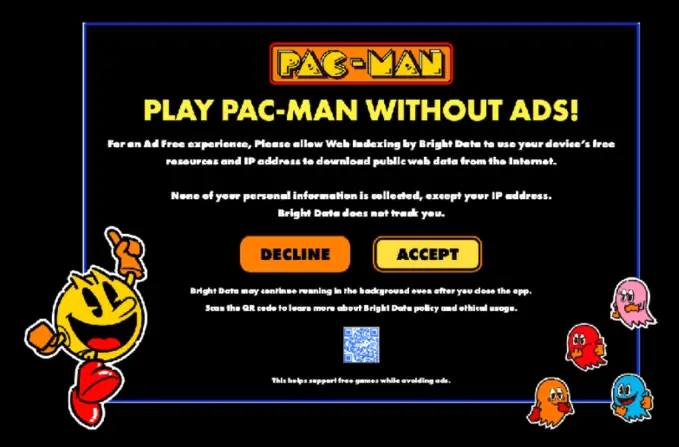
- Application Types: The offending code was not restricted to obscure utilities. It was embedded in recognizable formats, including arcade classics like Pac-Man, custom screensavers, media players, and file-management tools.
In many instances, these apps presented users with a forced-choice dichotomy: either pay a subscription fee, watch a continuous stream of advertisements, or agree to terms that allow the television to act as a shared network proxy node.
Official Statements and Industry Perspectives
Bright Data Defends Its Model
As the dominant proxy network identified in Spur’s research, Bright Data came under intense scrutiny. In an official statement provided to security researchers, the company defended its operational ethics, emphasizing consent, transparency, and regulatory compliance.
"Every peer opts in through a dedicated screen and receives value in return; every customer is vetted, and our practices have now undergone a second independent audit by PwC," Bright Data’s statement read. "We remain committed to an open, transparent internet where legitimate businesses, researchers, and institutions can responsibly access data that lives in the public domain."
Bright Data and its industry peers maintain that they enforce rigorous Know-Your-Customer (KYC) protocols to weed out malicious actors. Furthermore, they assert that technical countermeasures are engineered directly into their SDKs to prevent proxy clients from interacting with or mapping local area networks (LANs) connected to the host device.
The Security Community Pushes Back
Despite assurances from proxy providers, cybersecurity experts argue that the foundational premise of embedding proxy networks in smart TVs is fundamentally flawed. Trevor Sutter of Spur argued that consent models in household environments are functionally broken.
"A one-time consent prompt buried in a TV app is not a substitute for meaningful transparency, ongoing control, and platform oversight," Sutter noted. "The risk is amplified when consent comes from individuals within the household who use the device but shouldn’t give consent, such as minors."
When a child clicks "Agree" on a prompt inside a game of Pac-Man on the living room television, they unknowingly enlist the family’s broadband connection into a global data-routing pool. Parents, completely unaware that their smart TV is channeling commercial traffic, are left exposed to the reputational and legal risks associated with misuse of their residential IP address—ranging from flagged spam accounts to automated abuse complaints directed at their internet service provider.
Future Outlook & Emerging Controversies
While LG’s crackdown on residential proxy SDKs has earned widespread praise from the cybersecurity community, the manufacturer’s broader software ecosystem strategy remains a subject of public scrutiny.
The McAfee Monitor Controversy
Just as LG was garnering positive headlines for cleaning up its webOS marketplace, the company faced a separate software-bundling controversy involving its high-end consumer hardware. Investigations popularized by technology channels like Gamers Nexus revealed that certain premium LG LCD monitors automatically install promotional software utilities via Windows Update—specifically, applications pushing paid McAfee antivirus subscriptions—without requiring explicit user consent or interaction.
This incident underscores a persistent friction point in modern consumer electronics: the tension between user privacy, device autonomy, and aggressive hardware-monetization partnerships. Whether consumers purchase a smart television or a high-end display, they increasingly find themselves wrestling with hidden background processes, pre-installed promotional utilities, and opaque software pipelines designed to extract ongoing value long after the initial hardware purchase.
What Lies Ahead for webOS and Smart TVs?
LG’s pledge to purge proxyware from webOS represents a major step toward restoring consumer trust in smart home environments. However, the true test will lie in enforcement longevity.
As proxy networks evolve their obfuscation techniques to evade static code analysis, smart TV platform operators must maintain rigorous, continuous oversight of their application marketplaces. Consumers, meanwhile, must remain vigilant, treating modern connected appliances not as passive household objects, but as fully functioning network computers capable of complex, hidden data operations.