Sponsored by Writesonic. The opinions expressed in this article are the sponsor’s own.
Executive Overview
As consumers increasingly turn to conversational artificial intelligence to guide their purchasing decisions, the digital retail landscape is undergoing a profound structural shift. When modern shoppers query platforms like ChatGPT or Google for product recommendations, the days of sorting through endless blue links are rapidly vanishing. Instead, they are greeted by dynamic, data-rich product cards complete with real-time pricing, aggregated ratings, and frictionless "buy now" links.
Behind these seamless recommendations lies a complex web of aggregated product data drawn from across the internet. However, a startling number of brands remain entirely in the dark regarding how these algorithmic interfaces position, price, or even display their products.
This oversight represents a critical and potentially devastating vulnerability, particularly as the retail industry enters the high-stakes holiday shopping season. According to a holiday forecast report by Adobe Digital Insights, AI-driven traffic to U.S. retail sites is projected to skyrocket by a staggering 130% this season.
When AI shopping results fail, they typically manifest in one of three detrimental ways: a brand’s product fails to appear entirely, it populates with erroneous specifications or out-of-date pricing, or a third-party competitor or unauthorized reseller manages to capture the final conversion click. Fortunately, these operational errors are rarely random; they trace directly back to foundational product data that merchants can control, audit, and optimize.
This comprehensive guide explores the mechanics of AI shopping results, examines why they frequently go wrong, and outlines a strategic, step-by-step framework for auditing and fortifying your product catalog to secure maximum visibility.
Detailed Chronology: The Evolution of Conversational Commerce
The integration of transactional capabilities into generative AI platforms is not a sudden anomaly; it represents the culmination of years of rapid technological development and platform consolidation. Understanding how we arrived at the current state of agentic commerce requires tracking key milestones across major search and discovery engines.
The Rise of ChatGPT Shopping
The paradigm of AI-driven discovery shifted dramatically in March 2026, when OpenAI significantly expanded its Agentic Commerce Protocol (ACP) to encompass mainstream product discovery. This integration allowed merchants to seamlessly share standardized product feeds directly through the ACP framework, ensuring their catalogs could be dynamically accessed and recommended within ChatGPT conversations.

Major retail conglomerates—including Target, Best Buy, and Wayfair—were quick to adopt the protocol, while millions of independent merchants began feeding their inventories into the ecosystem via platforms like Shopify Catalog.
Concurrently, OpenAI streamlined the user journey by dropping in-chat Instant Checkout in favor of redirecting transactions to merchant-owned sites. While ChatGPT excels at capturing consumer attention at the top and middle of the funnel, retail brands quickly realized a fundamental truth: getting your product recommended inside an AI chat interface is only half the battle; your native product page must still successfully close the sale.
Google AI Overviews, AI Mode, and the Shopping Graph
Concurrently, Google cemented its dominance in the semantic search ecosystem by deploying robust product cards directly inside Google AI Overviews. Powered by the massive Google Shopping Graph—which reportedly indexes over 50 billion active product listings—these Overviews draw from merchant data feeds uploaded via Google Merchant Center.
As Google expanded its conversational capabilities through AI Mode and Gemini, it also introduced agentic checkout mechanisms. In this emerging ecosystem, Google’s autonomous agent finalizes purchases on behalf of the consumer using Google Pay once the user confirms the transaction. To qualify for these high-value placements, merchants are required to maintain an active Merchant Center account and implement the Universal Commerce Protocol (UCP), bridging the gap between open web architecture and closed-loop AI transactions.
| Platform | Where Product Data Comes From | What the Result Looks Like | Where the Click Goes |
|---|---|---|---|
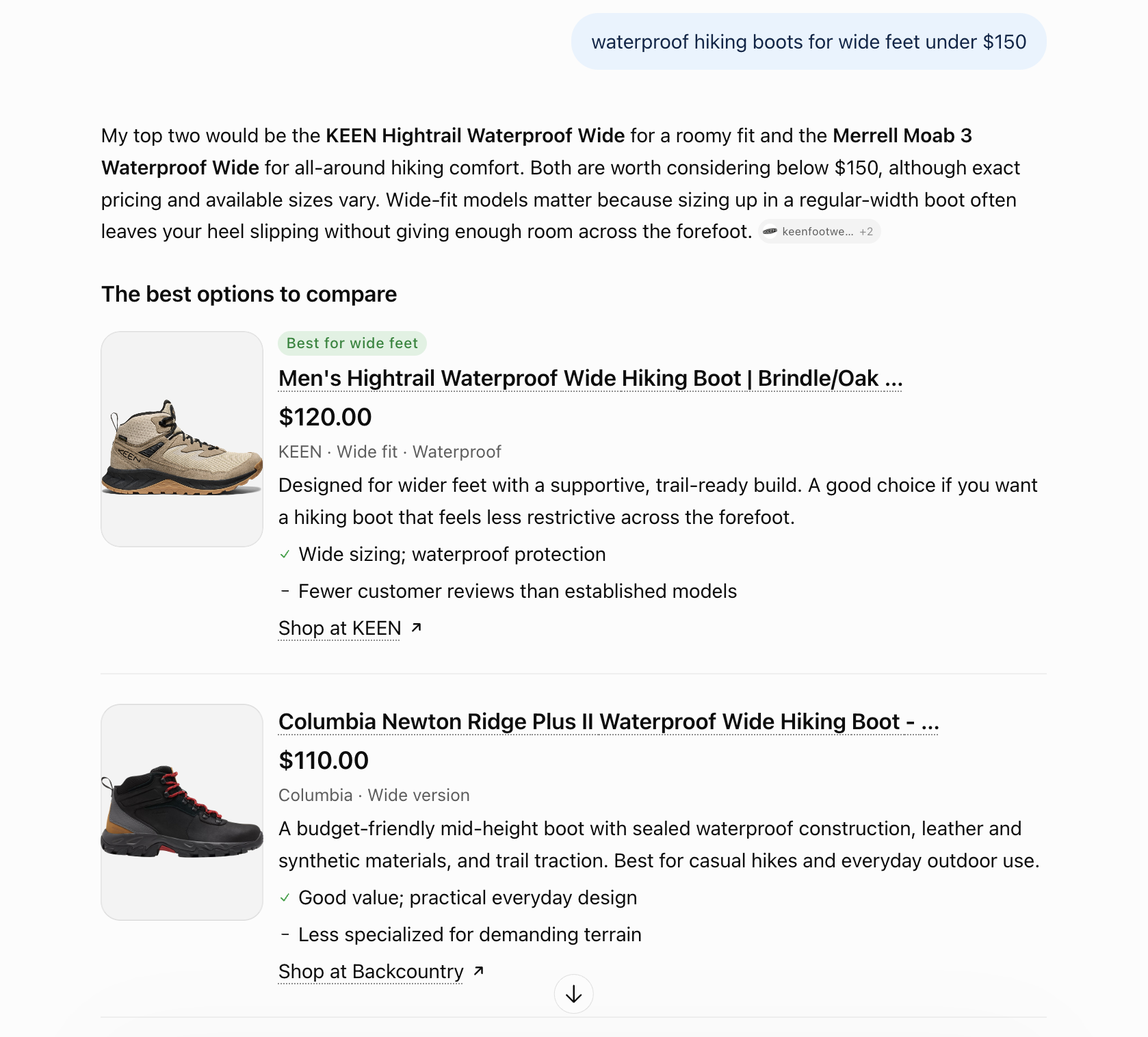
| ChatGPT Shopping | Merchant feeds via ACP, Shopify Catalog, third-party product data providers, and reviews from public websites | Product cards, side-by-side comparisons, and search by uploaded photo | Merchant site, via an in-app browser |
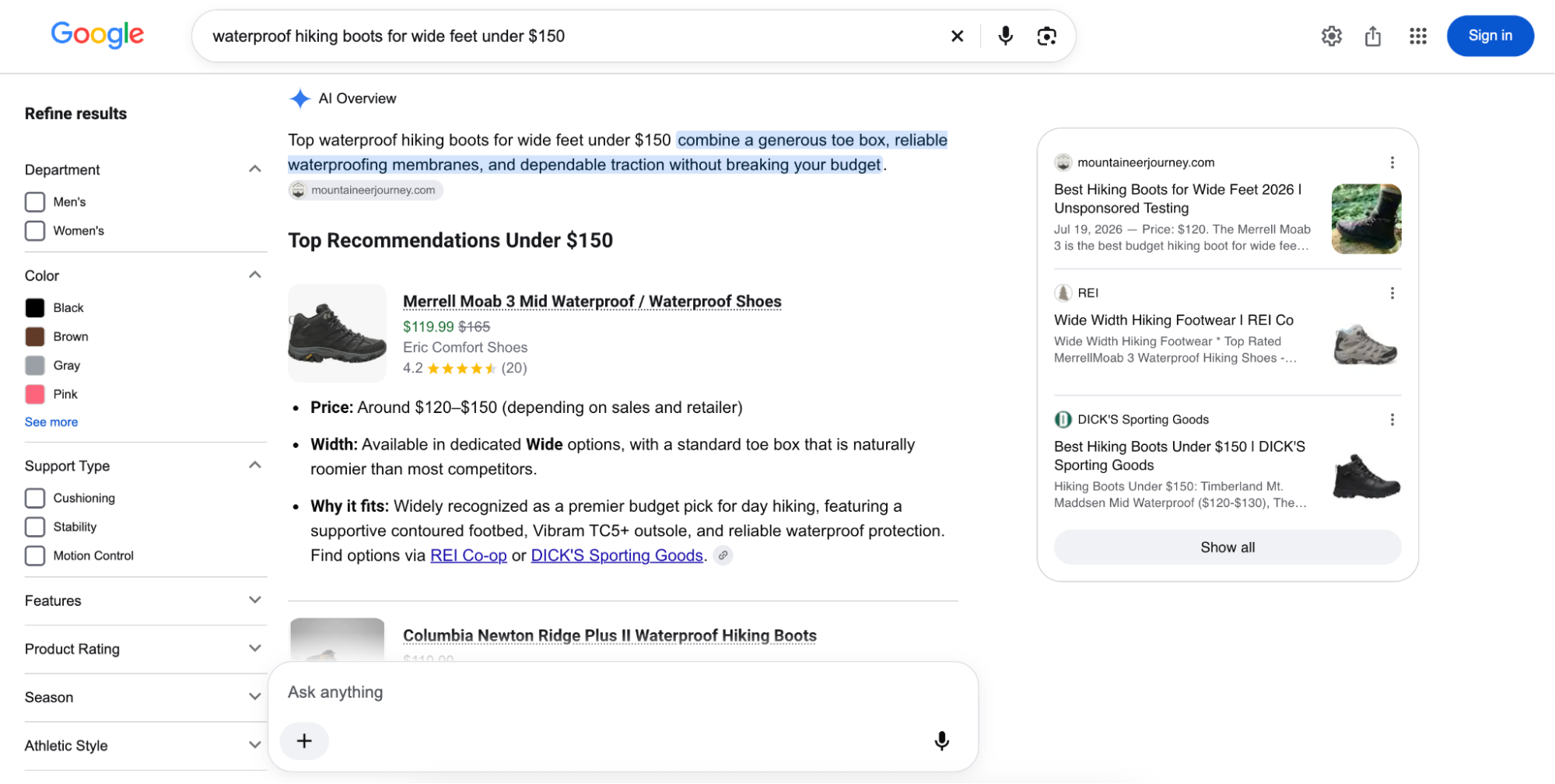
| Google AI Overviews | Shopping Graph and Merchant Center feeds | Product cards with price and ratings, inside regular search results | Merchant site |
Supporting Context & Metrics: Unpacking the Volatility of AI Visibility
As AI models increasingly dictate consumer choices, maintaining consistent visibility has become an exercise in managing extreme volatility. Recent industry data highlights just how precarious unmonitored product feeds can be.
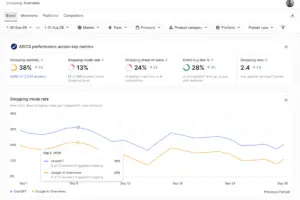
An empirical analysis tracked ChatGPT product recommendations sourced from integrated feeds and revealed massive algorithmic shifts. Over a single 24-hour period in July 2026, the aggregate market share of these feed-based recommendations surged from 8.26% to 61.54%. However, this volatility proved punishing for the broader retail market: out of 517 tracked online stores that experienced visibility swings of 33% or more, a staggering 450 suffered severe drops in placement.
Furthermore, merchant variety within AI responses contracted sharply. The collective market share of product references commanded by the top 10 merchants jumped from 22.5% to 41.8%. Stores operating without a connected, optimized product feed faced immediate marginalization, effectively locking them out of lucrative consumer queries they historically won through traditional SEO.
The Power of Third-Party Validation
Beyond direct product feeds, AI models rely heavily on external consensus to evaluate brand authority and product quality. A comprehensive June 2026 study conducted by Writesonic analyzed over 2,000 brands to determine which digital touchpoints most heavily influence AI citations.
The findings were unequivocal: mentions of a brand or product on external authority platforms like YouTube or YouTube-associated communities, Reddit, and trusted review forums made a brand roughly three times more likely to be surfaced in AI answers. In stark contrast, mentions confined exclusively to a brand’s own website increased their selection probability by a modest 1.3 times.
Ranking Instability Across Platforms
To compound these challenges, AI search results are inherently fluid. Writesonic’s extensive research analyzing 631,999 prompt runs across seven distinct AI platforms revealed that the top-ranked brand in ChatGPT rotated on an astonishing 52% of prompts when the exact same query was re-run sequentially. This high degree of instability underscores why manual, sporadic spot-checks are wholly inadequate for modern e-commerce governance.
Official Industry Analysis: Identifying Common Product Errors
When AI shopping results go awry, the root causes typically fall into three distinct operational categories. Most brands remain completely unaware of these issues until a customer complains or a revenue dip triggers an investigation.
1. Missing Products or Lower Positions
Brands frequently discover that their flagship items are entirely absent from conversational recommendations. Even when products are indexed, they may appear buried at the bottom of a list or omitted entirely in favor of agile competitors who have optimized their structured data and feed taxonomy.
2. Wrong Prices, Variants, or Specs
Discrepancies between what an AI model displays and the reality on your checkout page create immediate friction. An AI card might display an out-of-date promotional price, misidentify product sizing (such as wide-fit versus standard hiking boots), or confuse color variants, leading to high bounce rates and eroded consumer trust.
3. An Unexpected Merchant Gets the Buy Link
Perhaps the most damaging error occurs when a consumer issues a buying prompt for your proprietary brand, but the AI engine directs the final transaction click to an unauthorized reseller, a secondary marketplace (like Amazon or eBay), or a liquidator instead of your direct-to-consumer (DTC) storefront. This happens when third-party listings appear more complete, structured, or authoritative to the algorithm than your primary domain.
Strategic Action Plan: How to Audit and Fix Your Product Data
To prevent generative AI models from misrepresenting your catalog, e-commerce teams must execute a rigorous, four-step auditing and optimization protocol.
Step 1: Build Buying Prompts From Your Catalog
Do not rely on generic brand searches. Instead, map out complex, intent-driven queries that your target audience is likely typing into ChatGPT or Google AI Overviews—for example, "best lightweight camping tent for rainy weather under $300" or "sustainable leather Chelsea boots for narrow ankles." Build a comprehensive matrix of these prompts based on your core product catalog.
Step 2: Record Offers and Merchant Links
Systematically run your prompt matrix across multiple AI platforms. Document every detail: Which products appeared? What price and rating were displayed? Crucially, trace where the "buy now" link directed the user. Did it land on your product page, or did a reseller hijack the conversion?
Step 3: Compare Competitors and Rank Fixes
Analyze your competitors’ placements. Why did their product cards rank higher? Is their product schema cleaner, their pricing more uniform, or do they enjoy broader third-party review coverage? Rank your identified errors by revenue impact, prioritizing best-selling SKUs and critical seasonal categories.
Step 4: Optimize Data Inputs for Consistency
The thread connecting all AI shopping errors is data inconsistency. When your product feed, your native product page, and your various retailer listings disagree on price, inventory levels, or product naming conventions, the AI is forced to guess—and it frequently guesses incorrectly.
Quick Wins to Implement Immediately:
- Align Prices and Stock Across All Touchpoints: Ensure real-time synchronization between your inventory management system, product feeds (Google Merchant Center, Shopify Catalog, ACP), and front-end site pages.
- Clarify Product Identity via Schema and Identifiers: Implement robust, error-free Product schema markup. Populate mandatory Global Trade Item Numbers (GTINs), manufacturer part numbers (MPNs), brand identifiers, and precise variant attributes so AI models never confuse your models, sizes, or colorways.
- Refresh Use Cases and Review Ecosystems: Actively seed authentic reviews across high-authority third-party sites, video platforms, and discussion forums to ensure AI models have ample external validation to draw from when formulating recommendations.
Future Outlook: Scaling Monitoring with Advanced AI Tooling
Manual audits break down almost immediately in fast-moving retail environments. Because AI answers shift continuously and vary by region, platform, and time of day, maintaining visibility requires automated, scalable infrastructure.
Advanced solutions—such as Writesonic’s dedicated AI Shopping Tracker—are stepping in to fill this critical enterprise gap. These platforms automate daily audits across ChatGPT, Google AI Overviews, and emerging conversational search environments. By tracking how often specific catalog prompts successfully trigger shopping cards and monitoring real-time positioning against competitors, brands can transition from reactive firefighting to proactive algorithmic optimization.
As we look toward the future of digital commerce, the division between winners and losers will be stark. Brands that actively audit what AI models say about their products—and ruthlessly clean up the underlying data feeds that power them—will command the digital product cards of tomorrow. Those that rely on outdated SEO tactics and passive hope will find their market share quietly surrendered to automated models making decisions on their behalf.