Executive Overview
The legal battlelines defining the intersection of artificial intelligence, copyright law, and web indexing are shifting once again. On November 2, a high-stakes legal challenge was filed against Brave Software—the company behind the privacy-centric Brave Browser and Brave Search—by The New York Times. The lawsuit accuses Brave of copying more than 30 billion webpages "without identifying itself or providing website owners with any mechanism to block its crawler," and subsequently packaging and selling that proprietary content to commercial artificial intelligence companies.
While end-users might know Brave primarily as an ad-blocking browser or an alternative search engine, its backend infrastructure plays a critical, behind-the-scenes role in the modern AI ecosystem. Through its proprietary search index and commercial API products, Brave acts as a primary data broker, feeding real-time web context to some of the most prominent LLM (Large Language Model) developers in the world, including Cohere, Mistral, Perplexity, and Anthropic.
The core of the controversy touches on a fundamental tension in the digital age: traditional search engines operate on an implicit bargain where indexing is rewarded with referral traffic, whereas AI data syndication often bypasses the click entirely. Compounding the issue for publishers is an architectural hurdle—Brave’s crawler deliberately lacks a distinct user-agent string. This design choice prevents webmasters from blocking Brave via standard robots.txt exclusion protocols without simultaneously shutting out mainstream search visibility. As courts prepare to untangle these unprecedented copyright claims, the outcome of this litigation will set a monumental precedent for how creators control their digital footprints in an AI-driven economy.
Detailed Chronology: Escalating Tensions Between Publishers and Brave
The collision course between media publishers and Brave’s indexing practices has been years in the making, marked by strategic legal maneuvers, shifting industry partnerships, and growing publisher frustration over uncompensated data harvesting.
The Genesis of AI Data Syndication (2023–2025)
Brave’s journey into commercializing its search index began as a scaling solution for its independent search engine. However, as the generative AI boom accelerated, the company realized its vast repository of indexed web data held immense value for AI companies desperate for fresh, structured text.
- Late 2023: Brave publicly outlines how its infrastructure assists AI developers, notably highlighting its utility in training foundational models, such as Anthropic’s Claude 2.
- March 2025: Public scrutiny intensifies when Anthropic updates its list of corporate subprocessors to formally include Brave Search, a development first flagged by TechCrunch. Around the same time, independent AI researcher and developer Simon Willison tests Claude’s real-time retrieval capabilities, noting an exact 1-to-1 match between the search results generated by Claude and those produced natively by Brave Search.
- Mid-2026: Media conglomerates begin pushing back aggressively against unauthorized scraping. News Corp serves Brave with a formal cease-and-desist letter. Rather than capitulating, Brave takes a preemptive legal strike, filing a lawsuit asserting that its indexing activities constitute standard web operations necessary for the basic functioning of any search engine.
- July 2026: News Corp fires back with a countersuit in federal court, alleging that Brave deliberately obfuscates its web crawlers to evade publisher detection, effectively masking its AI-feeding mechanisms behind standard web-browsing utilities.
The November 2026 Legal Explosions
The friction boils over on November 2, 2026, when The New York Times files a comprehensive copyright infringement lawsuit against Brave in federal court. The publication asserts that Brave’s mass replication of copyrighted text—and its subsequent repackaging into ready-to-consume LLM context feeds—violates foundational copyright protections while undermining digital subscription models.
Simultaneously, a coalition of prominent daily newspapers, including the New York Daily News, the Chicago Tribune, and the Orlando Sentinel, launch a coordinated separate lawsuit mirroring many of the same grievances. As of publication, Brave has yet to formally respond in court to these late-year filings, leaving publishers, legal analysts, and webmasters waiting for the company’s official defense.
Supporting Context & Metrics: The Mechanics of Brave Search and LLM Indexing
To understand the gravity of the litigation, one must examine how Brave’s infrastructure operates, how it interacts with the broader web ecosystem, and why traditional publisher defenses have proven ineffective.
Inside the Brave Search API and "LLM Context"
Brave maintains an independent search index that reportedly spans over 30 billion individual webpages, with millions of fresh pages ingested daily. While the consumer-facing search engine presents results in a traditional format—directing users via outbound links—the commercial engine operates under an entirely different paradigm.
Through products like the Brave Search API and specialized data-packaging tiers often referred to in industry documentation as "LLM Context," Brave provides third-party AI developers with structured data packages. According to promotional materials cited in legal filings, these packages deliver "extracted page chunks and source metadata in a shape and length that satisfies the needs of an LLM without need for further scraping."
In practical terms, when an AI assistant requires up-to-date information to answer a user prompt, it bypasses the traditional loop of crawling the web independently. Instead, it queries Brave’s index via API, consumes the pre-digested text fragments, synthesizes a response, and presents it directly to the end-user.
The robots.txt Dilemma: An Unnamed Phantom Crawler
For decades, web publishers have managed web traffic and crawler access using the standard robots.txt protocol. By specifying user-agent names within this file, webmasters can selectively grant or deny access to specific entities—allowing Googlebot in while blocking aggressive scrapers like OpenAI’s GPTBot or ByteDance’s Bytespider.
However, Brave’s architecture disrupts this system entirely. According to Brave’s official documentation and help pages, its crawler "does not advertise a differentiated user agent."
Brave defends this design choice with a pragmatic, albeit controversial, rationale: many major news publishers and enterprise websites maintain strict exclusion lists that block all non-Google crawlers by default. By refusing to adopt a unique, identifiable user-agent string, Brave bypasses these blanket exclusions. Instead, Brave’s crawler adheres to a blanket policy: whatever content Googlebot is permitted to read, Brave reads; whatever Googlebot is blocked from accessing, Brave avoids.
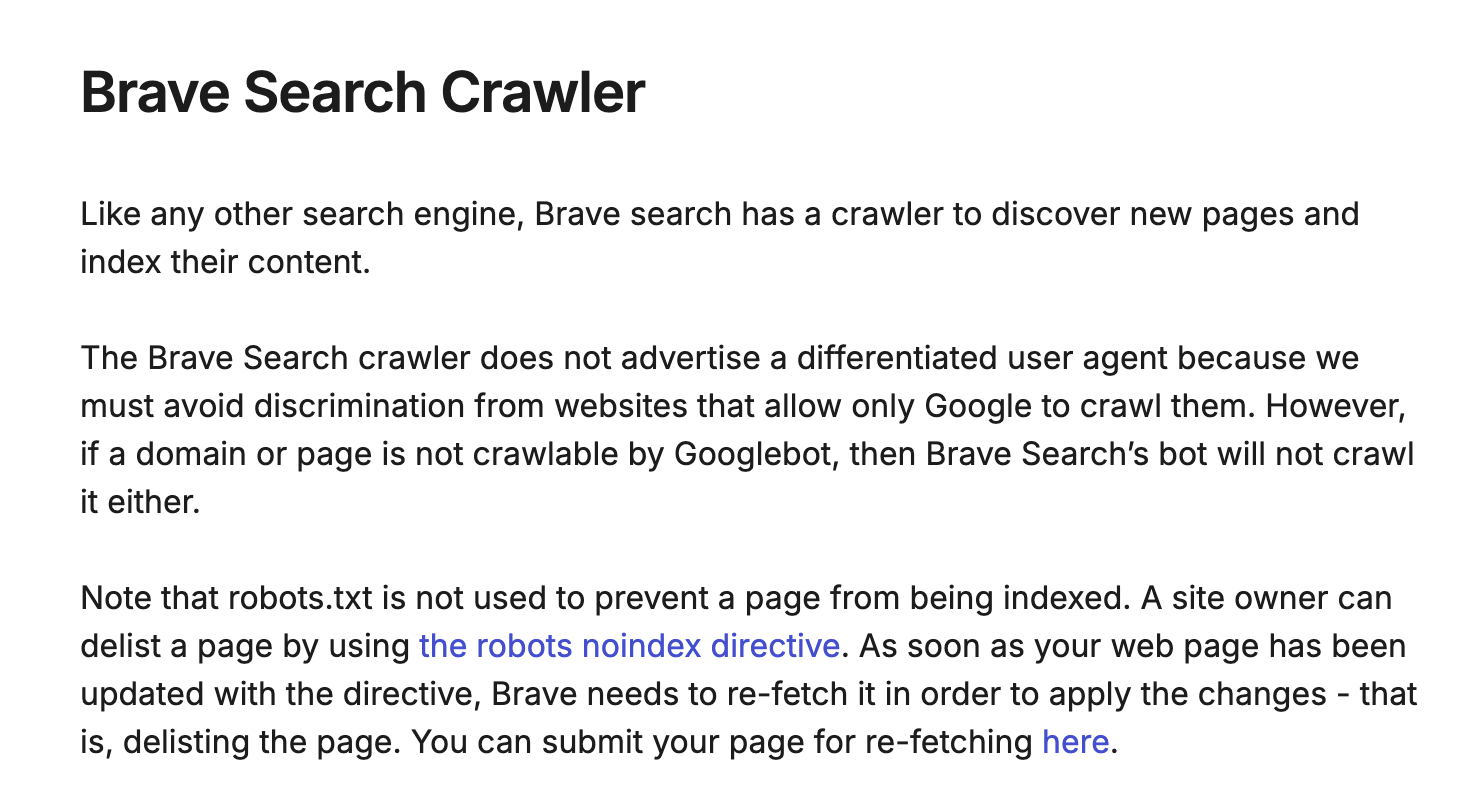
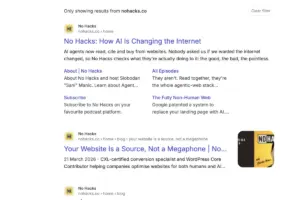
For website owners, this creates an impossible binary choice. As observed across countless independent publisher audits—such as tests run on technical domains where standard robots.txt files successfully exclude thirteen distinct AI bots—it is impossible to craft a rule that lets Google in while keeping Brave out.
Webmasters face an all-or-nothing dilemma:
- Allow Google (and consequently Brave): Your content remains visible in standard search engines but is simultaneously ingested into Brave’s index and syndicated to commercial AI models.
- Block Google (via
noindextags or total exclusion): You remove your pages from Brave’s index, but you simultaneously sacrifice your visibility and traffic on Google, the dominant gateway to the internet.
Official Statements and Industry Reactions
The legal challenges launched against Brave have ignited intense debate across the digital publishing, SEO, and artificial intelligence communities.
The New York Times and Media Coalition Perspective
Major journalistic institutions view Brave’s operational model as an existential threat to the economic foundations of original reporting. In their legal complaints, publishers argue that commercializing scraped text packages directly cannibalizes web traffic. When an AI model answers a complex news query using pre-extracted chunks provided by Brave’s API, the end-user has zero incentive to click through to the original source.
The Times specifically highlights Brave’s "refusal to release the name of its web crawler bot" as evidence of bad faith—an intentional evasion strategy designed to neutralize publisher oversight and render technical self-help mechanisms useless.
Brave’s Stated Defense and Industry Counter-Arguments
While formal court filings responding to the November 2 lawsuits remain pending, Brave has consistently defended its overarching indexing practices in previous legal skirmishes, such as its ongoing feud with News Corp.
Brave’s historical position rests on the assertion that comprehensive web indexing is an absolute prerequisite for the existence of any competitive search engine. Executives have argued that penalizing independent search operators for indexing public web content threatens to cement a permanent search monopoly, insulating legacy giants while crushing alternative competitors striving to break the duopoly of Google and Microsoft Bing.
However, independent technologists and SEO experts point out a critical distinction between operating a consumer search engine and acting as a B2B data wholesaler for generative AI platforms. While traditional search models rely on bidirectional referral traffic—sending users back to the publisher—AI data syndication models often function as terminal endpoints, absorbing publisher intellectual property without returning structural or financial value.
Future Outlook: What the Lawsuit Means for the Future of Web Publishing
As this high-stakes legal battle makes its way through the federal court system, its implications will reverberate far beyond the specific parties named in the complaints.
1. The Redefinition of Fair Use and Data Brokerage
The rulings handed down in the Brave litigation will clarify whether an independent search engine can legally repurpose and monetize its index as raw training and retrieval fuel for third-party artificial intelligence models. While a ruling focused strictly on The New York Times’ copyrighted articles will not automatically apply to every independent website on the internet, the legal principles established will serve as a bellwether for the entire digital publishing ecosystem.
2. The Evolution of Web Standards and Access Controls
If courts rule that crawlers must be clearly identified and easily blockable without collateral damage to standard search visibility, search providers and AI companies may be forced to adopt standardized, transparent user-agent protocols. Conversely, if publishers lose ground, the reliance on cryptographic paywalls, dynamic content gating, and legal licensing cartels will likely accelerate.
3. Actionable Advice for Webmasters and Site Owners
Until legal clarity or technical fixes emerge, website administrators must proactively audit their exposure:
- Perform Index Audits: Regularly check your site’s presence on alternative search engines by executing a
site:yourdomain.comquery on platforms like Brave Search. - Evaluate Traffic Quality: Monitor referral logs for shifts in traffic patterns originating from AI-assisted search interfaces and API-driven retrieval platforms.
- Weigh Visibility vs. Exposure: Understand that under current architectural limitations, maintaining standard search engine visibility via Google requires accepting inclusion in downstream indexing ecosystems that feed the generative AI pipeline.
The outcome of the Brave litigation will ultimately determine whether the open web can sustain itself in an era where automated retrieval agents consume intellectual property faster than publishers can track it. For now, digital creators, legal scholars, and technologists alike will be watching the courtrooms closely as the next chapter of the AI copyright wars unfolds.