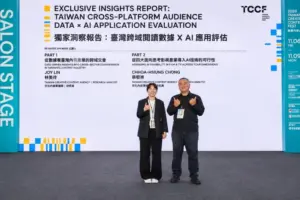
TAIPEI — At the prestigious Taiwan Creative Content Fest (TCCF) on Friday, the Taiwan Creative Content Agency (TAICCA) unveiled a sweeping diagnostic of the island nation’s cultural and creative industries. The spotlight event, titled “Exclusive Insights Report: Taiwan Cross-Platform Audience Data & AI Application Evaluation,” provided industry stakeholders with a dual-lens analysis.
The first part of the presentation mapped out the deeply intertwined media consumption habits of Taiwanese audiences, showcasing fertile ground for multi-format intellectual property (IP) development. The second part delivered a sober, globally contextualized assessment of artificial intelligence (AI) adoption in audiovisual production, balancing the allure of post-production efficiencies against a maze of technological bottlenecks, copyright litigation, international labor agreements, and consumer pushback.
Executive Overview
The findings presented at TCCF underscore a pivotal moment for Taiwan’s creative sector. On the consumer front, engagement with entertainment is virtually ubiquitous. Audiences move fluidly across traditional cinema, linear and streaming television, music streaming, book publishing, and interactive gaming. This high degree of cross-media consumption presents local creators and producers with golden opportunities to transform singular stories into sprawling, multi-platform franchises. Romance, in particular, stands out as a powerful bridge connecting literature, serialized television, comics, pop music, and mobile gaming.
Simultaneously, the industry faces an inevitable reckoning with generative artificial intelligence. While global data highlights that AI can drastically streamline post-production and visual effects workflows, the path to widespread integration is fraught with risk. Technical limitations in maintaining visual continuity, an explosion of global intellectual property litigation, stringent safeguards won by Hollywood labor unions, and a clear consumer aversion to synthetic media all point toward a measured, highly regulated transition. For Taiwan, navigating this technological revolution will require balancing the Ministry of Culture’s emerging guidelines with the practical realities of workflow integration and audience trust.
Detailed Chronology and Session Breakdown
The TCCF research session unfolded in two distinct segments, each led by a specialized TAICCA research analyst offering deep dives into empirical data and global industry trends.
Part I: Mapping the Omnivorous Consumer
The session opened with research analyst Joy Lin presenting the findings of TAICCA’s annual cultural consumption survey alongside a targeted 2026 cross-platform genre study. The annual survey, a robust tracking tool that secures approximately 2,000 valid responses annually, established a baseline of remarkable media saturation.
Lin revealed that in 2025, an overwhelming 96% of surveyed consumers engaged with audiovisual content. Simultaneously, 75% of respondents reported reading published works, and an equal 75% participated in video gaming. Most notably, the data exposed profound synergy between auditory and visual mediums: 90% of respondents reported engaging with both audiovisual content and music, highlighting natural avenues for cross-promotional soundtrack integration and music-video tie-ins.
Drilling deeper into cross-platform habits, a separate survey of 2,018 individuals aged 15 to 69 examined domestic viewing patterns. Among a subset of 1,242 respondents who had watched Taiwanese audiovisual productions over the preceding year, 40% had also explored screen adaptations derived from underlying literary or graphic properties.
When analyzing genre preferences, Lin contrasted local creations with imported content. Taiwanese productions mapped closely onto the fabric of everyday life, emphasizing interpersonal dynamics, family relationships, and romance. Conversely, foreign imports maintained dominance in high-concept genres such as action, fantasy, and suspense.
Romance surfaced as the crown jewel for cross-platform expansion. The research traced direct behavioral pipelines linking romantic storytelling, school-life narratives, comic books, pop music releases, and mobile gaming applications. Demonstrating an outward-looking consumer base, 84% of viewers of Taiwanese romantic dramas also consumed foreign series, 63% watched foreign films, and 58% engaged with foreign animation.
Part II: The AI Frontier in Audiovisual Production
Transitioning from consumer behavior to industrial production, TAICCA research analyst Chhoa Hiok-chong took the stage to evaluate the practical implementation of artificial intelligence in film and television creation. Chhoa’s presentation served as a cautionary roadmap, weighing potential cost-saving measures against severe legal, technical, and psychological barriers.
Citing macro-level global industry estimates rather than localized metrics, Chhoa detailed how AI has deeply penetrated various stages of production. Post-production and visual effects (VFX) boast the highest adoption rates, hovering between 70% and 85%. Pre-production follows closely at 60% to 75% adoption, primarily driven by script analysis, storyboarding, and conceptual design. Conversely, on-set physical production lags behind, with only 15% to 25% utilization.
To illustrate these efficiencies, Chhoa pointed to international case studies, including Netflix’s Argentine science-fiction epic The Eternaut and AI-assisted workflows deployed by South Korean entertainment giant CJ ENM. These examples demonstrated how targeted AI tools can compress timelines and reduce budgetary bloat in complex VFX pipelines.
However, Chhoa cautioned that technological hurdles remain formidable. Creators attempting to integrate generative tools frequently encounter stubborn technical obstacles, including maintaining visual consistency across disparate shots, executing precise camera controls, preserving narrative continuity, and seamlessly embedding AI modules into legacy production pipelines.
Supporting Context and Metrics: Legal, Labor, and Consumer Landscapes
The second half of Chhoa’s presentation broadened the scope to examine the external pressures shaping the AI discourse, drawing heavily on international litigation tracking, labor union negotiations, and consumer sentiment surveys.
The Litigious Landscape and Labor Safeguards
The regulatory and legal vulnerabilities of generative AI were underscored by data from the Database of AI Litigation. By August 2026, the database had cataloged 489 AI-related legal disputes worldwide, with 153 of those cases directly implicating cultural and creative industries—primarily concerning unauthorized data scraping, copyright infringement, and likeness misappropriation.
To protect human creators, major Hollywood labor unions have established strict contractual guardrails. Chhoa highlighted landmark agreements secured by:
- SAG-AFTRA (Screen Actors Guild-American Federation of Television and Radio Artists)
- WGA (Writers Guild of America)
- DGA (Directors Guild of America)
- IATSE (International Alliance of Theatrical Stage Employees)
These unions have successfully negotiated robust protections covering digital replicas, mandatory informed consent, fair compensation structures, and human creative control, establishing a global benchmark for labor rights in the age of automation.
Consumer Resistance and Market Pushback
Beyond legal and technical bottlenecks, the TCCF presentation revealed a profound consumer hesitancy toward AI-generated or AI-assisted entertainment. Far from embracing synthetic innovations, audiences worldwide have exhibited clear signs of resistance.
- United States: A November 2025 entertainment research study by Luminate revealed that 51% of U.S. respondents actively rejected the use of fully synthetic virtual performers in media productions.
- Japan: A consumer survey published in September 2026 by English Hub and the GRAS Group found that 44.7% of respondents reported being less willing to purchase or consume content once they discovered it was generated using artificial intelligence.
- South Korea: Highlighting a demand for transparency, a January 2026 survey by Embrain Trend Monitor indicated that 81.6% of South Korean consumers supported the advance disclosure of AI-generated elements in media, while 80.3% advocated for mandatory labeling of AI-derived content.
Official Statements and Industry Discourse
The session concluded with a dynamic Q&A period that laid bare the anxieties, skepticism, and pragmatic inquiries circulating among Taiwan’s creative community.
The Upfront Cost Paradox
Audience members challenged the prevailing narrative of AI-driven cost savings. Industry professionals questioned whether reported production efficiencies adequately accounted for the heavy upfront costs required to adopt nascent AI workflows. Attendees noted that the iterative cycle of experimentation, endless prompt revisions, and trial-and-error debugging often negates short-term budgetary gains, transforming anticipated savings into unexpected financial drains.
The Quest for Localized Legal Clarity
Another prominent critique raised during the session centered on the presentation’s reliance on international legal case studies. Taiwanese creators pressed for local examples illustrating how copyright disputes, liability issues, and ownership rights are currently playing out under Taiwanese jurisdiction. With the global database heavily skewed toward U.S. and European litigation, local producers voiced an urgent need for legal frameworks tailored to the domestic ecosystem.
Regulatory Guidance and Ministry Stance
Responding directly to queries regarding Taiwan’s regulatory preparedness, Chhoa pointed to proactive measures already underway within the government. He highlighted the Ministry of Culture’s existing guidelines on generative AI in arts and culture, which serve as an evolving foundational framework designed to protect domestic creators, encourage ethical technological adoption, and establish baseline standards for transparency and copyright attribution across the island.
Future Outlook
As the Taiwan Creative Content Fest concluded, the dual revelations presented by TAICCA painted a clear picture of an industry poised for transformation. On one hand, the domestic audience has proven itself to be voracious, highly interconnected, and deeply engaged across multiple media formats. The high overlap between audiovisual viewing, reading, gaming, and music consumption provides local production companies with a clear mandate: break down traditional silo walls and invest heavily in cross-platform IP incubation. By capitalizing on genres like romance—which naturally bridges books, screens, and interactive platforms—Taiwanese studios can build sustainable, multi-revenue franchises that resonate both domestically and internationally.
On the other hand, the integration of artificial intelligence cannot be approached as a silver bullet for production efficiency. As global litigation surges past 150 cases in the creative sector, and as international consumer sentiment demonstrates clear aversion to unlabeled synthetic content, Taiwanese producers must proceed with calculated caution.
The path forward for Taiwan’s entertainment economy relies not on an uncritical embrace of automation, but on a hybrid model. By combining the irreplaceable emotional resonance and cultural specificity of human storytelling with carefully vetted, legally compliant technological tools—all while adhering to the Ministry of Culture’s emerging guidelines—Taiwanese creators can safeguard their intellectual property, maintain consumer trust, and cement their position as a vibrant, forward-thinking hub on the global creative stage.