EXECUTIVE SUMMARY
For generations, the foundational question echoing through the corridors of newsrooms was deceptively simple: What do readers need from this story? Editors debated narrative arcs, ledes, word counts, and visual layouts to capture human attention in an increasingly crowded media ecosystem. Today, however, that existential inquiry has fractured into a dual challenge. Modern publishers must now answer a second, equally critical question: What does an AI agent need from this story?
As artificial intelligence shifts from a novelty tool to the primary intermediary between information and the consumer, the mechanics of content consumption are undergoing a seismic transformation. Autonomous AI agents are no longer just summarizing text; they are actively retrieving, cross-referencing, comparing, and executing real-world tasks on behalf of human users. In doing so, these algorithms evaluate journalism through a fundamentally different lens than human readers. They do not care about catchy rhetorical devices, emotional hooks, or aesthetic layouts. They hunt for structured facts, contextual clarity, verifiable provenance, and machine-readable clarity.
This evolution marks a profound paradigm shift for the media industry. Recent industry data reveals that while direct queries for hard news remain a minor fraction of overall chatbot traffic, journalism plays an indispensable, foundational role in answering complex, multi-layered user prompts. News publishers account for roughly one-third of all citations within AI-generated answers, acting as the raw, trusted intelligence powering the digital assistants of the modern era.
This deep-dive investigation explores the mechanics of AI-driven content discovery, analyzes the quantitative reality of how machines consume journalism, details the strategic insights shared by industry leaders at major global forums, and outlines the urgent structural adjustments newsrooms must make to survive the age of autonomous agents.
1. Executive Overview: The Rise of the Machine Audience
To understand the current crisis and opportunity facing contemporary journalism, one must examine the staggering velocity at which artificial intelligence has saturated daily life. Speaking at the prestigious Digital Media Europe conference, Ezra Eeman, Director of AI in Media at WAN-IFRA (World Association of News Publishers), delivered a stark assessment of the media landscape: AI assistants have ceased to be experimental tools and have instead become deeply ingrained, routine components of the global information diet.
This observation is heavily backed by empirical research. A comprehensive study by Gracenote tracking the rise of Gen Alpha and cross-generational media consumption habits revealed that 66 percent of respondents across all age groups reported a marked increase in their use of AI chatbots over the preceding year. Among younger demographics—specifically adults aged 25 to 34—adoption has reached near-ubiquitous levels, with an astounding 80 percent engaging with AI systems daily or multiple times a week.
The sheer volume of this traffic is staggering. OpenAI’s ChatGPT routinely handles approximately 2.5 billion queries every single day. Meanwhile, industry estimates place Google’s AI Overviews—which dynamically synthesize web content to answer direct search queries—at an eye-watering 8 billion daily responses.
Yet, a paradox lies at the heart of this data: very little of this immense digital traffic is explicitly about breaking news or traditional news consumption. According to usage tracking, fewer than 4 percent of ChatGPT queries focus directly on current events or headline news. Instead, the vast majority of human users turn to AI chatbots for functional utility. They want help planning a daily schedule, comparing consumer products, troubleshooting technical problems, or seeking personalized advice.
Despite this, journalism remains the indispensable bedrock upon which these interactions are built. When an AI chatbot generates a response to a complex prompt, it relies heavily on verified, authoritative reporting to construct its output. Publishers are discovering that their work is no longer merely read by human eyes; it is being ingested, atomized, and synthesized inside larger, task-oriented workflows.
2. Detailed Chronology: From Keyword Search to Autonomous Agent Ecosystems
To grasp how journalism became subservient to machine logic, it is necessary to trace the technological trajectory that brought the publishing industry to this exact juncture.
Phase One: The Human-Centric Search Era (Late 1990s – 2010s)
For two decades, the relationship between newsrooms and technology platforms was governed by search engine optimization (SEO) designed for human search behaviors. Readers typed keywords into search bars, and algorithms ranked web pages based on links, keywords, and metadata. News organizations learned to write headlines optimized for click-through rates, structuring stories to keep human readers on the page as long as possible to maximize programmatic ad impressions.
Phase Two: The Social Media Intermediary (2010s – 2020)
The rise of social media platforms—Facebook, Twitter, and Apple News—further disintermediated publishers. Algorithms dictated visibility based on engagement metrics like shares, likes, and comments. Newsrooms restructured their reporting strategies to capture emotional resonance and virality, tailoring content to fit the frantic, scroll-heavy habits of human social media users.
Phase Three: The Generative AI Disruption (2022 – Present)
The public launch of generative AI models in late 2022 fundamentally broke this traditional dynamic. Instead of presenting human users with a list of blue links to click, AI systems began generating direct, comprehensive answers on the spot. Users no longer needed to visit a news website to find out what happened; the AI digested the reporting, stripped away the publisher’s branding and layout, and served a synthesized summary directly to the user.
Ezra Eeman’s disclosures at Digital Media Europe highlight that we are now entering a sub-phase of this era: the age of the AI Agent. Unlike static chatbots that merely answer prompts, modern AI agents possess the autonomy to take actions, execute multi-step workflows, and negotiate tasks across disparate digital platforms on a human’s behalf.
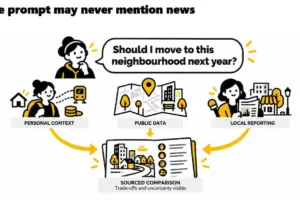
When an AI agent is tasked with planning a relocation, organizing a corporate event, or analyzing local real estate markets, it conducts automated research. It scrapes municipal databases, cross-references local crime statistics, reads restaurant reviews, and—crucially—pulls from recent local journalism to construct a nuanced profile of a neighborhood. The news article is no longer the destination; it is an instrumental data point in an automated machine process.

3. Supporting Context & Metrics: How Machines Consume the News
The invisible hand of the AI agent operating behind the scenes commands unprecedented economic and informational power. To understand the scale of this phenomenon, industry analysts have turned to advanced web traffic data providers, such as Similarweb, to track how search and conversational AI direct traffic and distribute citations.
The Citation Economy
Data from Similarweb reveals a fascinating reality about the modern information ecosystem: traditional news publishers account for roughly one-third of all citations embedded within AI-generated answers. This confirms that artificial intelligence models are fundamentally dependent on professional, verified journalism to maintain accuracy and factual grounding. Without newsrooms conducting investigative reporting, attending municipal council meetings, and verifying breaking facts, AI systems would quickly succumb to systemic hallucinations and stale data.
Furthermore, the temporal analysis of these citations yields vital strategic insights for publishers. The vast majority of material cited by AI systems is less than a year old. AI agents heavily prioritize recency, freshness, and verified currency. An investigative piece published five years ago may still hold archival value for a human researcher browsing a digital archive, but an AI agent tasked with providing up-to-date travel advice, economic indicators, or local developments will systematically favor granular, recent reporting.
The Anatomy of a Machine-Driven Query
Consider a practical, real-world scenario that illustrates how an AI agent interacts with journalism today:
- The Human Prompt: "I am considering relocating my family from London to a suburb in the East Midlands. We need good schools, low commute times to Nottingham, and a vibrant local community. What are my best options?"
- The AI Agent Execution:
- The agent queries transport databases for train timetables and commute durations.
- It accesses government education regulators for school performance ratings.
- It scans local news publications to assess community safety, recent infrastructure developments, local council budget disputes, and neighborhood cultural vibrancy.
- It synthesizes these disparate data streams into a cohesive, personalized relocation brief.
In this interaction, the user never consciously searched for "news." Yet, the final recommendation was heavily informed by local journalism. The news article served an essential need inside a larger, complex task.
4. Official Statements & Industry Insights
The implications of this shift are forcing media executives to rethink digital strategy from the ground up. At the Digital Media Europe conference, industry leaders debated the existential necessity of adapting editorial workflows to accommodate machine readers alongside human audiences.
Ezra Eeman emphasized that newsrooms can no longer afford to treat artificial intelligence as a mere distribution channel or a copyright adversary to be fought in isolation. Instead, publishers must recognize that AI platforms operate under a distinct set of cognitive constraints and informational preferences.
"For years, newsrooms have asked what readers need from a story. Now there is a second question: what does an AI agent need from it?" — Ezra Eeman, Director of AI in Media, WAN-IFRA
Eeman’s core argument points to the structural deficiencies inherent in traditional journalism when processed by automated agents. Narrative journalism—characterized by sweeping metaphors, non-linear storytelling, delayed ledes, and stylistic prose—often confuses or confounds parsing algorithms. While human readers appreciate literary flair, an AI agent trying to extract precise data points regarding a breaking political scandal or a local public health advisory needs clean, structured, and unambiguous context.
Industry analysts at the conference echoed these sentiments, noting that publishers must develop dual-track publishing strategies. Content must continue to engage human emotions and critical faculties while simultaneously satisfying the machine-readable requirements of automated retrieval systems. This does not mean writing bland, robotic text; rather, it means enhancing content architecture so that core facts, quotes, attributions, and data sets are clearly delineated and easily accessible to crawling agents.
5. Future Outlook: Adapting the Newsroom for the Agentic Era
As artificial intelligence continues its relentless integration into consumer technology, the publishing industry stands at a critical crossroads. The emergence of AI agents as primary information gatekeepers demands a comprehensive evolution in how news is gathered, structured, packaged, and monetized.
1. The Imperative of Structural Clarity
Newsrooms must invest heavily in metadata enhancement, semantic tagging, and machine-readable data structures. Story layouts should ensure that foundational facts—who, what, when, where, and why—are clearly articulated at the outset of articles, allowing crawling agents to accurately index and retrieve essential information without misinterpreting nuance or satirical framing.
2. Redefining Value and Attribution
The current economic model, which relies heavily on direct page views and programmatic display advertising, is fundamentally misaligned with an agent-driven ecosystem where users receive answers without visiting publisher websites. The media industry must aggressively negotiate licensing agreements, API access frameworks, and fair attribution models that compensate publishers when their journalism is utilized as core training data or synthesized inside AI-generated responses.
3. Maintaining Human-Centric Depth
While optimizing for machines is essential for visibility, newsrooms must not lose their unique human voice. Investigative depth, moral clarity, empathetic storytelling, and holding power to account are qualities that artificial intelligence cannot replicate. The ultimate paradox of the agentic era is that in order to be successfully discovered and cited by machines, journalism must become more rigorously factual, authoritative, and distinctively human than ever before.
Conclusion
The question facing modern journalism is no longer theoretical. AI agents are actively reading, filtering, and deploying the news every second of the day. By recognizing what machines need from a story—structural clarity, verifiable provenance, and timely facts—while continuing to deliver the emotional and investigative depth that human readers demand, forward-thinking publishers can secure their vital role in the automated information economy of the future.