
Executive Overview
The global transportation and mobility landscape is undergoing a structural transformation, defined by a dual race toward massive economic scale and heightened regulatory oversight. At the epicenter of this shift are autonomous vehicle (AV) pioneers, electric vehicle (EV) fleet operators, and logistics networks striving to find a sustainable path to profitability.
Recent developments highlight how deeply entrenched technological self-reliance has become. Waymo, a dominant force in autonomous ride-hailing, has pulled back the curtain on its hardware strategy, revealing a proprietary 5-nanometer ASIC chip designed to manage the massive data streams of its sixth-generation robotaxis. This vertical integration arrives alongside major commercial expansions across Los Angeles, Phoenix, and San Francisco, as well as sweeping new commercial permits in Nevada.
Yet, this rapid technological acceleration is accompanied by rising geopolitical and regulatory friction. Fresh reporting reveals that government laboratories are evaluating the security vulnerabilities of foreign-made lidar sensors, while massive international markets face safety recalls, structural corporate realignments—such as Uber’s strategic divestment from Serve Robotics—and heavy European data protection penalties.
Concurrently, alternative mobility sectors are surging. From electric cargo startups and heavy-duty electric semi-truck fleet acquisitions to ambitious drone delivery rollouts targeting millions of daily drops by the end of the decade, the modern transportation ecosystem is hurtling toward a hyper-connected, automated future. This report examines the critical milestones, technological breakthroughs, corporate realignments, and regulatory challenges shaping the industry.
Detailed Chronology of Industry Milestones
Hardware Verticalization and Commercial Scaling: Waymo’s Silicon Gamble
For years, public fascination with autonomous ride-hailing has focused primarily on geographic expansion—how quickly a company can drop pins in new metropolitan zones and scale existing fleets. However, long-term economic viability requires addressing the fundamental unit economics of building, operating, and maintaining autonomous hardware.
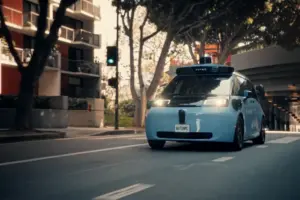
Waymo’s deployment of its sixth-generation self-driving system within its next-generation "Ojai" robotaxis—now open to all riders in Los Angeles, Phoenix, and San Francisco—represents a major milestone in this economic equation. Until recently, the true depth of Waymo’s vertical integration remained opaque. The company revealed that it has developed a custom silicon chip: a 5 nm Application-Specific Integrated Circuit (ASIC) engineered specifically to process the massive influx of raw data generated by its vehicle sensors before that data ever reaches the core decision-making "brain" of the self-driving stack.

With the Ojai vehicle equipped with 13 high-fidelity cameras, the volume of data is staggering. Waymo’s custom ASIC delivers more than 1,000 TOPS (trillions of operations per second) of computing performance. This puts the custom hardware in the same performance tier as industry-standard automotive processors like Nvidia’s DRIVE AGX Thor. According to Waymo, the resulting system achieves unmatched computational efficiency and execution speed—critical factors when navigating high-density, unpredictable urban environments where fractions of a millisecond determine safety outcomes.
While Waymo designed the core custom architecture, the company has emphasized its reliance on an elite manufacturing and semiconductor ecosystem, explicitly partnering with heavyweights such as AMD, Micron, Nvidia, Samsung, Sandisk, Socionext, and TSMC.
Supply Chain Security and Government Probes: The Lidar Investigation
As domestic autonomous technology advances, questions surrounding global supply chains and hardware provenance have drawn heightened scrutiny. Investigative reporting revealed that the Idaho National Laboratory is conducting a formal evaluation to determine whether Chinese-manufactured lidar sensors pose systemic security risks if widely integrated into vehicles deployed on United States roads.
What sets this evaluation apart is its funding source: industry insiders indicate that the research is being financed by one or more private corporations operating within the electric and autonomous vehicle sectors. When reporters queried major industry stakeholders—including Rivian, General Motors, Ford, Kodiak, Lucid Motors, Nuro, and Uber—all representatives stated they were unaware of the specific review, while firms like Aurora, Nvidia, and Zoox declined to comment. This quiet yet potent private backing underscores deep-seated industry anxieties regarding national security policy, intellectual property, and potential future trade restrictions on critical perception hardware.
Venture Capital Shifts and Micromobility Evolution: The Rise of "Also"
Corporate evolution in the mobility sector frequently demands rapid pivots in corporate identity and capital acquisition. This is exemplified by Also, a startup incubated within electric vehicle manufacturer Rivian, which secured $150 million in a Series D funding round led by Prysm Capital, with continued backing from Eclipse, Greenoaks, and MVP Ventures. This latest influx brings Also’s total capital raised to $455 million since spinning out of Rivian in March 2025.
When Also initially emerged, it was categorized as a micromobility venture focused on pedal-assist electric bikes and commercial cargo quads. In a short timeframe, however, the company’s mission has expanded significantly. It now positions itself as a Palo Alto-based technology firm building advanced driven and autonomous small electric vehicles. This strategic shift crystallized earlier in the year when the company closed a $200 million round alongside a multiyear commercial agreement with DoorDash to engineer and deploy autonomous urban delivery vehicles.

Sidewalk Robotics and Ecosystem Diversification: Serve, Grubhub, and Uber
The perils of over-reliance on single-channel distribution partners were underscored by developments surrounding sidewalk delivery robot developer Serve Robotics. During an earnings call earlier in the month, Serve disclosed that Uber had scaled back its utilization of the delivery bots on its platform, with the underlying partnership slated to conclude the following year. Concurrently, Uber executed a complete divestment, selling its entire equity stake in Serve.
Despite this setback, Serve’s broader commercial strategy demonstrates the necessity of aggressive diversification. Insiders confirmed that months prior to the Uber wind-down, Serve finalized several critical partnerships. The robotics firm announced an official integration with Grubhub to deploy sidewalk delivery bots in Chicago, Los Angeles, and Alexandria, Virginia. Simultaneously, Serve expanded its existing relationship with DoorDash, deploying robots to San Jose, California, and Washington, D.C. The episode serves as an instructive case study for hardware-as-a-service startups navigating the volatile waters of platform dependency.
Supporting Context, Metrics, and Market Data
The financial and operational metrics defining the current transportation ecosystem reveal a market characterized by immense capital deployment and aggressive regional scaling:
- Waymo’s Performance Footprint: The custom 5 nm ASIC chip delivers 1,000+ TOPS, matching top-tier automotive silicon like Nvidia’s DRIVE AGX Thor while processing raw inputs from 13 high-fidelity cameras on the Ojai robotaxi platform.
- Also’s Funding Trajectory: Reaching a Series D round little more than a year after its March 2025 spin-off from Rivian, Also secured an additional $150 million, bringing its total venture funding to $455 million.
- Nevada Robotaxi Deployment Scale: Regulatory approvals granted by Nevada authorities to Tesla, Uber, and Waymo in Clark County (Las Vegas) authorize the potential deployment of up to 8,000 commercial robotaxis over the upcoming 12 months.
- Heavy Electric Truck Fleets: Swedish autonomous trucking firm Einride finalized an acquisition agreement to integrate 500 Tesla Semi trucks into its commercial client fleet (including Amazon) over a rolling 24-month schedule.
- Drone Delivery Expansion Goals: Amazon’s Prime Air initiative targets an aggressive footprint expansion, aiming to bring drone delivery services to nearly 500 U.S. cities by the end of 2026—a sixfold increase over its current operational range. Meanwhile, Uber and Zipline have established a joint objective to execute 1 million daily drone deliveries via Uber Eats by the close of 2029.
- Regulatory Penalties: The Dutch Data Protection Authority issued a fine of €825 million (approx. $966 million) against Uber for violating European data privacy frameworks regarding automated driver suspensions.
Official Statements and Industry Perspectives
Corporate leadership across the mobility sector has increasingly emphasized technological self-reliance, regulatory compliance, and international collaboration as central pillars of their growth strategies.
Regarding its hardware verticalization strategy, Waymo representatives noted that the development of custom silicon is foundational to achieving the cost-efficiency required for commercial scale. The company asserted that its custom 5 nm ASIC architecture provides "unmatched efficiency and performance," ensuring that its autonomous vehicles can process hyper-dense environmental data rapidly enough to maintain safety margins in complex urban cores.
The evolving strategic landscape of logistics was further highlighted by technological expansions in the autonomous goods sector. Bedrock Robotics—founded by alumni from Waymo and Segment—commented on the deployment of its self-driving systems in heavy machinery, noting that excavators equipped with its autonomy kit are now operating "fully autonomously at three large customer sites in Nevada and Texas." This shift points toward an industrial automation boom where non-passenger heavy equipment outpaces passenger vehicles in commercial viability.

On the regulatory front, tensions continue to mount over automated accountability. Following a heavy financial penalty levied by European data regulators regarding automated driver deactivations, Uber’s compliance and legal teams face mounting pressure to balance algorithmic operational management with strict transparency mandates. Similarly, Waymo’s engagement with the National Highway Traffic Safety Administration (NHTSA) regarding low-speed pedestrian incidents—marked by heavily redacted public disclosures—highlights the delicate dance between corporate proprietary data protection and public safety oversight.
Future Outlook: The Road Ahead for Autonomous and Electric Mobility
As the mobility sector looks toward the remainder of the decade, several structural vectors will dictate the winners and losers of the transportation revolution:
- The Economics of Silicon Customization: Waymo’s move to proprietary silicon sets a high bar for competitors. Companies relying entirely off-the-shelf merchant silicon may struggle to match the unit economic efficiencies required to turn urban robotaxi services into profitable enterprises. Expect rival AV developers to accelerate custom chip development initiatives.
- Geopolitical Hardware Splits: The Idaho National Laboratory’s probe into Chinese lidar points toward an increasingly balkanized supply chain. If security reviews result in legislative bans or heavy tariffs on foreign perception hardware, domestic AV and EV developers will face supply chain redesigns and potential cost inflation.
- Multimodal Diversification in Logistics: The rapid pivot of companies like Also toward autonomous delivery quads, combined with massive investments in drone delivery networks (Amazon Prime Air and Uber-Zipline’s target of 1 million daily drops by 2029), signals that last-mile logistics will be heavily automated far sooner than passenger transport. Traditional urban delivery models face structural displacement.
- Regulatory Convergence and Oversight: With massive multi-thousand-vehicle commercial robotaxi permits being approved in regions like Las Vegas, municipal authorities are moving from a posture of cautious experimentation to large-scale operational integration. However, concurrent regulatory friction—exemplified by European data fines on Uber, multi-million vehicle safety recalls on hidden door handles in China, and federal crash investigations—ensures that oversight will remain a primary operational bottleneck.
Ultimately, the future of transportation will not be determined by software ambitions alone, but by the complex interplay of proprietary silicon manufacturing, geopolitical supply chain resilience, multimodal logistics integration, and proactive regulatory compliance.