Executive Overview
In the rapidly evolving landscape of digital marketing, the metrics that define success are shifting. For years, the industry has been obsessed with organic search rankings and direct traffic as the primary indicators of a healthy website. However, a quiet revolution is taking place beneath the surface of traditional analytics. As generative AI (GenAI) becomes the new interface for the internet, ChatGPT is emerging not just as a tool for content creation, but as a high-intent, high-engagement traffic source that often outperforms traditional search engines.
While the volume of traffic from AI platforms may currently appear modest in standard Google Analytics 4 (GA4) dashboards, the quality of that traffic is remarkably high. Users arriving via ChatGPT have often already interacted with a sophisticated AI model to refine their intent, meaning they land on your site with a clearer sense of purpose. For businesses ignoring this trend, the risk is not just a loss of data visibility, but a failure to recognize a fundamental shift in how consumers discover solutions. This article examines why ChatGPT traffic is the new gold standard for engagement and provides a tactical framework for tracking, analyzing, and optimizing for this elusive referral source.
Detailed Chronology: The Evolution of Referral Traffic
The journey from traditional search to AI-assisted discovery has been swift. Historically, search engine optimization (SEO) focused on "blue links"—a list of results that forced users to click, browse, and filter information themselves. The "search-click-evaluate" loop was the industry standard.

With the rise of ChatGPT, that paradigm shifted to an "answer-first" model. When a user asks an AI to solve a complex problem—such as "how to repair a leaky faucet" or "best CRM software for small retail businesses"—the AI synthesizes information from across the web and provides a curated recommendation. When that recommendation includes a link to your website, the user is no longer a "browser"; they are a "seeker" who has been pre-vetted by an intelligent system.
In early 2024, savvy digital marketers began noticing anomalies in their analytics: spikes in "Direct" or "Unassigned" traffic that correlated with the increased public adoption of GenAI tools. As the industry moved into 2025, the realization hit that this wasn’t a statistical error; it was a fundamental change in user behavior. The challenge now is that GA4, built for the era of browsers and cookies, is struggling to label these referrals correctly.
Supporting Context & Metrics: Decoding the "Unassigned" Mystery
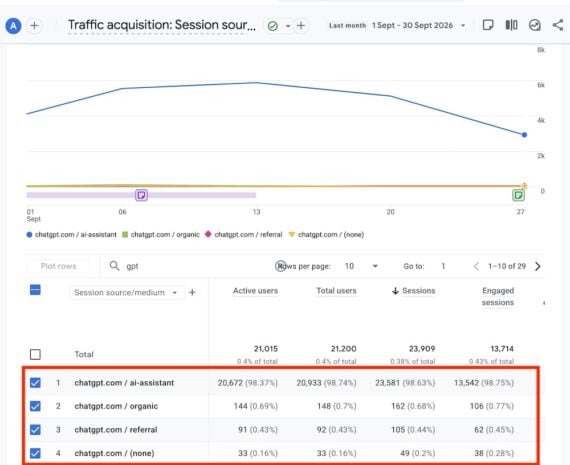
The primary hurdle in analyzing AI-driven traffic is the technical implementation of external links within platforms like ChatGPT. Because many GenAI tools append a noreferrer attribute to links for privacy and security purposes, the referral string is stripped away. Consequently, Google Analytics is unable to identify the origin of the click, dumping this high-quality traffic into the "Unassigned" or "Direct" buckets.
The Anatomy of Engagement
Despite the misclassification, the data that is captured shows a compelling story. Observations from site optimization specialists indicate that engagement metrics—such as average session duration, pages per session, and conversion rates—for traffic identified as coming from AI are consistently superior to those coming from traditional organic search.
Why does this happen? We can attribute this to two primary factors:
- Contextual Alignment: When a user asks a specific question to an AI, they receive a tailored answer. If your content is cited, it is because it directly addresses the user’s specific pain point. There is zero ambiguity in the user’s intent.
- Pre-Education: By the time a user clicks a link from a GenAI chat, they have already received a summarized solution. They aren’t looking to "research"; they are looking to "implement." They arrive on your page ready to act, which drastically reduces bounce rates.
The GA4 Tracking Strategy
To gain clarity, marketers must stop relying on standard overview reports and start building custom segments.
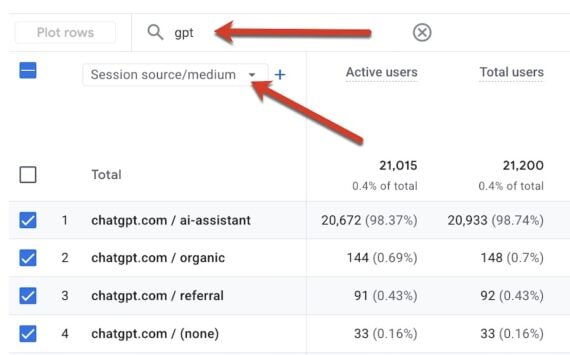
- Accessing Traffic Data: Navigate to Acquisition > Traffic acquisition in GA4.
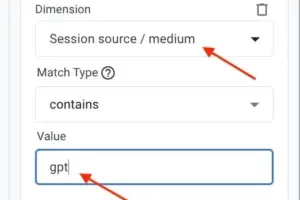
- Filtering for "GPT": Standard reports will often hide the specific referral source. You should build a custom filter that targets traffic sources containing "gpt." This creates a dedicated view that isolates AI-referred traffic from the noise of general web traffic.
- Landing Page Correlation: Once the filter is applied, look at the landing pages that receive the most traffic from these sources. Since ChatGPT does not provide the exact prompt used, you must reverse-engineer the query. If a specific page is consistently receiving traffic from ChatGPT, look at that page’s content. The topic of that page is almost certainly the solution to a prompt that the AI is frequently answering.
Tactical Optimization: Preparing for the AI Era
Understanding where the traffic comes from is only half the battle. The next step is ensuring your content is optimized for "AI-answerability."
The "Prompt-Aware" Audit
Once you have identified the pages that ChatGPT is citing, use the AI against itself. Copy the URL of your high-performing page and feed it into ChatGPT with a query like: "Analyze this content and tell me which specific user problems or questions would trigger an AI to recommend this URL as a solution."
By understanding the "source intent," you can:

- Refine Content: Add specific, concise answers at the top of your pages (the "AI snippet" approach).
- Structural Improvements: Use clear headers and structured data (schema markup) that make it easier for LLMs (Large Language Models) to crawl and categorize your content as an authoritative source.
- Secondary Validation: Use tools like Ahrefs, Semrush, or Google Search Console to monitor the performance of these specific landing pages. Cross-referencing your GA4 "GPT" report with Search Console keyword data will help you see if the same topics driving AI traffic are also ranking well in standard Google search, allowing you to double down on your content strategy.
Future Outlook: The Normalization of AI Discovery
We are currently in the "wild west" phase of AI-driven traffic. As models become more integrated into our operating systems—via Apple Intelligence, Microsoft Copilot, and Google’s Gemini—the distinction between "search" and "AI answer" will continue to blur.
In the near future, we can expect:
- Advanced Attribution: Analytics providers will likely develop specific "GenAI Referral" categories to replace the current "Unassigned" ambiguity.
- The Death of Traditional SEO? Not exactly. SEO will evolve into "AIO" (Artificial Intelligence Optimization). The goal will no longer be to rank #1 on a SERP, but to be the "source of truth" that the AI selects when a user asks a question.
- Economic Impact: As AI platforms begin to offer more sophisticated tracking and potential advertising models, the value of being a cited source will grow exponentially. Brands that can prove their content is the definitive source for AI-led inquiries will capture a higher share of voice and customer trust.
Final Recommendations for Stakeholders
For marketing teams and business owners, the directive is clear: Do not ignore the "Unassigned" traffic.
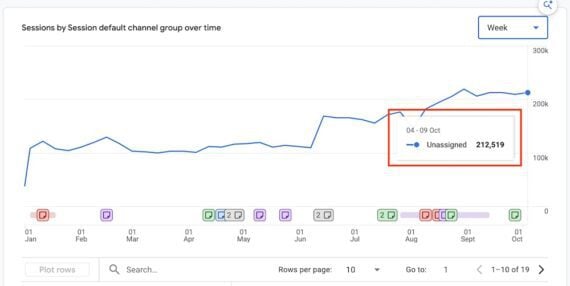
Start today by auditing your GA4 properties. If you see an uptick in unclassified traffic, perform a deep dive into the landing pages receiving those hits. Treat your high-performing pages as "AI-Ready Assets." Ensure they are technically sound, load quickly, and provide direct, actionable answers to the questions your customers are asking.
The internet is no longer just a collection of links; it is a giant knowledge graph that AI models are constantly querying. By positioning your business as an essential node in that graph, you aren’t just surviving the AI transition—you are positioning your brand to lead in the next decade of digital discovery. Monitoring your AI traffic is not merely a technical exercise; it is an essential business strategy for the modern digital age.