Executive Overview
The intersection of artificial intelligence, government regulation, and digital marketing has crossed a critical threshold. With the formal rollout of Regulation (EU) 2024/1689—more commonly known as the European Union AI Act—policymakers have mandated a high degree of transparency for synthetic media and machine-generated text. While framed as a consumer protection measure designed to combat deepfakes and algorithmic misinformation, the regulatory burden has far-reaching operational consequences.
Chief among them is the creation of a technological infrastructure that could allow governments, platforms, and monolithic tech gatekeepers to systematically segregate, filter, and censor text based entirely on its origin rather than its substantive quality.
In direct response to these stringent mandates, industry leaders are moving fast. Anthropic recently announced that all future iterations of its Claude family of large language models (LLMs) will natively embed invisible, machine-detectable watermarks directly into their generated text. Other major foundational model developers are expected to follow suit, signaling a paradigm shift where anonymity for AI-assisted writing will effectively cease to exist within European jurisdictions.
For ecommerce brands, content creators, and digital marketers, this development strikes at the heart of modern operational efficiency. Generative AI has served as an economic equalizer, allowing lean marketing teams to scale content creation, personalize email campaigns, and draft high-converting product descriptions at a fraction of traditional costs.
However, as cryptographic and statistical text watermarking becomes ubiquitous, this newfound efficiency faces an existential threat. If search engines, social media algorithms, and email clients adopt watermarking detection as a proxy for content quality—or a trigger for algorithmic suppression—marketers could find themselves fighting an uphill battle against automated discrimination.
Detailed Chronology: The Road to Mandated Transparency
To understand how the marketing landscape arrived at this crossroads, it is necessary to examine the regulatory and technological timeline that birthed machine-detectable text.
The Rise of Generative Proliferation (2022–2023)
When consumer-facing generative AI tools like OpenAI’s ChatGPT and Anthropic’s Claude burst onto the global stage in late 2022 and early 2023, they triggered a content explosion. Businesses of all sizes rushed to integrate LLMs into their workflows. Blog posts, product pages, social media captions, and customer service sequences could suddenly be generated in seconds.
Initially, attempts to identify AI-generated text relied on crude heuristics. Amateur sleuths and early detection tools looked for stylistic tells—such as an overreliance on em dashes, specific colons, or repetitive transitional phrases like "delve into" and "testament to." However, these stylistic markers proved fundamentally flawed. Punctuation marks like the em dash have centuries of human provenance, and as LLMs grew more sophisticated by design, their prose became increasingly indistinguishable from human writing.
Legislative Intervention: The E.U. AI Act (2024)
Recognizing that intuitive human detection was failing, regulators turned to hard mandates. The E.U. AI Act (Regulation (EU) 2024/1689), officially adopted in 2024, set strict compliance frameworks for artificial intelligence. Among its various provisions targeting high-risk systems, the regulation explicitly requires providers of artificial intelligence systems to ensure that synthetic audio, image, video, and text content is marked in a machine-readable format and detectable as artificially generated or manipulated.
The goal was noble: transparency. Yet, critics warned that building a universal machine-readable identification system for text would inadvertently lay the groundwork for automated surveillance and institutionalized content gatekeeping.
The Technical Solution: Google’s SynthID-Text (Late 2024–2026)
Meeting the E.U.’s mandate required more than flagging metadata; it required altering the text itself in a way that remains resilient even after copying, pasting, or minor editing. Traditional metadata can be easily stripped, forcing developers to look deeper into the generation mechanism.
Enter SynthID-Text, a breakthrough text-watermarking approach originally developed by Google DeepMind. Instead of appending a visible tag or an easily erasable file header, SynthID embeds a cryptographic, statistical watermark during the exact moment the AI model generates text token by token.

Anthropic’s Integration Announcement (2026)
Cementing this shift from theory to practice, Anthropic announced that future versions of its Claude models will incorporate native SynthID-Text capabilities. This move transforms watermarking from an experimental academic concept into an industrial standard. With one of the world’s leading AI labs baking watermarks directly into its infrastructure, the commercial use of unmarked AI text is rapidly drawing to a close.
Supporting Context & Metrics: How Statistical Watermarking Works
To grasp the implications of text watermarking, one must understand how large language models write and how systems like SynthID manipulate that process without degrading the quality of the output.
The Mechanics of the "Next Token"
In natural language processing, a token is a bite-sized piece of data—ranging from parts of words and punctuation marks to whole words and numbers. When an LLM is prompted to write a blog post or an email marketing message, it does not write sentences all at once. Instead, it predicts the text one token at a time using statistical probability.
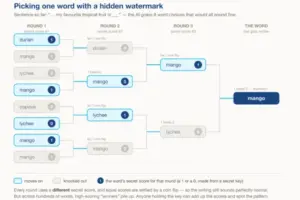
For example, imagine an AI model generates the partial sentence: "My favorite tropical fruit is…"
The model evaluates a universe of potential subsequent tokens (words like mango, papaya, durian, banana, or lychee). Based on its training data, it assigns a mathematical probability to each candidate word. Normally, the model might randomly select one of these top candidates based on its weighted score.
Running the "Tournament"
SynthID-Text alters this selection process by introducing a mathematically guided "tournament" for every single token generated:
- Candidate Pool Generation: The model compiles a list of acceptable next tokens for a given prompt position.
- Secret Scoring: Using a cryptographic pseudo-random number generator tied to a secret key, the system assigns hidden scores to the candidates.
- The Bracket Matchup: The candidates are filtered through a simulated tournament bracket where their natural probability scores and secret cryptographic scores interact.
- The Winning Token: A single token (e.g., mango) emerges victorious and is written to the output.
- Dynamic Variation: Because the context changes continuously, the watermarked words are never consistent. "Mango" might win in one sentence and lose in another, preventing static patterns that humans or simple scripts could easily spot.
[Candidate Pool] ---> [Secret Cryptographic Scoring] ---> [Tournament Bracket] ---> [Winning Token Output]Cumulative Evidence and Detection
One watermarked token proves nothing; any individual word could easily appear by chance in human writing. However, over the course of a multi-paragraph article containing hundreds of token generation cycles, the watermarked text accumulates a statistically improbable concentration of seed-influenced choices.
A detector algorithm equipped with the secret key can reverse-engineer this process. By splitting a passage into its underlying tokens and evaluating the cryptographic signatures, the detector can determine whether the token choices correlate strongly enough with the watermark to cross a predefined detection threshold.
Longer passages provide robust statistical evidence. Conversely, highly factual or constrained writing—where the model has very few acceptable alternative tokens—yields less watermarking evidence, making detection slightly more challenging in strict technical or mathematical contexts. Nonetheless, any text crossing the threshold is flagged as definitively AI-generated or AI-aided.
Official Statements and Industry Perspectives
The rollout of mandatory text watermarking has triggered intense debate across legal, technological, and commercial spheres. Stakeholders are deeply divided over the balance between accountability and overreach.
Regulatory and Open-Source Advocates
Proponents of the E.U. AI Act maintain that transparency is non-negotiable in an era of hyper-realistic synthetic media. Regulators argue that consumers have a fundamental right to know whether the information, news, or commercial pitches they consume are authored by a human being or synthesized by a machine.
Furthermore, legal scholars point out that watermarking provides a vital forensic tool for tracking the provenance of misinformation campaigns, fraudulent product reviews, and automated spam at scale.

Big Tech and Infrastructure Providers
Foundational model developers have largely cooperated with the push for watermarking, framing it as a responsible innovation step. Google DeepMind researchers behind SynthID emphasize that the technique is computationally lightweight, requiring no external database lookups and adding negligible latency during text generation.
Anthropic’s decision to integrate Claude into this ecosystem reflects a broader industry consensus: compliance with international regulations, particularly in lucrative European markets, takes precedence over absolute user anonymity.
The Digital Marketing Community
Conversely, industry associations and marketing professionals have voiced profound anxiety regarding the secondary effects of universal watermarking.
"Watermarking text is not a neutral act of transparency; it creates a persistent digital tattoo," notes a leading digital marketing technologist. "Once an algorithm can instantly tag content as machine-assisted, that tag becomes an immediate vector for discrimination, filtering, and automated censorship."
Marketers argue that the technology treats AI as a binary ethical issue rather than a collaborative productivity tool. Because modern content creation frequently involves human editing, prompt engineering, and iterative refinement, branding all output with an unyielding AI watermark ignores the substantial human creative effort invested in the final product.
Future Outlook: The Implications for Ecommerce and Digital Marketing
As machine-detectable watermarks become standard across all major LLMs, the downstream impacts on digital marketing will reshape SEO, content distribution, and customer communication channels.
1. The Risk of Algorithmic Segregation and Censorship
The most alarming prospect for marketers is how downstream platforms will utilize watermark detection data. If an email client, social network, or search engine can instantly identify watermarked text, nothing prevents them from building automated bias into their distribution algorithms.
- Search Engines: Google and other search providers could use watermark detection as a negative ranking signal, quietly discounting AI-aided web pages or burying them beneath human-authored content in search engine results pages (SERPs). While search engines currently claim to care about quality rather than origin, watermarks provide an easy, cheap heuristic to automate mass demotions.
- Social Media Platforms: Platforms are already experimenting with algorithmic suppression. Pinterest, for instance, has actively moved to reduce the visibility of purely synthetic content. If social feeds use watermark detectors to filter out AI-generated ad copy and organic posts, brands relying on generative scaling will see their organic reach collapse.
- Email Service Providers (ESPs): Major inbox providers could route watermarked marketing copy straight to spam or a dedicated "Likely AI" folder, completely undermining email marketing open rates and ROI.
2. The Threat of False Positives
Statistical detection is never 100% foolproof. If detection thresholds are set too aggressively to catch every instance of synthetic text, innocent human writers who naturally happen to align with algorithmic token patterns could be caught in the dragnet. This creates a dangerous environment where human creators are forced to deliberately alter their writing styles to avoid being falsely flagged as machines.
3. The Commoditization and Evolution of "Human-in-the-Loop" Workflows
To survive the age of watermarking, digital marketers must evolve their workflows. Simply prompting an LLM and publishing the raw output will no longer be viable.
Instead, marketing teams will have to adopt deep human-in-the-loop strategies:
- Using AI strictly for ideation, outlining, and raw data synthesis, while writing final prose entirely from scratch.
- Relying on heavy editorial rewriting and structural restructuring to disrupt the statistical token patterns required by watermarking detectors.
- Investing heavily in first-party data, proprietary brand voice modeling, and un-watermarked local open-source models (though regulatory pressure on open-source weights remains a looming battleground).
Conclusion
The E.U. AI Act and the implementation of technologies like SynthID-Text represent a watershed moment for the digital economy. While designed to foster transparency and protect consumers from deceptive automation, the resulting infrastructure opens a Pandora’s box of algorithmic control.
For ecommerce brands and digital marketers, the message is clear: the era of frictionless, anonymous AI content generation is drawing to a close. As the invisible fingerprints of artificial intelligence become standard across the web, marketers must adapt their strategies, prioritize genuine human editorial oversight, and prepare to defend their content in an increasingly guarded digital ecosystem.