Executive Overview: A Digital Anomaly
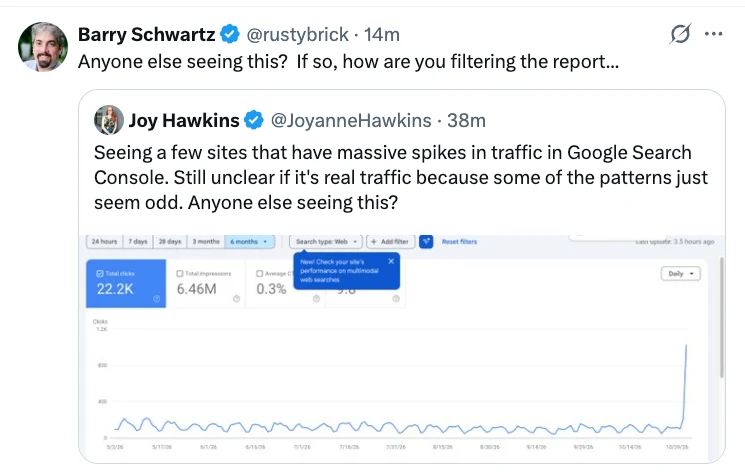
Earlier this week, the SEO community was set abuzz by a series of concerning reports surfacing on X (formerly Twitter) and the Search Engine Roundtable. The catalyst was a post by industry veteran Barry Schwartz, who highlighted a discovery by Joy Hawkins: several websites were experiencing sudden, inexplicable vertical spikes in Google Search Console (GSC) clicks.
While the click volume surged, the corresponding impression counts remained suspiciously flat, creating a statistical profile that defied standard organic traffic patterns. As SEOs scrambled to diagnose whether this was a reporting bug, a new Google algorithm update, or a sophisticated form of bot activity, the data suggested something far more targeted.
By leveraging "Marie’s Brain"—a proprietary agentic SEO and AI search analysis system—this investigation was able to scan multiple site properties simultaneously, cutting through the noise of manual reporting to identify the underlying cause of this anomaly. What we found was not a shift in organic search ranking, but rather a coordinated, automated event that underscores the evolving landscape of synthetic traffic in the age of AI.
Detailed Chronology: Tracking the November Surge
The phenomenon did not occur in a vacuum. While some SEO professionals noted early signs of instability beginning over the weekend of October 31 to November 1, 2026, the primary event occurred on Monday, November 2, 2026.
The Onset
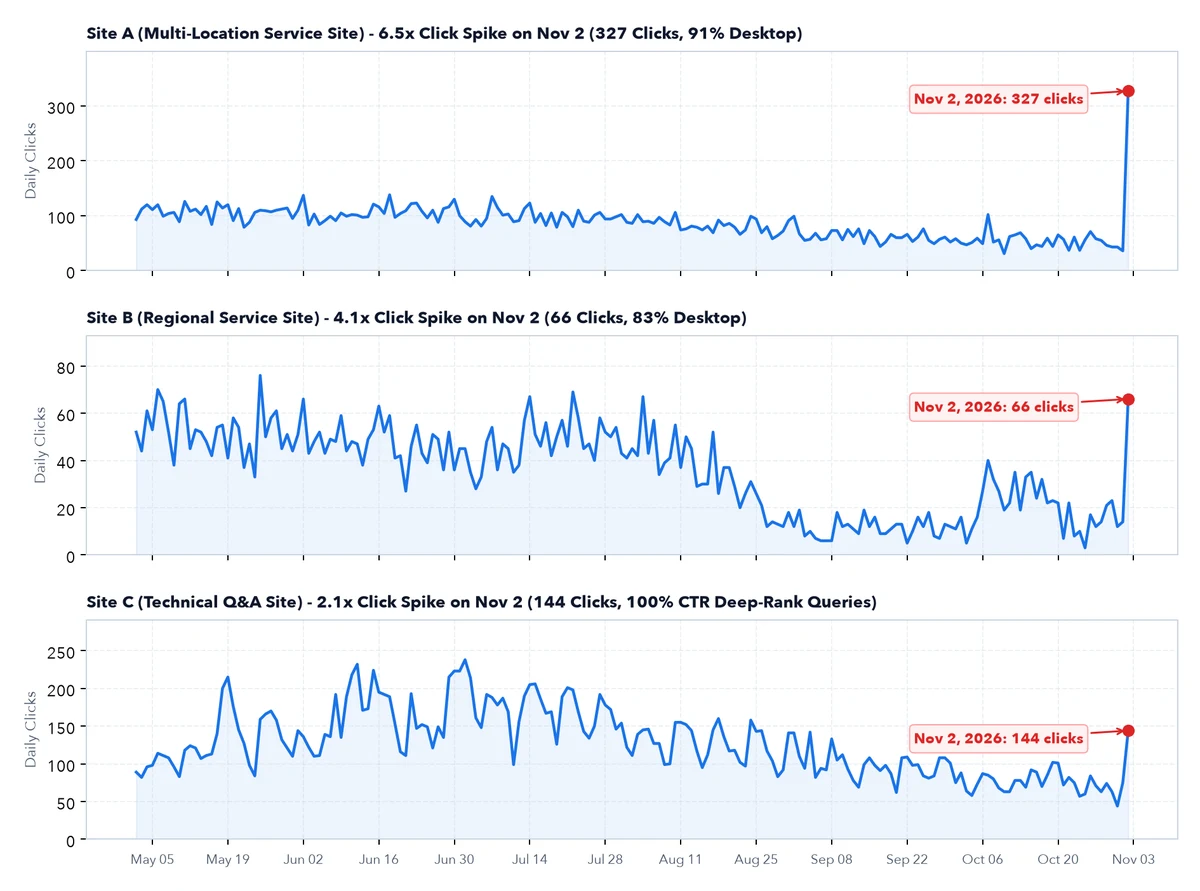
The anomaly appeared as a sharp, vertical line on daily GSC performance charts. Unlike typical traffic spikes—which often correlate with trending content, holiday shopping, or viral social media mentions—this spike was surgically precise. It appeared on specific pages, often buried on pages two through six of the search results, and displayed CTR (click-through rate) metrics that are mathematically impossible for human-driven traffic.
The Scale of Impact
In monitoring various properties, the divergence in performance was stark. While the vast majority of sites maintained their standard, rhythmic traffic patterns, a distinct subset of sites—ranging from multi-location service businesses to technical Q&A forums—reported surges ranging from 2x to over 6x their typical baseline.

For many site owners, the immediate fear was a "negative SEO" attack or a potential penalty. However, the lack of corresponding impression growth suggested that the traffic was not originating from users actively browsing, but from a system interacting with the search results in a way that Google’s logging mechanisms recorded as a legitimate click.
Supporting Context & Metrics: Decoding the Bot Behavior
To understand why this spike appeared, one must look at the granular dimensions provided by the Search Console API. My analysis identified two primary indicators that categorize this as "synthetic" activity rather than organic growth.
1. The Paradox of Flat Impressions and High CTR
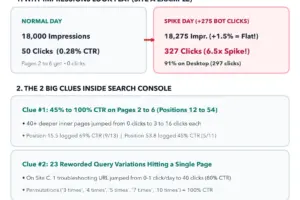
In a standard search environment, organic clicks are heavily concentrated in the top five results of page one. On November 2, however, the affected sites saw an explosion of activity on positions 11 through 55.
The reason impressions remained flat is a matter of scale. For a site receiving 18,000 daily impressions, the addition of a few hundred automated clicks is statistically negligible in the impression column. However, when applied to a baseline of 50 clicks, that same volume translates into a massive, eye-catching spike. The high CTR on these results—often approaching 45% to 100%—is a smoking gun. Human users rarely click on the 45th result of a search query, let alone with such consistency.
2. Synthetic Query Fan-Out Clusters
Perhaps the most telling piece of evidence came from a technical troubleshooting site. In this instance, a single long-tail page saw a dramatic jump in traffic from Canada, while its U.S. traffic remained dormant. The system identified 23 variations of the same search query, all involving systematic permutations of numbers (e.g., "3 times," "4 times," "5 times").
Each variation recorded a 100% CTR. This suggests an automated script or a "fan-out" bot was cycling through every possible phrasing of a query to see if it could trigger a specific result. The bot was essentially "training" or testing the SERP environment, clicking on every link it deemed relevant to its specific query set.
Technical Analysis: The Four Likely Culprits
When evaluating why Google Search Console would record these as clicks, we must consider how a bot interacts with the Google search infrastructure.
- Automated Rank Trackers: Some modern, high-intensity rank trackers that utilize browser-based rendering may be accidentally triggering click-tracking links while attempting to verify ranking position.
- LLM-Powered Research Agents: As more AI agents gain the ability to "browse" the web, they may be programmed to click through results to "read" the content to satisfy a user’s prompt. If these agents are not properly identified as crawlers, their activity is counted as human traffic.
- Synthetic Training Data Generation: Large Language Models require vast amounts of reinforcement learning data. Some organizations may be running automated scripts to gather data on how specific queries perform in various regions, using click-through data as a metric for "quality."
- Botnet Testing: Less benignly, this could be a stress test by bad actors to see if they can manipulate CTR signals in a way that influences Google’s ranking algorithms. By inflating CTR for specific pages, they may be attempting to "trick" the algorithm into rewarding those pages with higher rankings.
Official Statements and Community Consensus
As of this writing, Google has not released an official statement regarding this specific spike. Historically, Google’s search team tends to treat these anomalies as "transient data noise" unless they indicate a systemic vulnerability.
Prominent figures like Glenn Gabe and Joy Hawkins have weighed in, noting that while the spikes are anomalous, they do not appear to be tied to a core algorithm update. The consensus among the SEO community is one of cautious observation. There is no evidence that these spikes result in long-term ranking gains or penalties; rather, they are seen as "noise" in the data stream that must be filtered out for accurate reporting.
Future Outlook: Navigating the Synthetic Era
The November 2026 spike serves as a harbinger for the future of SEO. As the web becomes increasingly populated by AI agents and automated research tools, the definition of "traffic" is changing.
How to Protect Your Data Integrity
For agencies and site owners, the immediate priority is data hygiene. Relying on raw GSC data without applying filters or context is no longer sufficient.
- Annotate: Always document these events in your GSC reporting.
- Segment: Use device filtering (Mobile vs. Desktop) to check if the spike is isolated to a specific environment, as many bot scripts struggle to mimic mobile browser behavior perfectly.
- API Utilization: If you have access to technical resources, utilize the GSC API to programmatically isolate traffic with 100% CTR or traffic from specific, high-velocity query clusters.
The Rise of Agentic SEO
The use of systems like "Marie’s Brain" demonstrates that the next generation of SEO will be defensive and analytical. We are moving toward a period where human analysts must act as "data curators," separating authentic human engagement from the vast sea of machine-to-machine traffic.
Should You Worry?
The short answer is: No. This traffic is not human, it does not convert, and it does not represent a shift in your site’s actual authority or relevance. The most dangerous action an SEO can take in response to this is to over-correct. Do not attempt to "optimize" for these bots, as their behavior is erratic and driven by external scripts that have nothing to do with your content’s actual value.
As we look toward the end of 2026, it is clear that Google Search Console will continue to evolve, and so will the bots that interact with it. By staying informed, utilizing advanced data filtering, and keeping a cool head, we can ensure that our strategies remain grounded in what truly matters: providing genuine value to human users.
Disclaimer: This analysis was conducted using automated research systems and validated by human expertise. For further updates on this developing situation, continue to monitor official Google Search Central updates and industry analysis from trusted SEO researchers.