Executive Overview
In a decisive escalation against the financial infrastructure underwriting modern transnational cybercrime and the Russian wartime economy, the United Kingdom has levied sweeping economic sanctions against Cryptomus. Known colloquially as a "chameleonic" cryptocurrency platform, Cryptomus has operated under a succession of corporate pseudonyms—including Certa Payments and Xeltox Enterprises—while serving as an indispensable conduit for ransomware syndicates, darknet narcotics vendors, high-yield fraud networks, and illicit cybercrime services.
Announced on October 8, the U.K. Foreign, Commonwealth & Development Office’s restrictive measures freeze all domestic assets tied to Cryptomus, prohibit British entities and citizens from engaging in commercial operations with the platform, and effectively outlaw its virtual infrastructure within U.K. jurisdictions. Alongside Cryptomus, the U.K. government targeted several associated virtual payment ecosystems, including VexPay, TokenSpot, and the Tsunami Payments service.
While Canada previously issued a historic CAD $176 million administrative penalty against Cryptomus for egregious anti-money laundering (AML) violations, blockchain investigators and intelligence analysts note that monetary fines alone rarely halt agile digital asset processors. The implementation of sovereign economic sanctions, however, represents a fatal blow, cutting off access to institutional banking rails and enforcing legal compliance across traditional and decentralized financial borders.
This investigative report explores the operational evolution of Cryptomus and its parallel avatar, Heleket, detailing its multi-billion-dollar transaction history, its ties to phantom regulatory authorities in disputed geopolitical zones, and the collaborative blockchain analytics that finally unmasked its systemic threat to global financial security.
Detailed Chronology: From Certa Payments to Heleket
1. Inception and Early Growth (2022)
Emerging onto the digital asset landscape in 2022, Cryptomus initially positioned itself as an ordinary digital currency gateway, offering merchant processing services for online businesses. Operating quietly behind corporate entities such as Certa Payments and Xeltox Enterprises, the platform established a modest footprint before rapidly pivoting to capture a specialized, high-risk market segment: Russian cryptocurrency exchanges and underground websites hawking illicit cybercrime services.
During its formative months, Cryptomus registered an address in Vancouver, British Columbia—a shared, unstaffed commercial location housing dozens of other foreign currency dealers and money transfer businesses, none of which maintained a genuine physical presence at the site. This jurisdictional arbitrage allowed the platform to scale operations rapidly while remaining shielded from rigorous local regulatory oversight.
2. The Canadian Regulatory Hammer and the Birth of Heleket (2025)
As investigative journalists and blockchain intelligence firms began mapping the vast volume of illicit transactions passing through its ledgers, Canadian regulators took notice. Following comprehensive audits and investigations into systemic anti-money laundering failures, Canada levied a record-breaking CAD $176 million fine against Cryptomus.
Rather than complying with regulatory mandates or absorbing the penalty, the platform executed a classic evasion strategy. While formally appealing the fine, Cryptomus management launched a parallel service dubbed Heleket. Designed specifically to circumvent newly instituted "Know Your Customer" (KYC) requirements that had momentarily dampened transaction volumes on the legacy platform, Heleket continued to process enormous volumes of illicit funds with zero identity verification requirements. Telegram support channels for Heleket routinely denied any institutional affiliation with Cryptomus, despite overwhelming technical evidence linking the two brands to identical backend wallet infrastructures and administrative personnel.
3. The U.K. Sanctions Action (October 2026)
By late 2025 and into 2026, the illicit throughput of Cryptomus and its derivatives had attracted the sustained attention of international intelligence agencies. On October 8, the United Kingdom formally designated Cryptomus under its Russia-related sanctions regime, citing its critical role in helping Russian state entities and financial institutions circumvent international trade restrictions and Western economic embargoes.
Moments after the U.K. sanctions notice was published, users and automated monitoring systems observed sudden systemic disruptions across the platform’s digital touchpoints. Telegram support bots for both Cryptomus and Heleket began issuing automated error messages indicating an abrupt inability to process transactions, signaling the immediate freezing effect of the enforcement action on the platform’s operational liquidity.

Supporting Context & Metrics: The Scale of Illicit Throughput
The sheer volume of capital moving through the Cryptomus ecosystem dwarfs that of traditional cryptocurrency mixing services. According to empirical data compiled by leading blockchain analytics firms Chainalysis and TRM Labs, the platform functioned as a multi-billion-dollar juggernaut for global criminality.
Tracing the Billions
In an April 2026 forensic assessment, TRM Labs revealed that Cryptomus had processed more than $7 billion in cumulative transactions since its founding in 2022. While a portion of this volume originated from legitimate merchant checkout services, a disproportionate percentage was directly tied to high-severity criminal enterprises, including:
- Child Sexual Abuse Material (CSAM): Vendors utilizing digital asset rails to monetize illicit content distribution networks.
- Terrorist Financing: Cross-border micro-transactions routed through untracked wallets to support designated extremist cells.
- Human Trafficking Operations: Financial settlements clearing through pseudonymous multi-sig wallets.
- Ransomware Extortion: Major ransomware cartels laundering extortion payouts through automated exchange channels.
Chainalysis Metrics and the "Five Eyes" Milestone
Chainalysis underscored the systemic nature of the threat in an October 8 analytical post, noting that Cryptomus and Heleket routinely outpaced traditional crypto mixers in processing illicit funds. At its peak in late 2025, the platform interacted with more than 900 distinct illicit counterparties in a single month.
Crucially, blockchain investigator Richard Sanders—who spent months mapping out the infrastructure of Cryptomus—highlighted the unprecedented geopolitical significance of the U.K. action. The sanctions mark the first known instance of a "Five Eyes" intelligence-sharing nation (Australia, Canada, New Zealand, the United Kingdom, and the United States) directly sanctioning a cryptocurrency operation whose foundational corporate entities were incorporated within another Five Eyes jurisdiction.
As Sanders noted on professional networks:
"A fine doesn’t stop a cryptocurrency payment processor from processing payments. Sanctions kill the operation. The distinction matters."
Official Statements and Forensic Insights
The dismantling of Cryptomus’s operational facade was made possible through the collaborative efforts of independent blockchain investigators, forensic software developers, and public-sector sanctions compliance officers.
The Inadequacy of Monetary Fines
Financial penalties, such as the CAD $176 million assessment levied by Canada, often serve merely as a cost of doing business for transnational illicit networks if the underlying corporate shell companies remain operational. Without asset freezes and prohibitions on banking access, operators can simply absorb regulatory fines, rebrand under a new moniker (such as transitioning from Cryptomus to Heleket), and continue servicing high-risk Russian clientele. The U.K. Foreign Office’s decision to deploy economic sanctions effectively criminalized any interaction with the platform’s digital touchpoints, severing its access to global liquidity pools.
Telegram Denial Tactics
Despite transparent architectural linkages, customer service representatives staffing the Heleket support channels continued to issue public denials. Screen captures documented by Richard Sanders show support agents explicitly claiming zero institutional affiliation with Cryptomus, a defense undermined by shared API endpoints, identical customer management backend scripts, and overlapping blockchain deposit addresses.
The Phantom Regulator: Tracing Cryptomus to Western Sahara
Perhaps the most surreal aspect of the Cryptomus investigation involves the provenance of its operational authority. Where do shadowy digital asset processors operating out of Western corporate registries derive their legal standing to provide international financial services?

According to forensic investigations detailed in late 2024, the corporate lineage of Cryptomus leads directly to a web of fake financial institutions overseen by a phony regulatory body positioned within a disputed geopolitical territory.
The Ukrainian Connection and Certa Payments
Public registry filings indicate that the sole shareholder of Certa Payments—the original corporate parent of Cryptomus—was a 25-year-old Ukrainian national. Alongside her role in managing the payment processor, this individual held directorships across multiple shell companies, most notably the WS Management and Advisory Corporation.
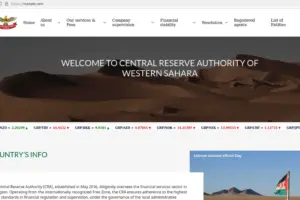
The Central Reserve Authority of Western Sahara
WS Management and Advisory Corporation markets itself as an exclusive, authoritative regulatory body responsible for issuing licenses to cryptocurrency exchanges, foreign exchange brokers, and online gaming operators. The catch? The jurisdiction it claims to represent is the Western Sahara, a disputed region in northwest Africa not widely recognized as a sovereign nation by the United Nations or the international community.
Through its primary web portal (crasadr.com), the so-called Central Reserve Authority of Western Sahara purported to assist applicants with corporate formation, bank account setup, and regulatory licensing for high-risk financial services. Forensic analysis by investigative journalists revealed that one of Certa Payments’ former domains (certa.website) shared a web hosting server with 12 distinct domains, including rasd-state.ws, the official digital portal for this phantom central reserve authority.
This ingenious structural design allowed Cryptomus to present prospective merchant partners with an aura of official regulatory compliance, utilizing a fictional government agency operating out of a contested desert territory to issue self-authenticated financial licenses.
Future Outlook: The Death Knell for Shell-Company Crypto?
The coordinated pressure applied by Canadian financial penalties and ultimate U.K. economic sanctions signals a profound shift in how Western governments intend to combat illicit cryptocurrency platforms that shield Russian financial evasion.
For years, rogue payment processors have exploited the seams between international jurisdictions, establishing shell corporations in allied nations while operating with virtual impunity. By piercing the veil of phantom regulators like the Central Reserve Authority of Western Sahara and imposing hard-hitting asset freezes on platforms like Cryptomus and Heleket, international regulators are establishing a new baseline for digital asset enforcement.
As blockchain analytics firms continue to de-anonymize complex laundering chains and investigative analysts expose the shell companies underpinning underground payment rails, the era of the "chameleonic" crypto platform is drawing to a close. Future illicit actors attempting to replicate the Cryptomus model will find that while rebranding is easy, surviving the combined wrath of sovereign sanctions is mathematically impossible.