The knowledge-commerce industry is undergoing a structural paradigm shift. For over a decade, subject-matter experts, consultants, and educators have relied on digital courses and static information products to scale their revenue. However, the rise of generative artificial intelligence has rapidly commoditized explicit knowledge. When end users can prompt models like ChatGPT or Claude for immediate answers, the value proposition of passive educational content diminishes significantly.
At the same time, traditional digital learning models suffer from severe engagement friction. Recent operational benchmarks, including a 2025 study by learning management platform Thinkific, reveal that completion rates for traditional online courses hover at a modest 10% to 20%. Buyers frequently stall when transitioning from conceptual understanding to practical execution—a phenomenon known as the "implementation gap."
To bridge this divide, a new model has emerged: expert-backed AI tools. Spearheaded by strategy practitioners such as Kelly Sinclair, this approach shifts the value proposition from education (teaching clients how to think) to implementation (providing software that executes using the expert’s proven frameworks).
Early deployments indicate that augmenting expert-led programs with dedicated suites of specialized AI assistants—termed "bot squads"—dramatically elevates course completion rates to between 70% and 80%. By embedding proprietary methodologies, decision-making matrices, and historical datasets directly into accessible AI architectures, experts are converting one-time course sales into scalable, subscription-based product ecosystems.
Detailed Chronology: The Process of Productizing Expertise
Transforming domain knowledge into commercial-grade AI tools requires a structured execution strategy. Rather than deploying generic chatbots, successful practitioners follow a rigorous diagnostic and architectural framework to turn tacit expertise into functional software.
The initial phase involves analyzing existing client workflows to pinpoint high-friction touchpoints where human support traditionally bottlenecks. Experts evaluate four primary operational markers:
Repetition Identifiers: Tracking inquiries that clients repeatedly submit across coaching calls, support desks, or onboarding stages. These predictable interactions serve as prime candidates for automated, customized response engines.
Implementation Gap Analysis: Mapping points where clients stop progressing after receiving strategic advice. This gap usually occurs between receiving a strategic plan and executing its first tactical draft.
Identification of Skip Zones: Pinpointing essential methodology steps that clients frequently bypass due to perceived complexity or cognitive friction (such as raw data gathering, audience research, or baseline copywriting).
Mindset & Confidence Bottlenecks: Highlighting phases where clients possess theoretical understanding but hesitate due to a lack of validation or fear of execution failure.
Phase 2: Architectural Blueprinting via the IPO Framework
Once an strategic opportunity is targeted, the AI tool is engineered using the Input-Process-Output (IPO) framework. This framework ensures that the tool produces standardized, high-quality results while remaining adaptable to diverse client data.
+-------------------------------------------------------------------------+
|                          THE IPO FRAMEWORK                              |
+-------------------------------------------------------------------------+
|  [ INPUT ]                                                              |
|  User-supplied context (intake forms, target metrics, business profiles)|
+-------------------------------------------------------------------------+
                                    |
                                    v
+-------------------------------------------------------------------------+
|  [ PROCESS ]                                                            |
|  1. Clearly Defined Operational Goal                                    |
|  2. Step-by-Step System Instructions                                    |
|  3. Embedded Proprietary Knowledge (transcripts, templates, frameworks)|
+-------------------------------------------------------------------------+
                                    |
                                    v
+-------------------------------------------------------------------------+
|  [ OUTPUT ]                                                             |
|  Actionable, structured deliverables (messaging maps, pitch drafts)     |
+-------------------------------------------------------------------------+
Input: The variable parameters provided by the end user. This may include raw voice-of-customer interviews, brand questionnaires, performance data, or industry descriptions.
Process: The core IP engine. This component integrates a defined system goal, sequential behavioral rules, and contextual knowledge assets (such as transcripts of high-converting coaching calls, internal templates, proprietary scoring rubrics, and diagnostic worksheets).
Output: A standardized deliverable explicitly defined prior to prompt configuration, such as a localized public relations pitch, an operational content calendar, or a strategic audit report.
Phase 3: Field Testing and Deployment
The final development phase requires rigorous validation across heterogeneous datasets. Because large language models (LLMs) operate nondeterministically, the system’s instructions must be stress-tested against atypical user inputs to prevent output drift. Practitioners refine system instructions until outputs meet quality baselines across diverse test cases.
Supporting Context & Metrics
Comparative Deployment Architectures
To launch expert-backed AI tools, creators generally choose from three primary technological pathways. Each option presents distinct trade-offs regarding development speed, security, and multi-agent management.
Deployment Tier
Primary Platform Examples
Technical Complexity
Core Operational Trade-offs & Strategic Fit
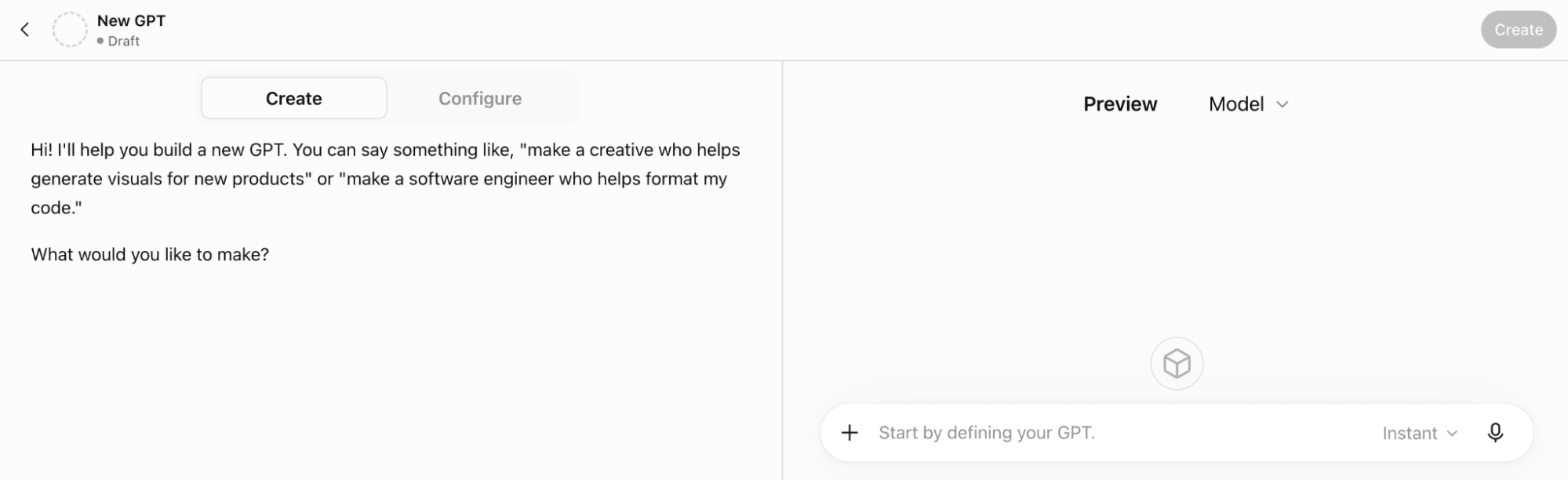
Tier 1: Custom GPTs
OpenAI Custom GPTs
Low (Conversational configuration)
Pros: Rapid prototyping; zero-code deployment. Cons: Limited to single-step execution; weak IP security; access cannot be revoked selectively; vulnerable to platform model updates.
Tier 2: Universal Skills
Claude Skills, Cross-Platform AI Workflows
Medium (File packaging & structured formatting)
Pros: Supports multi-agent orchestration within a single workflow; highly portable across model providers. Cons: Exposes underlying training assets (the skill package is shared directly with end users).
Tier 3: Custom Vibe-Coded Platforms
Lovable, Claude Code, wAIv (Gravia Studio)
Medium to High (Software orchestration)
Pros: Full multi-tenancy; robust access management; centralized client usage dashboards; flexible LLM model routing. Cons: Higher setup overhead; requires ongoing software governance and maintenance.
Field Applications: Empirical Case Studies
Strategic Brand Messaging (The "Moxie" Suite): Messaging strategist Dr. Michelle deployed an automated research suite to streamline consumer message extraction. Clients input unorganized voice-of-customer interview transcripts into the system, which parses the unstructured text using her communication methodology. What historically required months of qualitative analysis is compressed into real-time, actionable brand positioning, bypassing client analytical exhaustion.
Visibility Strategy Automation ("Valerie the Visibility Auditor"): Developed by Kelly Sinclair, this diagnostic tool addresses client habits of defaulting to low-ROI activities, such as routine social posting, over higher-impact initiatives like strategic collaborations. The system evaluates a user’s weekly operational logs against an internal performance rubric, automatically directing them back toward high-leverage growth strategies.
End-to-End Media Relations Workflows: Nicole, a PR consultant and journalist, designed a three-tier "bot squad" workflow. The initial bot processes intake questions to construct a standardized positioning narrative; the second bot scans media ecosystems to identify tailored podcast opportunities based on narrative fit rather than superficial vanity metrics; the third bot auto-drafts pitches using the client’s validated brand voice.
Cost Infrastructure & Model Allocation Optimization
Operating sustainable software systems powered by AI requires optimizing token unit economics. Advanced practitioners structure complex, multi-agent tools by assigning specific models to different tasks based on complexity, keeping operational costs under control.
Addressing the transition from passive learning to automated execution, strategy practitioner Kelly Sinclair emphasizes that generative model availability changes how expertise is valued:
"AI has commoditized pure knowledge. Anyone can prompt a generic LLM for a step-by-step framework, but raw outputs lack the curated lens of a strategist who has spent years refining what actually works in market environments. Generic models generate plausible first drafts, but end users lack the diagnostic context to determine if the output is strategic or flawed."
Sinclair highlights that integrating proprietary methodologies into structured AI interfaces preserves the expert’s strategic value:
"Digital courses teach people how to think, but introducing AI tools allows clients to directly leverage an expert’s decision-making frameworks. Moving from education to implementation changes the value proposition entirely."
Mitigating the Friction of Execution
On the drop-off in completion rates typical of digital info-products, Sinclair points to execution friction as the primary blocker:
"The drop-off in digital courses happens because clients stall when faced with a blank page. AI tools lower the perceived effort of implementation. When a client can move from an empty document to a structured baseline in minutes, momentum replaces friction."
Rethinking Product Delivery Models
Sinclair also notes how these shifts alter business models for consultants and creators:
"The goal isn’t to replace human expertise with full automation. Instead, automated tools manage the implementation baseline while the expert leads strategy, coaching, and accountability. This combination allows experts to shift away from one-off course launches and build recurring revenue models, as clients retain access to the tool suites that power their daily operations."
Future Outlook
Shift to Custom Multi-Tenant Software Environments
While consumer-facing AI interfaces like ChatGPT served as initial testing grounds, the industry is increasingly moving toward custom software platforms. This shift is driven by the need for enterprise-level access control, programmatic user deprovisioning, and intellectual property protection. Modern development ecosystems, accelerated by "vibe coding" paradigms where natural language prompts drive code generation, enable non-technical domain experts to build multi-tenant SaaS products without traditional engineering bottlenecks.
TRADITIONAL DEVELOPMENT                 VIBE-CODED ARCHITECTURE
+-----------------------+               +-----------------------+
|  Domain Expert        |               |  Domain Expert        |
|          v            |               |          v            |
|  Software Engineers   |               |  AI Coding Assistant  |
|          v            |               |  (Natural Language)   |
|  Product Architecture |               |          v            |
|          v            |               |  Multi-Tenant SaaS    |
|  Deploys App          |               |  Platform             |
+-----------------------+               +-----------------------+
Platforms like wAIv (developed by Gravia Studio) point toward a shift toward specialized AI management middleware. These environments allow experts to:
Manage client access, onboarding, and offboarding seamlessly.
Safeguard underlying system prompts and custom datasets from exposure or extraction.
Route tasks to appropriate language models dynamically to optimize operational costs.
Managing System Output Variability
As expert-backed software adoption grows, managing output variability remains a key technical challenge. Because language models operate nondeterministically, developers must incorporate programmatic guardrails, structured output validation (such as JSON schema controls), and clear instructional boundaries within the process layer.
The transition from passive educational content to AI-driven implementation represents a permanent shift in knowledge monetization. Organizations and experts that adapt to this landscape will likely shift away from content-heavy digital courses. Instead, sustainable growth will belong to those who build hybrid offerings: scalable, AI-powered software handling execution, paired with human coaching focused on high-level strategy and accountability.