Executive Overview
Nearly four years have passed since the public debuts of foundational generative AI platforms like ChatGPT and Claude fundamentally altered the digital landscape. Yet, a persistent and frustrating blind spot has plagued digital marketers, search engine optimization (SEO) professionals, and content strategists ever since: a glaring lack of concrete data regarding consumer prompt behavior and proprietary platform response methodologies.
For years, the industry has been forced to rely on traditional, aggregate search query data as a proxy to infer how users interact with generative artificial intelligence. Aside from Bing—which provides a degree of transparency by reporting the specific "Grounding Queries" that drive its AI-driven "fan-out" responses—major platforms have kept their cards close to their chest.
However, a quiet paradigm shift is underway. Recent revelations confirm that Google’s "AI Mode" is recording both initial prompts and subsequent conversational follow-ups directly into Google Search Console (GSC) as standard search queries. This accidental data leak offers SEO professionals an unprecedented, albeit unstructured, window into the true conversational queries of modern searchers.
This article explores how this discovery came to light, the mechanics of identifying these conversational prompts using regular expressions (regex) and API-connected tools, and what digital marketers must do to leverage this hidden data to future-proof their organic visibility strategies.
Detailed Chronology: How the Secret Came to Light
The discovery of generative AI prompts inside standard SEO reporting tools did not happen overnight; it was pieced together through the investigative curiosity of sharp-eyed digital marketers connecting anomalous data points.
The Mystery of the Conversational Queries
The journey began with anomalies in Google Search Console reports. SEO practitioners worldwide noticed unusual query patterns creeping into their performance data. Instead of short, transactional keywords—such as "best CRM software" or "how to fix 404 error"—dashboards were suddenly populating with long, hyper-specific, conversational questions. Queries featuring complete sentences, multi-layered constraints, and even bizarrely fragmented conversational continuations began appearing out of nowhere.
For months, many dismissed these anomalies as statistical noise, edge-case long-tail keywords, or errors generated by automated scraping tools.
The Breakthrough Inquiry
The turning point arrived when Anastasia Kourou, an SEO Manager at Greece-based Relevance Digital Agency, noticed peculiar, monosyllabic search queries appearing in her clients’ Google Search Console profiles. Terms like "yes" and "yes, pricing" were logging impressions, despite making zero semantic sense in the context of traditional keyword search behavior.
Recognizing that these short strings were characteristic of conversational multi-turn dialogue trees rather than independent search queries, Kourou took her findings to LinkedIn. She directly tagged Google’s Search Advocate, John Mueller, asking for clarification on why Search Console was indexing these genAI-like conversational fragments.

Confirmation from Google
In a move that validated months of industry speculation, Mueller confirmed Kourou’s suspicions. He verified that these queries were, in fact, follow-up prompts generated by users interacting with Google’s AI Mode.
This confirmation fundamentally changed how digital marketers viewed Search Console. It proved that Google’s AI features were not operating in a completely siloed ecosystem divorced from traditional search tracking; rather, the conversational ripples of AI interactions were bleeding directly into the data pipelines that SEO professionals monitor every single day.
Supporting Context & Metrics: The Quest for Generative AI Transparency
To understand the magnitude of Mueller’s confirmation, one must look at the broader historical context of the search industry’s data drought regarding generative AI.
The Post-Keyword Era
When ChatGPT launched in late 2022, it triggered a panic across the digital marketing ecosystem. Traditional search engines were suddenly competing with conversational interfaces that answered user intents directly, bypassing the traditional "10 blue links" entirely.
Marketers realized that optimization could no longer rely solely on keyword volume and click-through rates (CTR). They needed to know how users were prompting AIs to find information, what underlying sources AIs trusted, and how to structure content to become an AI’s cited reference. Yet, OpenAI, Anthropic, and Google kept their prompt datasets tightly encrypted.
The Bing Exception
Microsoft’s Bing was an early outlier in addressing this frustration. By introducing explicit reporting on "Grounding Queries"—the underlying search queries executed behind the scenes to fetch fresh data for AI-generated answers—Bing gave marketers a breadcrumb trail. It proved that search engine architectures could bridge the gap between AI generation and query tracking.
Google’s AI Mode Integration
Google’s approach has been far more opaque. As the company rolled out conversational features, Search Generative Experience (SGE), and dedicated AI search modes, SEOs were left wondering where those interactions went.
The revelation that AI Mode logs both initial inputs and follow-up prompts into Search Console bridges a critical data gap. While the data is messy and unsegregated from traditional searches, it provides the first scalable, direct look into consumer prompting habits on the world’s dominant search engine.
Technical Guide: How to Identify and Filter AI Prompts in Search Console
Because Google Search Console does not feature a dedicated "AI Prompt" toggle or filter, SEO professionals must use creative technical workarounds to isolate these conversational entries from traditional search queries.
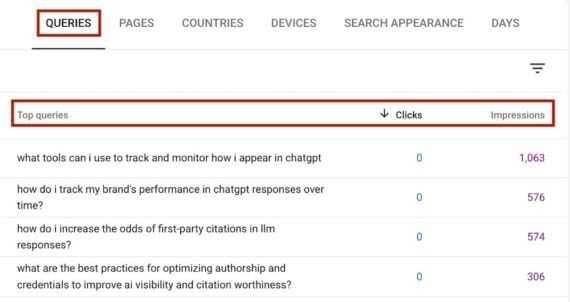
Method 1: Using Regular Expressions (Regex) in GSC
The native Google Search Console interface allows for custom filtering using regular expressions. By targeting query length and conversational syntax, you can strip away standard keywords and isolate potential AI prompts.
To apply this filter:
- Navigate to your Google Search Console property and click on the Performance report.
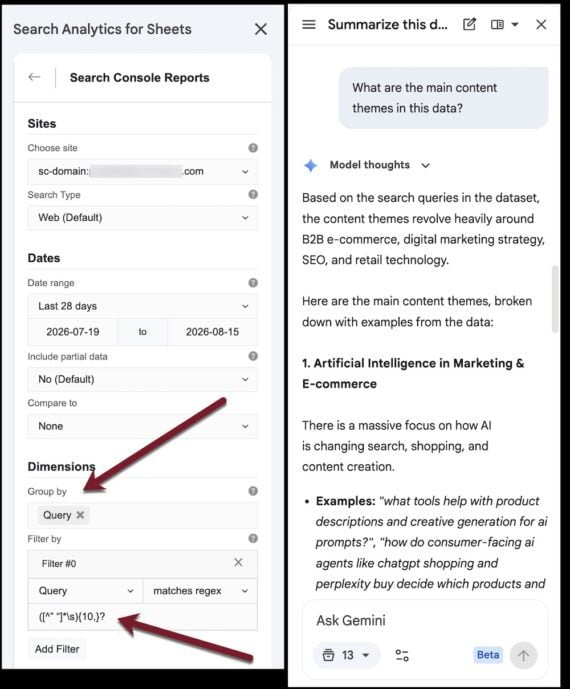
- Click New > Query > Custom (regex).
- Select the "Matches regex" parameter.
- Input a regex pattern designed to capture long-tail strings. For instance, a basic word-count filter can be established using:
([^" "]*s)10,?This expression targets queries containing ten or more words, immediately filtering out short-tail and mid-tail search phrases.
Recognizing that initial prompts are only part of the puzzle, industry experts have expanded on this technique. Jean-Christophe Chouinard, an SEO strategist at Tripadvisor, shared advanced regex patterns capable of capturing multi-turn follow-up prompts—such as conversational continuations like "yes, please," "tell me more," or "compare the second option"—which would otherwise be lost in standard reporting.
Method 2: Leveraging External Tools and APIs
While the native GSC interface is useful for quick spot-checks, its front-end UI imposes strict row limits and export caps. For deep, scalable analysis, marketers often turn to external tools that interface directly with the Google Search Console API.
Free tools—such as advanced Google Sheets add-ons—allow users to pull up to 25,000 queries directly from Search Console into a spreadsheet environment. The true power of these external integrations lies in their ability to pair raw data with built-in artificial intelligence models (such as Gemini).
By connecting GSC data to these analytical layers, marketers can:
- Automatically categorize thousands of long-tail prompt queries into semantic content themes.
- Identify patterns in how users refine their questions during multi-turn AI interactions.
- Isolate zero-click queries that show high impressions but zero traffic—a hallmark of AI-generated answer boxes and conversational sessions where users found what they needed without clicking through to a website.
Strategic Implications: Applying the Data to Future-Proof SEO
Uncovering AI prompts in Search Console is only half the battle; the real value lies in translating this unstructured data into actionable optimization strategies.
1. Decoding Competitive Intelligence
When analyzing long queries with unusually high impression counts, marketers must exercise caution. Many of these prompts are not generated by human end-users, but rather by automated brand-monitoring software and AI tracking tools pinging search engines.
However, far from being useless, this automated activity provides a massive competitive advantage. It reveals what questions your competitors are actively tracking. By examining which prompts trigger impressions for your domain versus competitors, you gain a clear map of the competitive monitoring landscape.
2. Crafting Content for Multi-Turn Conversations
Traditional SEO focused on answering a single search intent per page. Generative AI, however, thrives on multi-turn dialogue. The presence of follow-up prompts like "yes, pricing" or "tell me more about the enterprise tier" in Search Console highlights the importance of comprehensive, deep-funnel content architecture.
To rank in AI modes and satisfy conversational searchers, your content must anticipate the follow-up questions a user will naturally ask after receiving an initial answer. Structuring pages with logical subheadings, detailed FAQ sections, and contextual internal linking mirrors the conversational flow of modern AI interactions.
3. Shifting from Keyword Optimization to Intent Orchestration
The era of stuffing exact-match keywords into title tags is rapidly receding. Because AI prompts are conversational, highly descriptive, and context-heavy, marketers must optimize for topical authority and semantic nuance.
Reviewing your filtered GSC prompt data allows you to read the exact phrasing your target audience uses when speaking to an AI. Instead of guessing what your customers want to know, you can extract their verbatim questions and use them as foundational blueprints for your content strategy.
Future Outlook
The accidental exposure of generative AI prompts within Google Search Console marks a critical milestone in the maturation of modern SEO. While Google has yet to release a native, cleanly segmented "AI Prompt Report," the ability to reverse-engineer conversational data using regex and API integrations empowers digital marketers to peek behind the curtain.
As search engines continue to evolve into hybrid platforms that blend traditional algorithmic results with generative, conversational agents, the boundaries between SEO and generative AI optimization (AIO) will completely dissolve. Professionals who learn to harness this hidden prompt data today will be uniquely positioned to dominate the search landscape of tomorrow—transforming a chaotic data leak into a strategic roadmap for digital visibility.