Executive Overview
The engineering lifecycle of a Large Language Model (LLM) wrapper has evolved from a weekend hackathon project into a rigorous production discipline. However, transitioning from a static single-turn API query to a fully autonomous agentic loop introduces a radically different economic and architectural paradigm. In modern multi-step agentic systems, time is money—and tokens are both.
While building a proof-of-concept chatbot is trivial, keeping an autonomous agent from quietly bankrupting cloud infrastructure over a six-month deployment is an entirely separate enterprise. Every time an LLM processes text, it incurs a direct financial charge measured in tokens—the fundamental sub-word chunks that models utilize to parse and generate language. Think of tokens as the metered units on your cloud utility bill: the higher the token density per API call, the steeper the operational overhead.
In a standard chatbot interaction, this linear cost growth remains manageable. But within an agentic loop—where an artificial intelligence autonomously invokes external tools, parses unstructured responses, and strategizes its next sequential move across dozens of iterative steps—token expenditures do not grow linearly. They compound exponentially. A naive architectural setup that dumps every intermediate tool output into an ever-expanding message array can easily transform a $0.05 routine automation task into a $5.00 infinite loop before triggering a single error flag.
Mitigating this financial drain requires a fundamental conceptual shift in how developers handle information: distinguishing between State (the absolute minimum set of validated facts required to propel the task forward) and Context (the full, verbose transcript of historical interactions). Most off-the-shelf agentic frameworks conflate these two concepts by default. When scaling agentic architectures in production, developers must systematically identify, isolate, and neutralize five hidden token traps that drive runaway cloud expenditures.
Detailed Chronology: The Evolution of Agentic Spend and Production Realities
To understand how modern infrastructure budgets are eroded by autonomous loops, one must examine the operational timeline of deploying LLM agents into enterprise environments—a trajectory marked by initial overconfidence followed by rapid budgetary scaling.
Phase 1: The Honeymoon Period (Weeks 1–2)
During the initial development phase, engineering teams typically test agents on constrained, highly curated datasets. Single-digit turns and mock APIs create an illusion of fiscal efficiency. Token consumption per task remains tightly bound within predictable thresholds, leading teams to treat context as an unlimited resource. Frameworks are selected based on developer ergonomics rather than memory efficiency or token footprint optimization.
Phase 2: Integration and Real-World Friction (Months 1–3)
As agents are connected to live enterprise systems—legacy databases, verbose REST APIs, and unpredictable web scrapers—edge cases multiply. Tool failures occur, throwing unparsed stack traces and voluminous JSON payloads back into the system. Without robust orchestration controls, the agent attempts to self-correct by ingesting the entire historical trajectory of its failures. This is the inflection point where linear costs transition into geometric compounding, catching finance teams off guard at the end of the billing cycle.
Phase 3: Production Scale and Operational Hardening (Months 4–6+)
By the fourth month of continuous deployment, infrastructure bottlenecks extend beyond API billing. Uncompressed agent trajectories bloat operational databases, degrading query latency and compounding storage costs for observability and crash recovery. At this maturity stage, enterprises are forced to refactor their orchestration layers. They must transition away from monolithic model wrappers toward dynamic orchestration graphs, context compaction, and strict circuit breakers to survive economically.
Supporting Context & Metrics: The Five Cost Traps in Detail
Each of the following five failure modes represents a distinct architectural vulnerability. Left unchecked, they account for the vast majority of runaway token spend in production deployments.
1. The $O(N^2)$ Context Accumulation Tax
The Concept
In an agentic workflow, passing the complete, unedited conversation history to every subsequent model call forces the system to pay for historical tokens repeatedly, rather than just once.
How It Works
Most orchestration frameworks default to appending every user, assistant, and tool message to a single, monotonically growing array. By step 20 of a complex 20-step workflow, the model is forced to re-read the entire textual history from steps 1 through 19 on every single API call.
To counteract this tax, engineers must implement context compaction—collapsing previous turns into a dense, rolling summary—or leverage KV-cache prompt caching to freeze the prefix state, ensuring the system only incurs costs for the conversational delta. This optimization is directly tied to the mathematical reality of how transformer attention mechanisms scale with sequence length.
[Step 1] ---> Input (1x Cost)
[Step 2] ---> Input (2x Cost: Step 1 + Step 2)
[Step 20] --> Input (20x Cost: Steps 1 through 20 re-read continuously)
Worth Noting
Compress too aggressively, and the system suffers from "context amnesia." If the agent drops a critical parameter retrieved during step 2, it may hallucinate a replacement value by step 8, triggering a cascading chain of failed downstream tool executions.
When to Use It
Apply context compaction protocols to any multi-step workflow expected to exceed five discrete turns or interact with high-latency, data-heavy external APIs.
2. Unbounded Retry Loops on Stale State
The Concept
Context bloat is not merely an accumulation problem; it aggressively exacerbates failure states. When a tool call fails, the agent attempts to self-correct while dragging along the full, bloated context of the failure for every subsequent retry.
How It Works
A standard ReAct (Reasoning and Acting) loop catches an exception—such as a 400 Bad Request—and appends the raw error trace directly to the context before prompting the model to generate a fix. If the agent remains stuck in an error loop, each retry transmits all prior failures alongside the new attempt.
The structural solution is a circuit breaker implemented at the orchestrator level. This mechanism strips failed trajectories from the active state before presenting the error back to the model, or halts execution entirely once a predefined retry threshold is breached.
Worth Noting
Stripping failure history entirely runs the risk of causing the agent to repeat the exact same invalid tool call. Developers must extract and inject a deterministic "failure heuristic" (e.g., "Tool X failed because parameter Y was missing"), rather than dumping raw, unstructured stack traces.
When to Use It
Enforce circuit breakers and trajectory pruning across all non-deterministic external API calls where the model dynamically generates payloads.
3. Unfiltered Tool Payload Bloat
The Concept
Beyond managing retry loops, engineers must scrutinize the raw data injected into the context from tool executions—specifically, unparsed responses generated by external systems.
How It Works
When an agent queries a database or a third-party REST API, it frequently receives massive JSON payloads containing extensive metadata, null fields, and structural boilerplate. Dumping this raw output directly into the prompt wastes thousands of tokens on information the agent will never utilize.
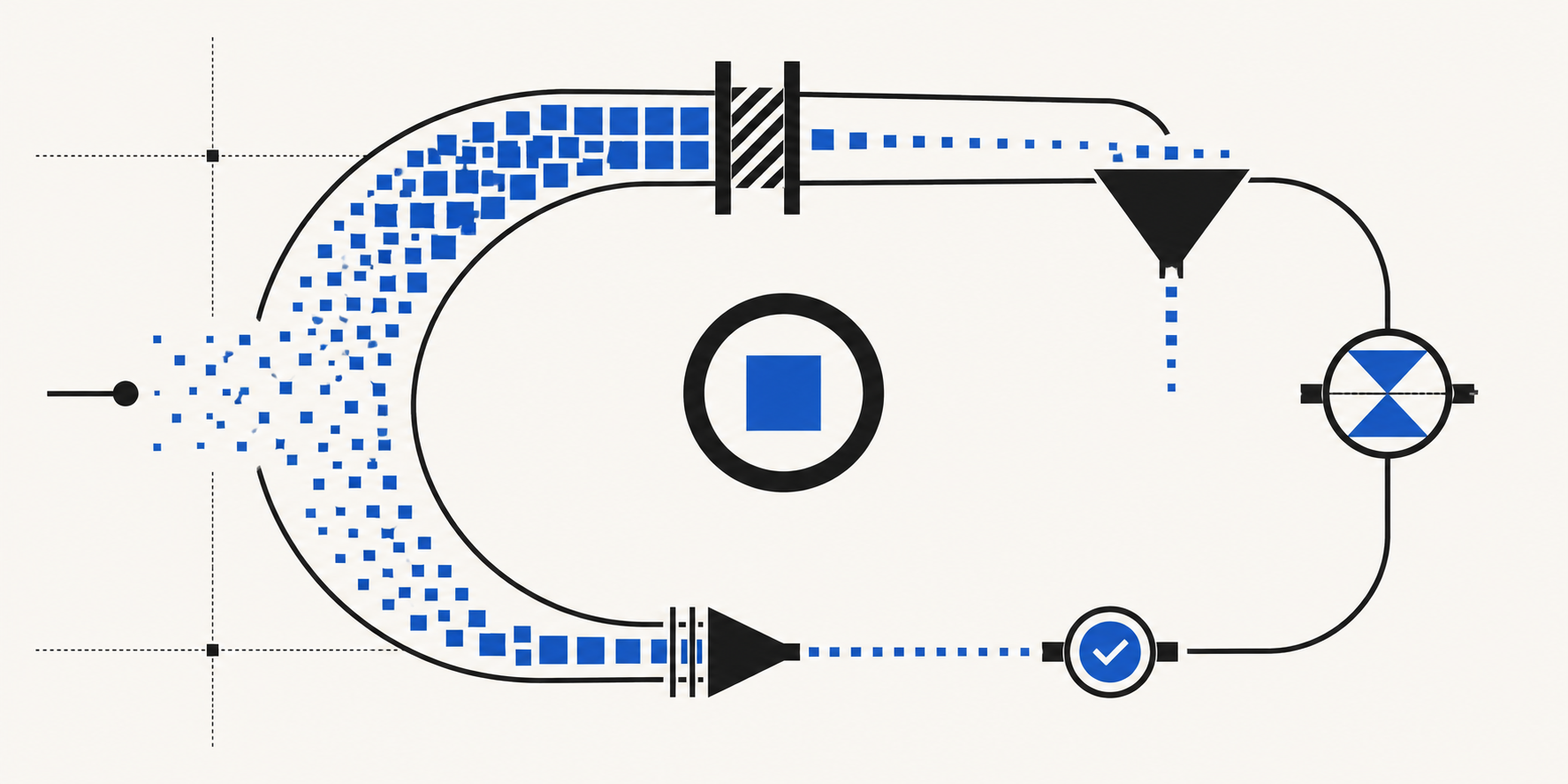
The remediation strategy involves routing tool outputs through a deterministic extraction layer (jq, regex filtering, or a dedicated parser) that strips unnecessary overhead. Only the schema-validated key-value pairs required to advance the task should enter the agent’s active context.
Worth Noting
If an extraction middleware quietly drops a field required further down the pipeline, the agent will silently hallucinate a plausible substitute to bridge the gap—leading to corrupted data writes in enterprise databases.
When to Use It
Deploy payload filtering middleware whenever an agent integrates with legacy systems, verbose enterprise REST APIs, or unstructured web scraping pipelines.
4. Monolithic Model Routing
The Concept
Even with lean contexts and filtered payloads, many engineering teams overlook a primary cost lever: the specific model selected to execute individual workflow steps.
How It Works
An agentic workflow is fundamentally a directed graph of heterogeneous tasks. While complex semantic reasoning and strategic planning justify the use of heavyweight, state-of-the-art frontier models, auxiliary tasks such as intent classification, JSON formatting, or schema validation do not.
By utilizing dynamic routing, the orchestrator can direct these lightweight nodes to smaller, highly efficient open-weights models (e.g., Llama 3 8B or optimized instruction-tuned variants) at a fraction of the token cost.
Worth Noting
Dynamic routing introduces orchestration overhead. If the serving infrastructure must load a distinct model into VRAM or establish a new network socket at every graph node, the resulting latency spike can easily negate the financial savings.
When to Use It
Dynamic model routing yields high ROI in high-throughput, multi-agent systems where the workflow graph contains cleanly isolated nodes dedicated to deterministic data transformation.
5. Static Context Duplication
The Concept
The final hidden trap resides at the absolute apex of every API call: the system prompt itself. Injecting a monolithic system prompt that covers every available tool definition and edge case into every single API request wastes significant token capacity.
How It Works
Rather than initializing every call with a sprawling 5,000-token system prompt defining 20 distinct tools, modern architectures employ dynamic prompt construction. The orchestrator maintains a vector index or a lightweight rules engine containing available tools and constraints. At runtime, it injects only the tool definitions and behavioral guidelines strictly required for the immediate step.
Worth Noting
Dynamic context injection introduces potential prompt injection vulnerabilities if the lookup query is influenced by untrusted user input. A maliciously crafted prompt could manipulate the orchestrator into retrieving and executing a compromised tool definition.
When to Use It
Transition to dynamic prompt construction when an agent’s accessible tool count exceeds a dozen, or when operating multi-tenant systems requiring strict role-based access controls (RBAC).
Official Statements and Industry Perspective
As generative AI adoption matures from experimentation to production-grade deployment, industry leaders and systems architects have increasingly emphasized the urgency of cost governance.
According to leading machine learning operations (MLOps) research:
"Treating agentic context as an infinite resource is the single most common failure mode in enterprise AI deployments. As autonomous loops scale, token efficiency is no longer an optimization metric; it is a core structural prerequisite for financial sustainability."
Furthermore, systems infrastructure engineers highlight that the hidden costs extend beyond API billing cycles:
"By day 100 in production, uncompressed agent trajectories create severe database bloat. Storing verbose historical transcripts for observability without implementing strict time-to-live (TTL) policies degrades operational query latency and inflates cloud storage bills just as rapidly as raw LLM inference fees."
Future Outlook: The Next Generation of Agentic Economics
As the AI landscape looks toward future architectural standards, the economics of agentic loops are poised for significant transformation. Model providers continue to introduce hardware-level optimizations, such as advanced native prompt caching and reduced inference pricing. However, relying solely on external price reductions is a risky strategy for enterprise engineering teams.
Looking ahead, the industry is shifting toward stateless execution graphs and hybrid memory tiers, where working memory is managed through dedicated vector stores and relational state databases rather than raw conversational transcripts. Orchestration frameworks are rapidly adopting native middleware for automatic payload pruning, circuit breaking, and dynamic model routing out-of-the-box.
Ultimately, tokens must be treated as the scarce compute currency of agentic systems. Organizations that architect their orchestration layers from day one to treat context as a volatile, highly constrained resource will successfully scale autonomous AI. Those that do not will continue to face the silent, compounding bankruptcies of unmanaged agentic loops.