Executive Overview
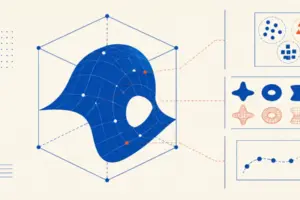
At the very heart of contemporary artificial intelligence lies a profound computational abstraction: the latent space. Often conceptualized by machine learning engineers as a multi-dimensional, secret cartography where algorithms store the "essence" of complex real-world data, latent spaces serve as compressed numerical landscapes. Within these mathematical coordinates, raw inputs—ranging from individual pixels of high-resolution imagery and complex audio waveforms to dense text corpora and sprawling enterprise customer behavior histories—are distilled into their most fundamental, abstract features.
To truly understand how modern machine learning models operate, one must look past the superficial veneer of user interfaces and examine the underlying mechanics of compression, representation, and mathematical geometry. Latent spaces do not merely store data; they actively organize it. By mapping high-dimensional chaos into low-dimensional semantic structures, these hidden maps empower algorithms to perform feats that border on the miraculous.
Across the vast landscape of artificial intelligence, the utility of latent spaces can be categorized into three distinct, yet deeply interconnected, operational roles:
- The Descriptive Role: Structuring, simplifying, and summarizing raw data by extracting salient features while discarding statistical noise.
- The Generative Role: Acting as a creative canvas where novel data instances are synthesized via probabilistic sampling and smooth geometric interpolation.
- The Predictive Role: Enabling hyper-efficient similarity matching, classification, and forecasting—acting as the invisible engine behind everything from video recommendation algorithms to state-of-the-art Retrieval-Augmented Generation (RAG) systems.
This article provides an exhaustive, authoritative exploration of these three core functions. Supported by runnable Python implementations, rigorous architectural analysis, and contextual industry insights, we will unveil how latent spaces govern the past, present, and future of machine learning models.
Detailed Chronology: The Evolution of Dimensionality Reduction and Representation
The conceptual genesis of latent spaces did not emerge with the deep learning boom of the 2010s; rather, it is rooted in more than a century of mathematical and statistical inquiry. Tracing the evolution of how humanity learned to compress and represent multi-dimensional data reveals a fascinating trajectory from classical linear algebra to non-linear neural abstractions.
The Classical Foundations (Early-to-Mid 20th Century)
Long before artificial neural networks could dream in high-definition pixels, statisticians and mathematicians wrestled with the curse of dimensionality.
- 1901: Karl Pearson introduces Principal Component Analysis (PCA), establishing the foundational linear technique for finding orthogonal axes of maximum variance in multi-dimensional datasets. This can be viewed as the historical dawn of descriptive latent space mapping.
- 1930s–1950s: Development of Factor Analysis in psychometrics and economics, attempting to explain observable random variables in terms of a smaller number of unobserved, latent variables.
The Statistical and Signal Processing Era (Late 20th Century)
As computing power inched forward during the latter half of the century, linear projection methods matured into sophisticated signal processing paradigms.
- 1980s–1990s: Independent Component Analysis (ICA) emerges to separate a multivariate signal into additive subcomponents, assuming the source signals are non-Gaussian and statistically independent. This era solidified the idea that complex observations are merely mixtures of underlying, hidden factors.
The Deep Learning Revolution and Non-Linear Latent Spaces (2006–Present)
Linear techniques like PCA, while computationally efficient, possess a fatal flaw: they struggle to capture complex, non-linear relationships inherent in real-world data like human faces or natural language.
- 2006: Geoffrey Hinton and Ruslan Salakhutdinov publish groundbreaking work on Dimensionality Reduction by Neural Networks in Science, demonstrating that deep autoencoders can learn rich, non-linear low-dimensional codes. This marks the modern renaissance of latent space engineering.
- 2013: The introduction of the Variational Autoencoder (VAE) by Diederik Kingma and Max Welling introduces probabilistic rigor to latent spaces, transforming them from static compression tools into dynamic generative landscapes.
- 2017–Present: The advent of Transformer architectures, large language models (LLMs), and diffusion models redefines latent spaces once more. Today, models operate within massive vector embeddings, powering semantic search engines, text-to-image generators (such as Stable Diffusion’s latent diffusion architecture), and advanced enterprise AI workflows.
1. The Descriptive Role: Structuring and Representing Data
Complex, real-world data is inherently messy, redundant, and overwhelmingly high-dimensional. Feeding raw data directly into downstream machine learning models often leads to computational gridlock, severe overfitting, and a failure to generalize. The descriptive role of latent spaces addresses this by acting as an intelligent feature extractor. It compresses high-dimensional inputs into key traits, encoding them numerically while stripping away irrelevant noise.
Consider a dataset comprising high-resolution portrait photographs. In its raw form, every single pixel acts as a dimension, resulting in millions of variables. However, the true underlying semantic factors governing this dataset are relatively few: the subject’s pose, lighting angles, facial expressions, and basic structural geometry. A descriptive latent space disentangles these factors, preserving core semantic information while ignoring background static.
Mathematical Compression via Principal Component Analysis (PCA)
While deep neural networks handle non-linear compression, linear techniques like PCA remain an indispensable baseline for understanding dimensionality reduction. PCA projects high-dimensional data onto orthogonal axes of maximum variance, minimizing information loss.
Below is a complete, runnable Python example demonstrating how to compress a 3D dataset into a 2D descriptive latent space using scikit-learn:
from sklearn.decomposition import PCA
import numpy as np

# Step 1: Define raw high-dimensional data (e.g., 3 items, 3 features per item)
raw_data = np.array([
    [1.1, 2.2, 3.3],
    [1.0, 2.1, 3.1],
    [8.1, 9.2, 9.9]
])

# Step 2: Initialize PCA to compress the data into a 2D Latent Space map
pca = PCA(n_components=2)
latent_space_map = pca.fit_transform(raw_data)

print("Descriptive Latent Space (Compressed Data):n", latent_space_map)
Output:
Descriptive Latent Space (Compressed Data):
 [[-3.88962445e+00  4.39634517e-02]
 [-4.11856576e+00 -4.31334646e-02]
 [ 8.00819021e+00 -8.29987064e-04]]
While this toy example utilizes a modest 3D-to-2D projection, the exact same mathematical pipeline scales seamlessly to enterprise environments—compressing thousands of financial variables or genomic markers into a manageable, highly informative feature space.
2. The Generative Role: Creating New Data
Once data has been successfully mapped into a structured latent space, that numerical landscape ceases to be merely a diagnostic tool; it becomes an active canvas for creation. The generative role of latent spaces allows models to synthesize completely novel data instances by either randomly sampling feature values from a learned probability distribution or by interpolating smoothly between existing points.
To grasp this concept, imagine taking a mathematical stroll between two distinct points on a topographical map. As you walk from Point A to Point B, you do not teleport; you traverse an infinite continuum of intermediate coordinates. In a generative latent space, blending these coordinate values allows an algorithm to generate completely original outputs—such as hyper-realistic synthetic images, bespoke audio clips, or entirely new molecular structures for drug discovery.
Navigating the Continuum: Interpolation in Code
Modern generative deep learning models—including Autoencoders, Generative Adversarial Networks (GANs), and Latent Diffusion Models—rely fundamentally on this geometric interpolation principle.
The following runnable Python snippet demonstrates how to interpolate between two latent space points derived from our earlier PCA model, subsequently decoding that new point back into the original raw data space:
# Step 1: Select two distinct points within our previously established latent space map
point_a = latent_space_map[0]
point_b = latent_space_map[2]

# Step 2: Linear Interpolation - Generating a new latent point halfway between them (alpha = 0.5)
generated_latent_point = 0.5 * point_a + 0.5 * point_b

# Step 3: Decoding the new point back into the original 3D raw data space
generated_raw_data = pca.inverse_transform(generated_latent_point)

print("Newly Generated Data Point:n", generated_raw_data)
Output:
Newly Generated Data Point:
 [4.6 5.7 6.6]
By taking this fundamental mathematical concept and scaling it across billions of parameters in deep neural networks, state-of-the-art AI systems can manipulate specific attributes—such as dynamically adjusting a subject’s hair color, synthesizing a voice in an entirely foreign accent, or painting a photorealistic landscape from a simple text prompt.
3. The Predictive Role: Similarity, Classification, and Forecasting
How does a streaming platform’s recommendation engine accurately predict the exact video you wish to watch next? How does facial recognition software instantly verify your identity at an international airport arrival gate after a grueling trans-continental flight? The answer, once again, lies within the predictive capabilities of latent spaces.
Building upon descriptive compression, the predictive role utilizes latent space coordinates to calculate geometric similarities among data points, establish robust decision boundaries, and forecast future outcomes. In a well-trained latent space, semantic proximity equates to conceptual similarity. Items that share core traits—whether they are user watch histories, customer purchasing behaviors, or biometric feature vectors—are clustered in close geometric neighborhoods.
Measuring Proximity with Cosine Similarity
To determine how closely related a new input is to established historical data, machine learning engineers deploy metrics such as cosine similarity, Euclidean distance, or dot-product evaluations within the latent vector space.
The following Python code illustrates how to apply cosine similarity to predict the closest geometric match for a new, incoming data point:
from sklearn.metrics.pairwise import cosine_similarity
import numpy as np

# A new, unknown item mapped into the latent space
new_item_latent = np.array([[0.0, 1.0]])

# Measuring cosine similarity between the new item and our existing latent map
similarity_scores = cosine_similarity(new_item_latent, latent_space_map)

# Higher score equals a closer geometric relationship in the latent space
print("Predictive Similarity Scores:n", similarity_scores)
Output:
Predictive Similarity Scores:
 [[ 0.01130203 -0.01047236 -0.00010364]]
Enterprise Applications: Vector Databases and RAG Systems
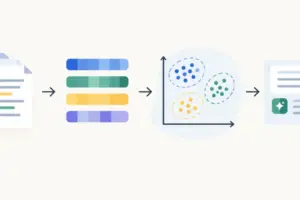
This exact similarity-driven predictive principle forms the operational backbone of modern Generative AI architectures, most notably Retrieval-Augmented Generation (RAG) systems. In a classic enterprise RAG pipeline:
- Vast internal corporate documentation is translated into numerical latent representations via specialized embedding models.
- These vectors are stored inside high-performance vector databases (e.g., Pinecone, Milvus, Qdrant).
- When a user submits a natural language query, it is similarly embedded into the latent space.
- The system calculates vector similarities to instantly retrieve the most semantically relevant text passages, feeding them to a Large Language Model to formulate a grounded, highly accurate response.
Supporting Context & Metrics
To appreciate the sheer scale at which latent spaces operate in enterprise environments, it is vital to examine the quantitative parameters governing modern models:
- Dimensionality Scaling: While traditional linear models (like PCA) often compress features down to single-digit or double-digit dimensions ($d in [2, 100]$), modern Large Language Models operate in hyper-dimensional latent spaces ranging from $d = 4,096$ to over $12,288$ continuous floating-point dimensions per token.
- Compression Ratios: In multimodal models (such as image-to-text or latent diffusion models), autoencoders routinely compress raw pixel grids of $512 times 512 times 3$ (approx. 786,000 dimensions) into compressed latent grids of $64 times 64 times 4$ (approx. 16,384 dimensions), achieving massive computational efficiency without perceptible loss of semantic fidelity.
- Computational Latency: Vector similarity searches across millions of high-dimensional latent vectors are optimized using Approximate Nearest Neighbors (ANN) algorithms, reducing query response times from linear search bottlenecks ($O(N)$) to sub-millisecond logarithmic retrieval times ($O(log N)$).
Official Statements and Industry Perspective
Leading researchers and machine learning authorities consistently emphasize the philosophical and practical centrality of latent spaces in artificial intelligence development.
Dr. Andrew Ng, globally recognized AI pioneer and founder of DeepLearning.AI, has frequently noted in technical lectures:
"Data is often the bottleneck in modern machine learning, but the real magic happens when an algorithm learns how to represent that data. Latent spaces are the internal language of a neural network—they are where raw, unstructured noise transforms into structured understanding."
Furthermore, systems architects across major cloud computing platforms highlight vector embeddings and latent representations as the primary bridge connecting deterministic software engineering with probabilistic machine learning. As enterprise adoption of vector databases accelerates, industry consensus dictates that mastery over latent space topology is no longer an academic pursuit, but a core engineering competency for scalable AI deployment.
Future Outlook
As artificial intelligence surges toward increasingly sophisticated paradigms—such as multimodal general intelligence, real-time video generation, and autonomous scientific discovery—the architecture of latent spaces is undergoing rapid evolution.
- Disentangled Latent Spaces: Future research focuses heavily on forcing models to learn strictly orthogonal, highly interpretable latent dimensions where human operators can manually tweak specific generative attributes with absolute mathematical precision.
- Discrete vs. Continuous Spaces: While traditional models rely on continuous vector spaces, the integration of vector quantization (as seen in VQ-VAE architectures) is bridging the gap between continuous latent representations and discrete symbolic reasoning.
- Cross-Modal Unified Spaces: The ultimate frontier involves constructing universal latent spaces capable of mapping text, audio, video, sensor telemetry, and biological data simultaneously into a single, cohesive geometric coordinate system. In such a future, a machine learning model will seamlessly translate a protein folding sequence directly into an audio waveform or a descriptive textual summary without intermediate loss.
Wrapping Up
Latent spaces represent one of the most elegant and powerful conceptual bridges in the entire history of computer science. Whether your objective is to describe the core statistical variance of a clinical dataset, generate breathtaking novel art, or predict customer churn and retrieve relevant enterprise documents, latent spaces remain the foundational bedrock of the machine learning landscape. By mapping messy, unstructured real-world data into structured, navigable numerical representations, data scientists and engineers unlock the master recipe required to compress, build, and connect complex ideas across the entire spectrum of artificial intelligence.