Executive Overview
The landscape of artificial intelligence has shifted dramatically. What was once confined to massive cloud-based servers and enterprise data centers is now increasingly running on local hardware—from developer workstations to edge devices. This decentralization of machine learning has transformed large language models (LLMs) from static text generators into active, dynamic agents. At the heart of this transformation is tool calling (frequently referred to as function calling). By bridging the gap between isolated text generation and real-time computation, tool calling allows a model to query live databases, execute custom code, interact with external APIs, and trigger real-world actions.
As the open-weight ecosystem matures, developers are no longer forced to rely exclusively on proprietary, cloud-locked APIs to build intelligent applications. Instead, they can deploy sophisticated models locally. However, achieving reliable, low-latency, and accurate tool calling on local hardware introduces significant engineering challenges.
This article provides a rigorous, deep-dive comparative analysis of how three of the industry’s most prominent open-weight model families—Google DeepMind’s Gemma 4, Meta’s Llama 3, and Mistral AI’s Mistral—implement tool calling locally. We will examine their underlying architectures, parsing mechanics, real-world trade-offs, and strategic considerations for production-grade deployments.
Detailed Chronology: The Evolution of Open-Weight Tool Calling
To understand where local tool calling stands today, it is essential to trace the rapid chronological arc that brought us here. For years, open-weight models lagged behind proprietary counterparts like OpenAI’s GPT-4 or Anthropic’s Claude regarding native function execution. Early local deployments relied on fragile prompt engineering or heavy post-processing frameworks (such as Regex-based parsing or constrained grammar decoding via libraries like llama.cpp) to force models into emitting valid JSON objects.
The Turning Point: 2023–2024
The paradigm began to shift in late 2023 with the release of Mistral 7B, followed rapidly by Meta’s Llama 3 family in early 2024. While initial iterations of these models were text-focused and required external scaffolding to handle structured tool outputs, the open-weight community recognized that agentic workflows were the definitive future of AI.
The Maturation Phase: 2024–2025
Meta’s release of Llama 3.1 marked a major watershed moment. For the first time, a widely adopted open-weight model family incorporated native tool calling across its intermediate and large parameter sizes (specifically the 70B and 405B variants). Concurrently, Mistral AI introduced version 0.3, embedding native JSON function definitions directly into its pipeline and setting the stage for more advanced, memory-efficient sparse architectures.
The Current Standard: 2026
Fast forward to the present day. Google DeepMind’s release of Gemma 4 has redefined the edge-deployment landscape by introducing robust, native multi-modal function calling and configurable thinking modes built from the ground up on Gemini research infrastructure. Today, local tool calling is no longer an experimental hack; it is a first-class citizen in the open-weight ecosystem, enabling developers to build fully offline, high-security, and context-aware agentic pipelines.
Supporting Context & Metrics: Architecture and Mechanics
To evaluate how Gemma 4, Llama 3, and Mistral approach tool calling, we must first dissect the fundamental mechanics of the process and analyze how each family’s structural DNA impacts its execution reliability.
The Mechanics of Local Tool Calling
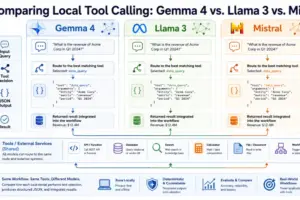
Regardless of the underlying model family, the tool-calling loop generally adheres to a standardized four-step protocol:
- Schema Definition: The host application provides the LLM with a system prompt or a structured array of JSON schemas detailing available functions, descriptions, and expected parameters.
- Intent Recognition & Generation: The model processes the user’s natural language query against the provided tools. If an external action is required, the model bypasses standard conversational text and instead emits a precise, structured JSON payload specifying the target function name and its required arguments.
- External Execution: The local host application intercepts this JSON payload, parses it securely, and executes the physical function (e.g., querying a local SQLite database, calling a weather API, or reading a local file system).
- Context Integration: The output of the function execution is fed back into the model context window as a subsequent message. The model then synthesizes this raw data into a coherent, natural-language response for the user.
In a local deployment environment—where the model operates entirely offline without access to live web APIs or cloud memory buffers—this pipeline serves as the vital link between static reasoning and dynamic utility.
Architectural Comparison
| Feature / Metric | Gemma 4 (Google DeepMind) | Llama 3 (Meta) | Mistral (Mistral AI) |
|---|---|---|---|
| Architectural Design | Dense & Mixture-of-Experts (MoE) mixes | Dense transformers | Dense & Sparse MoE (Mistral Small) |
| Context Window | Up to 256K tokens (medium/large variants) | Varies by sub-release (up to 128K+) | Optimized for high-throughput local inference |
| Tool Calling Support | Native, first-class training integration | Native (introduced in 3.1, refined in 3.2/3.3) | Native (introduced in v0.3 and later variants) |
| Key Advantage | Edge optimization & advanced thinking modes | Ecosystem maturity & extensive fine-tunes | High compute efficiency & low VRAM footprint |
Deep-Dive Analysis of Model Families
1. Gemma 4: Native Edge Intelligence and Configurable Reasoning
Google DeepMind’s Gemma 4 represents a major leap forward for edge and on-device machine learning. Built upon the robust research infrastructure powering proprietary Gemini models, Gemma 4 is inherently multi-modal, capable of processing text, images, video, and audio natively across its various size classes (ranging from lightweight edge variants like E2B and E4B up to larger 26B and 31B architectures, alongside the versatile 12B Unified model).
Tool Calling Philosophy:
Gemma 4 does not treat tool calling as an afterthought or a prompt-engineered hack. Instead, function calling is built directly into its post-training alignment. This native integration ensures that the model understands the semantic nuances of complex tool definitions with high fidelity.
Furthermore, Gemma 4 introduces a configurable thinking mode. Developers can programmatically scale the amount of intermediate reasoning the model performs before committing to a final tool call or text response. For complex multi-step agentic workflows where selecting the wrong parameter could trigger cascading system errors, this tunable reasoning layer is an invaluable asset. Combined with a massive context window of up to 256K tokens on larger variants, Gemma 4 excels at multi-turn operations that require ingesting large blocks of returned tool data.
2. Llama 3: The Ecosystem Heavyweight
Meta’s Llama 3 family has long served as the backbone of the open-weight AI movement. Beginning with the Llama 3.1 release, Meta systematically addressed structural limitations by introducing native tool-calling capabilities across its lineup.
Tool Calling Philosophy:
Llama 3 relies on explicitly fine-tuned prompt structures and native JSON emission training. While smaller variants (such as the 8B parameter model) perform adequately on straightforward, single-tool tasks, they can occasionally struggle with syntax drift or misaligned arguments when confronted with ambiguous, multi-tool scenarios. Conversely, the larger 70B and 405B dense models handle complex, multi-layered tool-calling sequences with exceptional reliability.
Meta also experimented with alternative interfaces—notably introducing a "Pythonic" tool-calling syntax for smaller 1B and 3B text models within the Llama 3.2 release, where the model emits native Python function syntax instead of rigid JSON blocks. Nevertheless, for production deployments requiring standard API interfacing, the JSON-based implementations across Llama 3.1 and subsequent iterations remain the gold standard for community integration.
3. Mistral: European Engineering and Sparse Efficiency
Founded by former researchers from Google DeepMind and Meta, Mistral AI has carved out a distinct reputation for architectural efficiency. Models like Mistral 7B and the Mixtral Mixture-of-Experts (MoE) series demonstrated that smaller, highly optimized models could punch well above their weight class.
Tool Calling Philosophy:
Mistral introduced formal function calling in version 0.3. While early iterations required careful orchestration and community-maintained system prompt templates (often injected via deployment runners like vLLM or Ollama) to achieve maximum reliability, recent architectures have streamlined the process.
The standout in Mistral’s local lineup is Mistral Small, which consolidates reasoning, multi-modal vision, and tool-use capabilities into a unified architecture. Utilizing sparse MoE routing (activating only a fraction of its total parameters per token), Mistral Small delivers near-enterprise-grade tool-calling performance while demanding significantly less VRAM than dense models of comparable capability. This makes it an ideal choice for engineers operating on constrained consumer-grade or mid-tier workstation hardware.
Official Statements and Industry Insights
As the adoption of local, agentic AI accelerates, industry leaders and researchers have increasingly emphasized the shift toward verifiable, deterministic execution loops.
In technical briefs accompanying the rollouts of these models, AI infrastructure architects frequently stress that "the intelligence of an LLM is only as valuable as its ability to reliably interact with deterministic systems." While raw benchmarks measuring text generation and perplexity remain ubiquitous, real-world deployment metrics are rapidly pivoting toward tool-call success rates—measuring how often a model correctly structures a JSON payload on the first attempt without requiring error-correction feedback loops.
Furthermore, maintainers of popular local serving runtimes like Ollama and LM Studio have noted an exponential increase in requests for native tool-calling abstractions. According to platform deployment data, developers are overwhelmingly moving away from brittle, regex-heavy wrappers in favor of native model-level API specifications. This shift underscores why Google, Meta, and Mistral have all prioritized baking tool-calling directly into their base instruction-tuning datasets rather than relying on external developer middleware.
Future Outlook: The Road Ahead for Local Agents
Looking forward, the trajectory of local tool calling points toward several transformative trends:
- Quantization and Quant-Aware Training: As models grow larger and more capable, maintaining low-latency local tool calling requires advanced quantization techniques (such as GGUF and EXL2 formats). Future iterations will likely feature quantization-aware training designed specifically to preserve complex JSON schema adherence even when compressed down to 4-bit or 2-bit representations.
- Standardized Tool-Calling Protocols: Just as OpenAI’s chat completion format became a de facto API standard, the open-source community is converging on unified schemas that allow developers to swap out Gemma 4, Llama 3, and Mistral backends seamlessly without rewriting application-layer function parsing logic.
- Autonomous Multi-Agent Swarms: Moving beyond simple single-function triggers, local models will increasingly be deployed in decentralized multi-agent architectures. In these setups, local models will act as specialized autonomous agents, passing structured tool outputs back and forth to one another across secure, offline local networks.
Conclusion
Choosing the right open-weight model for local tool calling is ultimately an exercise in balancing hardware constraints, architectural strengths, and ecosystem support.
- Gemma 4 stands out as the premier choice for edge deployments, resource-constrained hardware, and applications requiring deeply integrated reasoning and multi-modal tool interactions.
- Llama 3 remains the undisputed king of ecosystem depth, offering unrivaled community documentation, broad framework compatibility (such as LangChain and LlamaIndex), and robust performance on larger hardware configurations.
- Mistral delivers unmatched computational efficiency, providing developers with high-performance tool execution on mid-range machines without the crushing VRAM demands of massive dense models.
By carefully evaluating your deployment environment, hardware specifications, and functional requirements, you can leverage these powerful open-weight models to transform static text interfaces into dynamic, action-oriented local agents.