Executive Overview
In the lifecycle of software engineering, few events are as quietly catastrophic as the midnight MemoryError. A script that has reliably processed production traffic for twelve months suddenly seizes, terminates mid-execution, and leaves downstream consumers waiting for reports that will never arrive.
Most often, the culprit is not a flaw in the business logic or an unexpected surge in global user base. Instead, it is a deceptively simple design pattern: building lists in memory. When log rotation policies shift—collapsing weeks of distributed traffic into a single, monolithic 9 GB file—traditional "eager" programming models buckle under the weight. They attempt to load every record into RAM simultaneously, triggering a cascade of failures.
For decades, Python has shipped with native mechanisms designed specifically to circumvent this trap: iterators, generator functions, and generator expressions. When architected correctly, these tools construct a lazy data processing pipeline, pulling a single record through every stage of parsing, filtering, and transformation, then releasing it from memory before the next record arrives.
This article explores the foundational contracts of Python streaming, provides blueprints for constructing end-to-end memory-efficient pipelines, and details quantitative methodologies for tracking runtime memory utilization under extreme loads.
Detailed Chronology: The Anatomy of a Memory Leak
To understand the necessity of lazy evaluation, one must examine how standard Python data processing workflows degrade. Consider a common architecture designed to parse application logs and extract critical performance metrics:
with open("app.log") as f:
    records = [parse(line) for line in f]      # every record exists at once
errors = [r for r in records if r["level"] == "ERROR"]
slow = [r for r in errors if int(r["latency_ms"]) > 1000]
During code review, this script is rarely flagged. It reads cleanly, uses Pythonic list comprehensions, and executes quickly on small datasets. However, underneath this elegance lies a sequential compounding of memory allocations:
- The First List Comprehension (
records): Forces the complete evaluation of the open file object. Every single line is read, transformed viaparse(), and stored inside a massive list object in RAM. For a multi-gigabyte file, this step alone consumes orders of magnitude more memory than the raw file size due to Python dictionary overheads. - The Second List Comprehension (
errors): Allocates another distinct list in memory, copying references to every dictionary where the log level equals"ERROR". - The Third List Comprehension (
slow): Allocates a third list to isolate transactions exceeding a 1,000-millisecond latency threshold.
If the raw data file expands from 200 MB to 9 GB, the first step demands an immediate, continuous block of RAM that exceeds system capacity. The operating system invokes its out-of-memory (OOM) killer, or Python raises a fatal MemoryError.
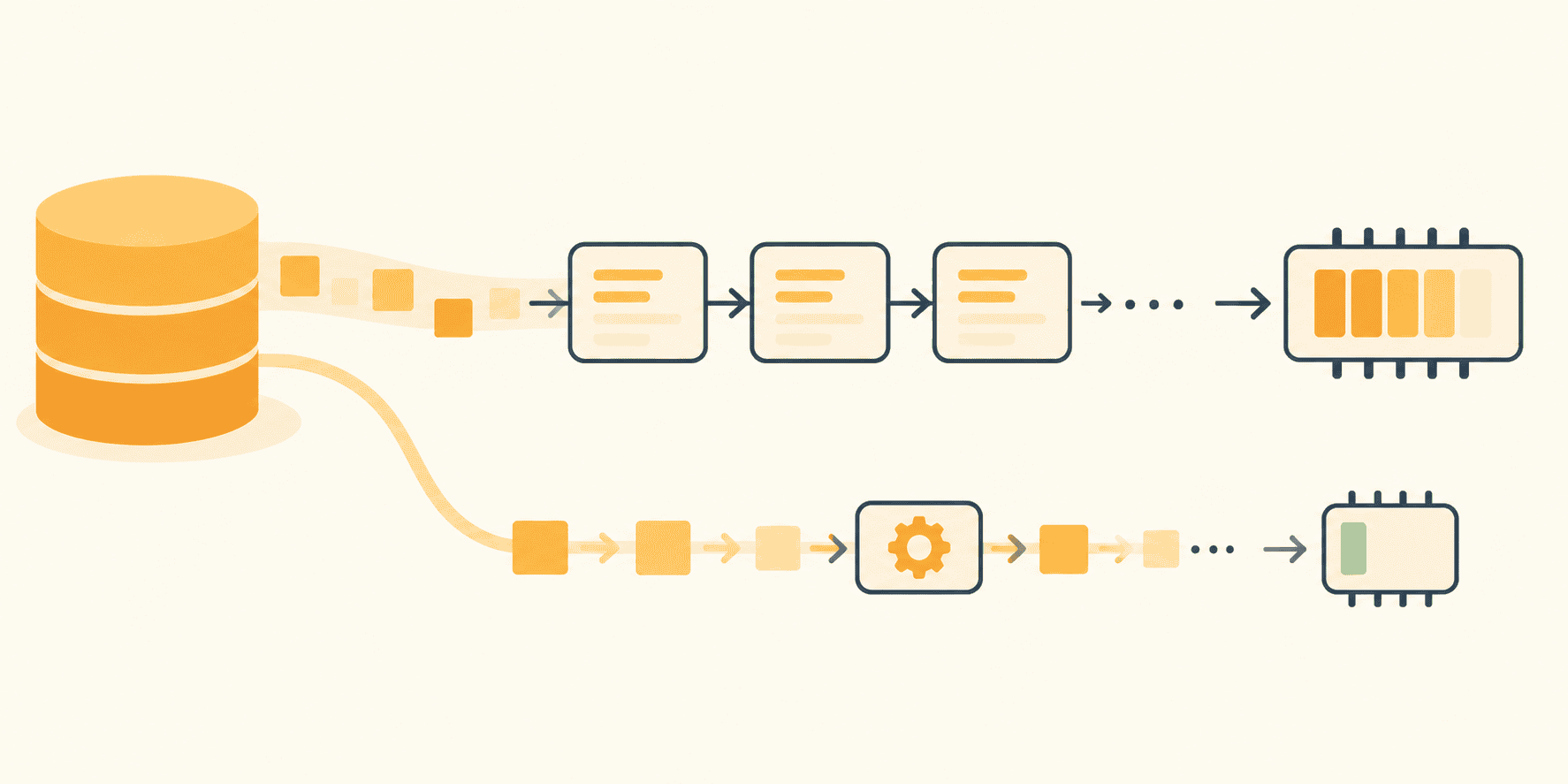
The core architectural flaw is not the transformation logic, but the lack of lazy evaluation. If each processing stage requires only one record at a time, forcing every record into existence concurrently introduces an existential bottleneck.
Supporting Context & Metrics: Iterators, Iterables, and the Streaming Contract
To rebuild this pipeline safely, developers must master the fundamental contracts governing Python’s iteration machinery.
The Iterator Protocol
Python’s for loop syntax abstracts a strict low-level protocol.
- Iterable: Any object capable of returning its members one at a time (e.g., lists, strings, dictionaries, open file handles). Iterables implement the
__iter__()method. - Iterator: An object representing a stream of data. Iterators implement
__iter__()(returning themselves) and__next__(), which yields the subsequent element or raises aStopIterationexception when exhausted.
numbers = iter([10, 20, 30])
next(numbers)   # 10
next(numbers)   # 20
next(numbers)   # 30
next(numbers)   # raises StopIteration
Unlike lists, iterators are forward-only cursors. They do not store copies of entire datasets; instead, they maintain a lightweight pointer or read buffer. When iterating over a 9 GB log file using native file object iteration (for line in f), Python reads buffered chunks from the disk dynamically, ensuring only a single line resides in memory at any given microsecond.
Leveraging Generator Functions
While file iterators manage reading, transformation stages require custom logic. This is achieved via generator functions containing the yield keyword.
Unlike standard functions that execute sequentially and return a finalized value via return, calling a generator function instantiates a generator object without executing its body. The function body pauses at each yield statement, preserving local variable bindings, instruction pointers, and evaluation stacks.
import re

LINE = re.compile(r"^(?P<ts>S+) (?P<level>[A-Z]+) (?P<service>[w-]+)(?P<rest>.*)$")

def read_lines(paths):
    for path in paths:
        with open(path, encoding="utf-8") as f:
            yield from f

def parse_records(lines):
    for line in lines:
        match = LINE.match(line)
        if match is None:
            continue
        record = match.groupdict()
        record["fields"] = dict(
            item.split("=", 1) for item in record.pop("rest").split() if "=" in item
        )
        yield record

def only_level(records, level):
    for record in records:
        if record["level"] == level:
            yield record
By chaining read_lines, parse_records, and only_level, developers construct a modular, highly testable processing line where data flows continuously without intermediate materialization.

Official Standards & Practical Implementation
Composing the Middle Pipeline
With individual generator stages defined, assembling the overarching pipeline requires combining generator functions, generator expressions, and standard library utilities from itertools:
from itertools import islice

lines = read_lines(["app.log.2", "app.log.1", "app.log"])
records = parse_records(lines)
errors = only_level(records, "ERROR")

# Generator expressions handle lightweight projections and filters
slow = (r for r in errors if int(r["fields"].get("latency_ms", 0)) > 1000)
rows = ((r["ts"], r["service"], r["fields"].get("request_id", "-")) for r in slow)

# Use islice to inspect streams without consuming the broader dataset
for row in islice(rows, 5):
    print(row)
Boundary Batching
Laziness cannot persist indefinitely; applications must ultimately write outputs to databases, API endpoints, or disk storage. However, writes should occur in bounded batches rather than single rows or monolithic dumps.
Since Python 3.12, the standard library provides itertools.batched() to handle this cleanly:
from itertools import batched

def write_batches(rows, path, size=1000):
    with open(path, "w", encoding="utf-8") as out:
        for batch in batched(rows, size):
            out.writelines(f"tstservicetridn" for ts, service, rid in batch)
            out.flush()

write_batches(rows, "slow_errors.tsv")
Measuring Performance: Empirical Metrics and Memory Profiling
A pipeline that appears lazy may still harbor eager allocations if a developer inadvertently introduces a list coercion or sorting mechanism. To verify true memory efficiency, engineers rely on Python’s native tracemalloc module.
import tracemalloc

tracemalloc.start()
write_batches(rows, "slow_errors.tsv")
current, peak = tracemalloc.get_traced_memory()
tracemalloc.stop()

print(f"Current memory: current / 1e6:.1f MB, Peak memory: peak / 1e6:.1f MB")
Comparative Benchmarking
When running synthetic benchmarks against a 200,000-line log dataset (~17 MB):
- The Eager Approach (List Comprehensions): Peaked at 198 MB of RAM consumption, scaling linearly with file size.
- The Streaming Approach (Iterators & Generators): Peaked at a negligible 0.4 MB of RAM consumption, remaining entirely flat regardless of input scale.
Future Outlook: The Evolution of Streaming Architectures in Python
As data volumes across enterprise environments continue to scale exponentially, the reliance on raw RAM as a default computing buffer is rapidly becoming obsolete. Modern Python development practices increasingly emphasize streaming-first architectures across diverse domains—ranging from large-scale machine learning dataset tokenization (processing massive JSONL files for LLM pre-training) to high-throughput event-driven microservices.
Future iterations of the Python runtime and standard library will likely introduce deeper syntactic sugar and performance optimizations for lazy evaluation chains. However, the core engineering principle remains unchanged: mastering iterators and generators transforms fragile, resource-heavy scripts into robust, production-grade engines capable of processing unbounded datasets with minimal hardware footprints.