Executive Overview
The landscape of agentic AI has matured at a blistering pace. What was once dismissed as experimental scaffolding—fragile loops of code duct-taped together with API calls in late 2023—has transformed into a mature ecosystem of serious enterprise orchestration frameworks. Today, development teams are not merely building conversational novelties or toy projects; they are deploying agentic architectures that shape core business processes, customer success pipelines, and autonomous data pipelines.
However, a dangerous disconnect persists between how frameworks are marketed and how they perform in production. Conventional evaluation metrics—such as GitHub star counts, benchmark leaderboards on open-source datasets, or claims of being the "easiest to get started with"—tell developers almost nothing about how an orchestration layer will behave when a critical workflow hits an unexpected edge case at 2:00 AM on a Sunday.
A framework optimized for open-ended, creative research and collaborative synthesis will inevitably collapse when injected into a tightly regulated compliance pipeline. Conversely, a rigid, deterministic state-machine framework will introduce suffocating bureaucratic overhead to a lightweight customer support assistant.
This comprehensive guide moves past the marketing hype, providing engineering leaders and system architects with a robust, decision-tree-based methodology. By analyzing your workload’s actual production requirements—spanning durability, state management, developer ecosystem constraints, and error recovery—you can select the precise framework tailored to your operational realities.
Detailed Chronology: The Evolution of Agentic Frameworks
To understand where the agentic ecosystem stands today, it is vital to examine the rapid evolutionary trajectory that brought the industry here.
Phase 1: The Wild West of Prompt Stitching (2022–2023)
In the immediate wake of large language models achieving general availability, developers built agents by writing raw Python scripts. These early implementations relied on basic while loops, appending model completions to message histories and parsing raw text outputs with regular expressions to determine tool calls. This era was characterized by high fragility; minor changes in model weights could completely break prompt-parsing logic, and error recovery usually meant crashing the entire application.
Phase 2: The Emergence of General-Purpose Chains (2023–2024)
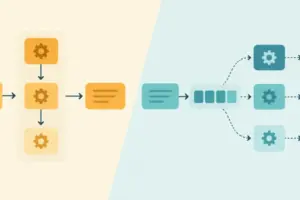
As the complexity of use cases grew, tools like early LangChain and LlamaIndex emerged to standardize data retrieval and prompt templating. Developers began chaining LLM calls sequentially or in simple branching paths. While this abstracted away boilerplate network requests, developers quickly realized that linear chains were insufficient for tasks requiring dynamic reasoning, loops, and autonomous tool selection.
Phase 3: The Multi-Agent Explosion and Metaphorical Abstractions (2024–2025)
The introduction of advanced reasoning models triggered an explosion in multi-agent frameworks. Developers sought to mirror human organizational structures, creating virtual teams where specialized agents—researchers, coders, reviewers—passed tasks back and forth. Frameworks adopting metaphorical abstractions (such as CrewAI and early AutoGen) democratized prototyping, allowing non-specialists to spin up multi-agent simulations in minutes. However, these abstractions often obscured underlying state management, making enterprise debugging notoriously difficult.
Phase 4: Production-Grade Specialization and Determinism (2025–2026)
By 2026, enterprise realities forced a hard pivot toward production-grade engineering. Organizations demanded type safety, audit trails, human-in-the-loop checkpointing, and absolute determinism. This maturity gave rise to specialized architectural approaches: graph-based state machines (LangGraph), type-safe functional frameworks (PydanticAI), ecosystem-native runtimes (OpenAI Agents SDK), and robust multi-agent debaters (AG2). The conversation shifted away from how fast can we build a prototype? toward how safely can we scale this to millions of enterprise transactions?
Supporting Context & Metrics: When Do You Actually Need Multi-Agent Complexity?
Before evaluating specific framework branches, engineering teams must confront a foundational architectural question: Does your task actually require a multi-agent system?
Empirical data from enterprise deployments in 2025 and 2026 reveals that the single most common architectural mistake is introducing orchestration complexity prematurely. A single agent equipped with well-defined, robustly typed tools and a precise system prompt can handle an astonishingly broad array of workloads. Single-agent systems are dramatically easier to debug, monitor, reason about, and audit.
The True Cost of Multi-Agent Multipliers
Introducing a multi-agent setup introduces compounding operational complexities:
- Token Consumption Multiplier: A four-agent collaborative crew running iterative refinement loops can easily consume four to ten times the token volume of a single agent executing the same task sequentially.
- Latency Inflation: Network round-trips multiply as agents converse, debate, and hand off tasks, turning a sub-second API response into a multi-minute orchestration flow.
- Failure Surface Expansion: Every additional agent in a workflow represents another point of potential prompt drift, hallucination injection, and state corruption.
Production Triggers for Multi-Agent Architectures
You should only introduce a multi-agent framework when a single agent hits unmistakable operational boundaries:
- Separation of Concerns and Context Windows: The required contextual scope exceeds a single model’s effective context window, or different steps demand fundamentally conflicting system prompts (e.g., an aggressive code generator paired with a hyper-conservative security auditor).
- Adversarial Validation: Tasks requiring critical self-correction, where one agent’s output must be rigorously tested, critiqued, and refined by an independent specialized agent before downstream consumption.
- Complex, Non-Linear Routing: Workflows where the next step cannot be determined statically and requires dynamic, autonomous evaluation by specialized domain experts.
If none of these conditions apply, build a robust single-agent system first. Add orchestration layers only when concrete operational bottlenecks demand it.
The Decision Tree: Navigating the Architectural Matrix
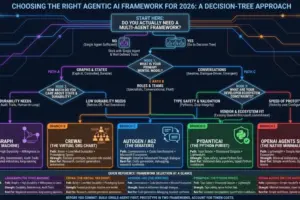
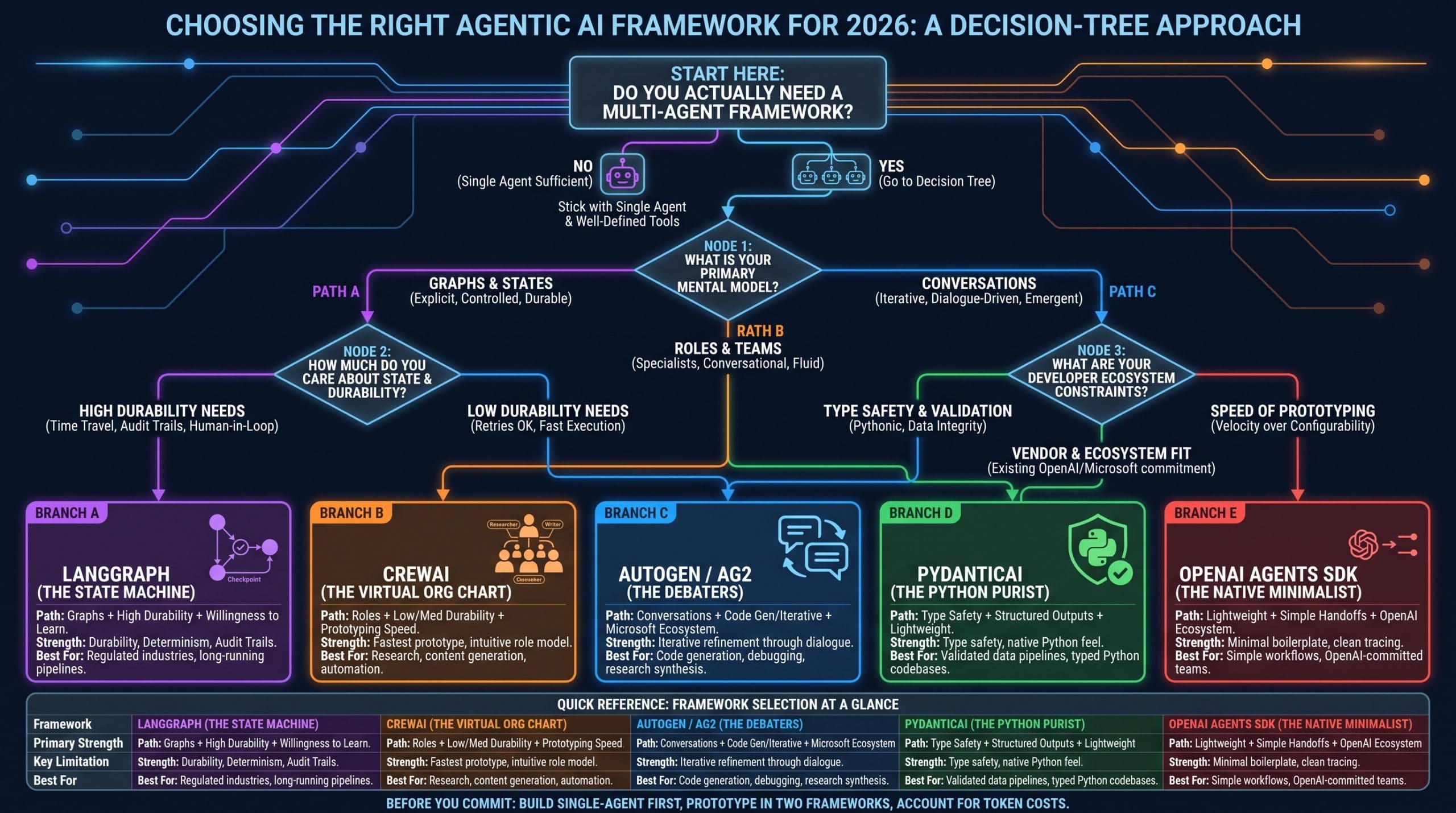
For workloads that genuinely require multi-agent orchestration, navigating the framework landscape demands a systematic, three-node decision tree.
[Start: Do you need Multi-Agent?]
          │
          ├── No  ──> Build Single-Agent System
          │
          └── Yes ──> Node 1: Primary Mental Model?
                        │
                        ├── Graphs & States ─────────> LangGraph
                        ├── Roles & Teams ───────────> CrewAI
                        └── Conversations / Debates ─> AutoGen / AG2
          │
          └── Node 2: State & Durability Needs?
                        │
                        ├── High Durability ─────────> LangGraph
                        └── Low Durability ──────────> CrewAI / OpenAI SDK
          │
          └── Node 3: Ecosystem & Typing Constraints?
                        │
                        ├── Strict Python Types ─────> PydanticAI
                        └── OpenAI Native API ───────> OpenAI Agents SDK
Node 1: What Is Your Primary Mental Model?
- Option A: Graphs and States. Your workflow follows defined steps with explicit transitions. You care deeply about failure handling, retries, and mandatory human-in-the-loop approvals.
- Option B: Roles and Teams. Your workflow maps directly to specialist contributors—researchers, writers, reviewers—handing tasks off in a semi-fluid organizational structure.
- Option C: Conversations. Your workflow is iterative and emergent. Agents discuss a problem back and forth until the output crosses an established quality threshold.
Node 2: How Much Do You Care About State and Durability?
- High Durability: Workflows run for minutes or hours. You must be able to pause mid-execution, inspect state, roll back errors, or wait indefinitely for human sign-off. Essential for financial transactions, medical workflows, and legal compliance.
- Low Durability: Workflows execute within seconds or minutes. Failures can be resolved simply by retrying from scratch. Intermediate state persistence is unnecessary.
Node 3: What Are Your Developer Ecosystem Constraints?
- Type Safety: Your team writes strictly typed Python, and runtime data corruption at function boundaries is entirely unacceptable.
- Vendor Ecosystem: Your infrastructure is tightly coupled with Microsoft Azure or OpenAI APIs, making ecosystem-native SDKs the path of least resistance.
The Five Framework Branches
Mapping your answers through the decision tree leads directly to one of five primary framework branches dominating the 2026 production landscape.
Branch A: LangGraph (The State Machine)
- Path: Graph-based mental model + High durability needs + Investment in a steep learning curve.
- Architecture: Developed within the broader LangChain ecosystem, LangGraph models workflows as explicit directed graphs. Nodes are executable functions; edges are conditional transitions. State is maintained via a typed dictionary that flows through the graph, capable of being snapshotted and persisted at every checkpoint.
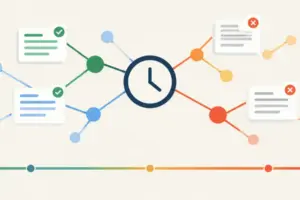
- Production Advantage: LangGraph natively supports "time travel"—the ability to pause execution mid-stream, inspect historical node states, alter data manually, and resume execution. Human-in-the-loop approvals and audit trails are first-class architectural features, making it the gold standard for banking compliance, legal document processing, and regulated enterprise pipelines.
- Trade-Offs: Verbosity and steep learning curves. Defining state schemas, wiring explicit edges, and configuring checkporters requires writing substantial boilerplate code. Teams seeking rapid afternoon prototypes will find LangGraph punishingly deliberate.
Branch B: CrewAI (The Virtual Org Chart)
- Path: Role-based mental model + Low-to-medium durability needs + Rapid prototyping priority.
- Architecture: CrewAI structures orchestration around human organizational metaphors. You instantiate agents with specific roles, goals, and backstories, assign them discrete tasks, and assemble them into operational crews.
- Production Advantage: Exceptional developer velocity. Teams routinely transition from initial concept to working multi-agent prototypes in under two hours. The mental model is intuitive, mapping neatly to standard business processes.
- Trade-Offs: Constraining misbehaving agents is notoriously difficult. Because coordination relies on conversational handoffs rather than rigid state transitions, agents that get caught in infinite loops or misinterpret goals are hard to intercept. It is ill-suited for strict enterprise pipelines where every action must be deterministic and fully auditable.
Branch C: AutoGen / AG2 (The Debaters)
- Path: Conversational mental model + Code generation / iterative refinement + Microsoft ecosystem alignment.
- Architecture: Formalized under the AG2 governance structure, this framework leverages multi-agent natural language dialogue. One agent generates code, another executes it in a sandboxed environment, and a third critiques the output in an iterative feedback loop until convergence.
- Production Advantage: Unmatched capability for iterative refinement tasks, particularly software engineering assistants, automated bug hunting, and complex data science pipelines. It features deep integration with enterprise Microsoft and Azure OpenAI services.
- Trade-Offs: Conversational drift. Multi-turn dialogues can occasionally spiral into unexpected tangents or circular arguments. Managing hard termination conditions requires meticulous prompt engineering.
Branch D: PydanticAI (The Python Purist)
- Path: Lightweight tool execution + Strict type safety + Structured data outputs.
- Architecture: PydanticAI adopts a minimalist philosophy. Rather than attempting to serve as a massive orchestration engine, it brings FastAPI-style ergonomics to agent development. Agents are defined with typed inputs/outputs, and tools are declared via standard Pydantic models.
- Production Advantage: Native integration for Python-heavy teams accustomed to strict type validation. Data integrity is enforced at every execution boundary without requiring developers to master complex graph abstractions or metaphorical frameworks.
- Trade-Offs: It is fundamentally an agent framework, not a complete orchestration framework. Teams requiring durable, multi-agent checkpointing must integrate external state management layers.
Branch E: OpenAI Agents SDK (The Native Minimalist)
- Path: Lightweight tool execution + Simple handoffs + OpenAI ecosystem commitment.
- Architecture: Released to streamline API interactions, the OpenAI Agents SDK provides an exceptionally clean, low-boilerplate mechanism for defining agents, binding tools, and executing linear handoffs.
- Production Advantage: Maximum speed-to-production for teams building strictly within the OpenAI ecosystem, backed by out-of-the-box tracing and observability.
- Trade-Offs: Severe vendor lock-in and limited orchestration flexibility. It handles linear, sequential handoffs brilliantly but buckles under complex branching, parallel execution, or multi-provider model switching.
Quick Reference: Framework Selection at a Glance
| Framework | Primary Strength | Key Limitation | Best For |
|---|---|---|---|
| LangGraph | Durability, determinism, audit trails | Steep learning curve, verbose setup | Regulated industries, long-running enterprise workflows |
| CrewAI | Rapid prototyping, intuitive role model | Harder to constrain rogue agents | Research automation, content generation, business processes |
| AutoGen / AG2 | Iterative refinement via dialogue | Conversational drift, unpredictable in strict pipelines | Software engineering, code generation, Microsoft stacks |
| PydanticAI | Type safety, structured outputs, native Python | Not a full orchestration engine | Validated data pipelines, strict typed codebases |
| OpenAI Agents SDK | Minimal boilerplate, clean tracing | Vendor lock-in, limited orchestration complexity | Simple workflows, OpenAI-committed engineering teams |
Official Statements and Industry Consensus
Industry leaders and principal architects have increasingly emphasized the necessity of architectural sobriety in agentic deployments.
Dr. Sarah Lin, Principal AI Systems Architect at Enterprise Intelligence Labs, noted during a recent systems engineering symposium:
"In 2023, the industry was intoxicated by the illusion of autonomous magic. In 2026, we have sobered up. Production systems do not care how poetic an agent’s inner monologue is; they care about state serialization, deterministic error recovery, and strict boundary validation. Choosing an orchestration framework is no longer about developer convenience—it is about risk mitigation."
Furthermore, enterprise security councils have established rigorous compliance mandates regarding agentic autonomy. Regulatory bodies across financial and healthcare sectors now require complete deterministic audit trails for any automated decision-making system affecting human assets or records—a regulatory reality that has heavily penalized unstructured conversational frameworks while cementing the dominance of state-machine architectures like LangGraph.
Future Outlook: The Horizon of Agentic Infrastructure
As we look toward the remainder of 2026 and into 2027, the agentic AI landscape is converging toward a unified modular paradigm. Several emerging trends will dictate the next generation of infrastructure:
- Native Protocol Standardization: We are witnessing the nascent standardization of inter-agent communication protocols, moving away from proprietary framework wire formats toward universal interoperability standards. This will allow agents built on PydanticAI to seamlessly query agents orchestrated within LangGraph instances.
- Deterministic-Probabilistic Hybrids: Future orchestration engines will increasingly blend deterministic business logic (traditional code, state machines, and relational databases) with probabilistic reasoning steps, reducing hallucination risks by bounding agent autonomy strictly within hardcoded constraints.
- Hardware-Accelerated State Tracking: As multi-agent enterprise workloads scale to thousands of concurrent threads, specialized vector and state-checkpointing databases will become native components of cloud infrastructure, dramatically reducing the latency penalty of long-running, durable agent workflows.
Final Recommendations Before You Commit
- Start Monolithic: Always build and stress-test a single-agent system before introducing multi-agent orchestration overhead.
- Build Proof-of-Concept Dual-Runs: If your requirements sit on the boundary between two architectural branches, invest two days into prototyping the core workflow in both frameworks. Real-world edge cases will quickly expose the superior fit.
- Model Your Economics: Factor token consumption multipliers directly into your financial projections before committing to resource-intensive collaborative multi-agent crews.
Ultimately, the correct framework is not the one dominating social media hype cycles or boasting the most GitHub stars; it is the infrastructure that makes your specific system failure modes easiest to anticipate, isolate, and recover from. Define your operational constraints first, and let your architecture follow.