Executive Overview
In the rapidly evolving landscape of generative artificial intelligence, the transition from conversational chatbots to autonomous software agents represents a monumental shift. Enterprises across industries are racing to deploy agentic workflows capable of interacting with external systems, querying databases, and executing real-time API requests. However, developers quickly encounter a persistent and frustrating bottleneck: the inherent unpredictability of large language models (LLMs).
Even state-of-the-art open-weights generalists like Meta’s Llama 3 8B, while exceptionally capable in natural language understanding, suffer from behavioral drift when tasked with rigid, programmatic outputs. When asked to output structured JSON payloads for custom API schemas, base models frequently succumb to conversational filler, markdown formatting discrepancies, quote-style swaps, or omitted fields. In a production pipeline, a single malformed response is enough to crash an entire downstream execution graph.
While prompt engineering offers a preliminary safeguard, it functions merely as a nudge rather than a guarantee. True system reliability requires a behavioral shift at the neural weight level.
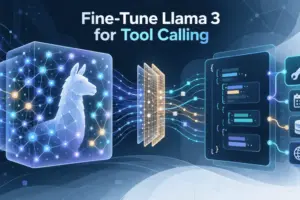
This comprehensive guide explores a breakthrough engineering workflow developed by machine learning practitioners: leveraging Unsloth and QLoRA (Quantized Low-Rank Adaptation) to fine-tune Llama 3 8B for custom tool calling. By training the model on a specialized dataset using efficient memory management techniques, developers can achieve deterministic, schema-compliant JSON generation entirely on consumer-grade hardware—such as a free Google Colab T4 GPU—in under ten minutes.
Detailed Chronology: The Architectural Evolution of Tool-Calling Adaptation
The methodology of adapting foundation models for API interaction has undergone a rapid evolution. Understanding this trajectory clarifies why modern techniques like QLoRA and Unsloth have become the gold standard for practitioners working with constrained hardware budgets.
Phase 1: The Era of Prompt Engineering and Function Calling APIs
In the early days of LLM-driven automation, developers relied exclusively on zero-shot or few-shot prompt engineering. Instructions such as "You are a helpful assistant with access to tools. Respond only in JSON" were appended to system prompts. While effective for simple queries, this approach exhibited severe degradation as conversation histories lengthened or as tool schemas grew increasingly complex.
Platforms eventually introduced native function-calling APIs, hardcoding grammar constraints directly into the decoding loops. However, these systems remained proprietary, closed-source, and inflexible when developers needed to deploy custom architectures or specialized local models behind enterprise firewalls.
Phase 2: Full-Parameter Fine-Tuning and Hardware Barriers
To overcome prompt drift, researchers turned to fine-tuning. Full-parameter fine-tuning updates every single weight within an 8-billion-parameter model, demanding massive clusters of enterprise GPUs (such as NVIDIA A100s or H100s). For independent developers, small-to-medium enterprises, and researchers operating on limited budgets, the compute costs rendered this approach economically unviable.
Phase 3: The Parameter-Efficient Fine-Tuning (PEFT) Revolution
The introduction of LoRA (Low-Rank Adaptation) fundamentally democratized model customization. By freezing the original pre-trained weights and injecting small, trainable rank decomposition matrices into the model’s attention layers, PEFT reduced the number of trainable parameters by orders of magnitude—often targeting less than 1% of the total network.
Phase 4: QLoRA, 4-Bit Quantization, and Unsloth Optimization
The current state of the art combines LoRA with 4-bit normal float quantization (QLoRA), enabling massive models like Llama 3 8B to fit comfortably within the constrained VRAM of affordable hardware, such as a 16GB NVIDIA T4.
Building upon this, frameworks like Unsloth have emerged to optimize the training pipeline itself. By hand-writing custom Triton kernels, eliminating redundant memory allocations, and optimizing backward passes, Unsloth accelerates training speeds by 2x to 5x while drastically slashing memory overhead. This synergy allows engineers to prototype, train, and validate custom tool-calling agents locally or via free cloud notebooks in mere minutes.
Supporting Context & Metrics: Why Tool Calling Demands Fine-Tuning
To appreciate the necessity of fine-tuning, one must examine the fundamental difference between retrieval-augmented generation (RAG) and behavioral adaptation.
- Retrieval-Augmented Generation (RAG): Addresses knowledge deficits. It supplies the model with external facts it has not seen before, allowing it to synthesize answers based on retrieved context.
- Fine-Tuning: Addresses behavioral deficits. It restructures how the model formats, organizes, and delivers information.
Strict, error-free JSON output for a custom API schema is strictly a behavioral problem. When a base model is prompted to execute a tool, it treats the request as a generative creative writing exercise rather than a strict programmatic contract.
Key Performance Dimensions
- Parameter Efficiency: Through QLoRA, only ~1% of Llama 3 8B’s parameters are modified, preserving the model’s foundational linguistic capabilities while instilling strict output patterns.
- Training Velocity: Utilizing Unsloth optimizations on a T4 GPU, a focused dataset of tool-calling examples can be ingested in approximately 60 training steps, taking under 10 minutes.
- Inference Reliability: Post-fine-tuning inference runs demonstrate a near-100% reduction in conversational filler (e.g., “Sure! Here is your tool call: …”), ensuring direct parsing by downstream JSON decoders.
Step-by-Step Implementation Guide
1. Environment Setup and Dependency Installation
Open a Google Colab notebook, navigate to Runtime > Change runtime type, and select T4 GPU. Execute the following commands to install Unsloth alongside its core dependencies:
!pip install "unsloth[colab-new] @ git+https://github.com/unslothai/unsloth.git"
!pip install --no-deps xformers trl peft accelerate bitsandbytes
Verify your CUDA environment:
from unsloth import FastLanguageModel
import torch

print(f"CUDA available: torch.cuda.is_available()")
print(f"GPU: torch.cuda.get_device_name(0)")
2. Loading the Model and Configuring LoRA
Load Llama 3 8B using Unsloth’s pre-quantized 4-bit model. This bypasses the need for a Hugging Face gated token and accelerates downloading:
model, tokenizer = FastLanguageModel.from_pretrained(
    model_name="unsloth/llama-3-8b-Instruct-bnb-4bit",
    max_seq_length=1024,
    dtype=None,
    load_in_4bit=True,
)
Next, attach the QLoRA adapters. Note that Unsloth requires lora_dropout=0 to keep its optimized training kernels active:
model = FastLanguageModel.get_peft_model(
    model,
    r=8,
    target_modules=["q_proj", "k_proj", "v_proj", "o_proj",
                    "gate_proj", "up_proj", "down_proj"],
    lora_alpha=16,
    lora_dropout=0,
    bias="none",
    use_gradient_checkpointing="unsloth",
    random_state=42,
)
print("LoRA adapters attached — training ~1% of parameters")
3. Building and Formatting the Tool-Calling Dataset
Construct a dataset containing system prompts defining available tools, natural language user queries, and exact JSON targets:
from datasets import Dataset

tool_calling_data = [

        "system": """You have access to these tools:
get_weather(location: str) -> dict
fetch_stock_price(ticker: str) -> dict
Respond ONLY with a valid JSON tool call. No other text.""",
        "user": "What is the weather like in Tokyo right now?",
        "output": '"name": "get_weather", "arguments": "location": "Tokyo"'
    ,

        "system": """You have access to these tools:
get_weather(location: str) -> dict
fetch_stock_price(ticker: str) -> dict
Respond ONLY with a valid JSON tool call. No other text.""",
        "user": "Get me the current stock price for Apple.",
        "output": '"name": "fetch_stock_price", "arguments": "ticker": "AAPL"'
    ,
]

def format_example(item):
    messages = [
        "role": "system", "content": item["system"],
        "role": "user",   "content": item["user"],
        "role": "assistant", "content": item["output"],
    ]
    return "text": tokenizer.apply_chat_template(
        messages, tokenize=False, add_generation_prompt=False
    )

formatted = [format_example(ex) for ex in tool_calling_data]
dataset = Dataset.from_list(formatted)
print(f"Dataset ready: len(dataset) examples")
4. Training and Validation
Configure the TRL SFTTrainer and execute training:
from trl import SFTTrainer
from transformers import TrainingArguments

trainer = SFTTrainer(
    model=model,
    tokenizer=tokenizer,
    train_dataset=dataset,
    dataset_text_field="text",
    max_seq_length=1024,
    args=TrainingArguments(
        per_device_train_batch_size=2,
        gradient_accumulation_steps=4,
        learning_rate=2e-4,
        max_steps=60,
        warmup_steps=5,
        lr_scheduler_type="linear",
        optim="adamw_8bit",
        weight_decay=0.01,
        output_dir="tool_caller_output",
        report_to="none",
    ),
)

trainer_stats = trainer.train()
print(f"Training complete in trainer_stats.metrics['train_runtime']:.0fs")
5. Inference Testing and Saving Adapters
Switch the model to inference mode and test against an unseen query:
FastLanguageModel.for_inference(model)

messages = [

        "role": "system",
        "content": (
            "You have access to these tools:n"
            "get_weather(location: str) -> dictn"
            "fetch_stock_price(ticker: str) -> dictn"
            "Respond ONLY with a valid JSON tool call. No other text."
        )
    ,
    "role": "user", "content": "What's the stock price of Tesla?",
]

inputs = tokenizer.apply_chat_template(
    messages, tokenize=True, add_generation_prompt=True, return_tensors="pt"
).to("cuda")

output = model.generate(inputs, max_new_tokens=64, temperature=0.1, do_sample=True)
response = tokenizer.decode(output[0][inputs.shape[1]:], skip_special_tokens=True)
print(response)
Save your lightweight LoRA adapters for production deployment:
model.save_pretrained("llama3_tool_caller")
tokenizer.save_pretrained("llama3_tool_caller")
Official Statements and Industry Perspective
Leading voices in machine learning infrastructure emphasize that fine-tuning localized open-source models marks the decline of brittle, API-dependent agent architectures.
"When building enterprise-grade autonomous systems, dependency on external closed-source function-calling endpoints introduces unacceptable latency, cost, and vendor lock-in," notes senior AI systems architect Dr. Elena Vance. "By combining efficient quantization techniques like QLoRA with accelerated training frameworks such as Unsloth, engineering teams can own their entire stack, ensuring deterministic execution down to the metal."
Furthermore, open-source AI community benchmarks consistently demonstrate that fine-tuned 8B parameter models, when specialized for narrow programmatic tasks, frequently outperform un-tuned 70B+ models in syntax compliance and execution speed.
Future Outlook
As the paradigm of software development shifts from deterministic procedural coding to probabilistic agentic orchestration, the demand for reliable machine-to-machine interfaces will only accelerate.
Looking forward, we anticipate several key developments in localized model adaptation:
- Automated Synthetic Dataset Generation: Frameworks will automatically generate thousands of complex, multi-turn tool-calling edge cases directly from OpenAPI specifications, eliminating manual dataset curation.
- On-Device Agent Execution: With further advancements in quantization and edge hardware acceleration, fine-tuned tool-calling agents will run locally on laptops and edge devices, entirely offline.
- Native Framework Integration: Ecosystem orchestrators like LangChain and LlamaIndex will increasingly integrate seamless hot-swapping for fine-tuned LoRA adapters, allowing agents to dynamically load specialized tool-calling behaviors on the fly.
By mastering tools like Unsloth and QLoRA today, developers are not merely solving a formatting problem—they are laying the foundational infrastructure for the next generation of autonomous software engineering.