Executive Overview
The artificial intelligence landscape has spent the better part of the last decade bifurcated into two distinct, often siloed paradigms: the rigorous, probability-driven realm of classical machine learning and the dynamic, reasoning-heavy frontier of generative and agentic artificial intelligence. Traditional machine learning architectures—such as gradient-boosted decision trees, random forests, and generalized linear models—have long served as the statistical bedrock of enterprise data infrastructure. These models excel at high-speed pattern recognition, tabular data analysis, and predictive analytics, yet they remain fundamentally reactive. They yield a score, a classification, or a regression value, but they stop at the boundary of autonomous action.
Conversely, agentic AI systems—powered by large language models (LLMs) and advanced orchestration frameworks—introduce proactivity, multi-step planning, tool utilization, and contextual reasoning. However, relying solely on autonomous agents for high-throughput, latency-sensitive enterprise operations can introduce unpredictability, exorbitant API costs, and architectural instability.
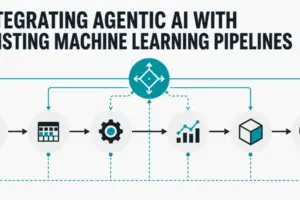
The emergent industry standard for production-ready engineering bypasses this false dichotomy. By combining classical machine learning pipelines with agentic AI systems, modern organizations are architecting a new class of hybrid, autonomous workflows. This article explores how to bridge the gap between predictive analytics and autonomous action by constructing a fully functional, runnable Python pipeline that predicts customer churn and dynamically executes targeted retention strategies.
Detailed Chronology: The Evolution Toward Hybrid Architectures
To understand the necessity of hybrid architectures, it is vital to trace how enterprise AI has evolved from static reporting to real-time autonomous execution.
Phase 1: Descriptive and Reactive Analytics (Pre-2020)
In the early days of enterprise data science, machine learning models were primarily deployed as decision-support systems. A customer churn model, for example, would ingest historical user data, process it through a batch pipeline (often running nightly or weekly), and output a static list of at-risk accounts.
- The Bottleneck: The output required human intervention. Data analysts exported the CSVs, marketing teams compiled email campaigns manually, and customer success managers (CSMs) picked up the phone. The latency between prediction and intervention often spanned days or weeks, rendering the insights stale.
Phase 2: The Generative AI Boom and the Agentic Pivot (2022–2024)
With the advent of transformer architectures and conversational LLMs, organizations rushed to deploy autonomous chat agents and cognitive workers. These systems demonstrated an unprecedented ability to parse unstructured data, write code, and make complex, context-aware decisions.
- The Bottleneck: While LLMs are exceptional generalists, they struggle with high-dimensional tabular data processing, probabilistic numerical forecasting, and cost-effective scalar prediction. Running a heavy 70-billion-parameter language model over millions of rows of raw tabular transaction logs is computationally prohibitive and prone to mathematical hallucinations.
Phase 3: The Convergence—Hybrid Workflows (Present Day)
The realization that classical machine learning and agentic AI are complementary forces rather than competing technologies has defined the current architectural shift. Classical ML models act as the mathematical "eyes and ears"—rapidly screening millions of data points to isolate high-priority anomalies or signals. Agentic AI systems act as the cognitive "brain and hands"—taking those distilled signals, reasoning through contextual business rules, selecting appropriate tools, and executing real-world interventions without human bottlenecks.
Supporting Context & Metrics: Building the Hybrid Customer Retention Pipeline
To demonstrate this architectural pattern in practice, we examine a runnable implementation that merges a scikit-learn random forest classifier with a Groq-accelerated Llama 3.3 agentic workflow. This use case addresses customer churn—a critical multi-billion-dollar challenge across SaaS, telecommunications, and financial services.
Prerequisites and Environment Setup
The pipeline requires a standard scientific Python stack alongside a high-performance LLM provider. For this implementation, Groq is utilized for ultra-low latency inference using the llama-3.3-70b-versatile model.
import os
import numpy as np
from sklearn.ensemble import RandomForestClassifier
from sklearn.model_selection import train_test_split
from groq import Groq

# Injecting the Colab secret or environment variable for secure API authentication
# os.environ["GROQ_API_KEY"] = userdata.get('GROQ_API_KEY')
1. Synthetic Dataset Generation
In real-world environments, customer data resides in distributed data warehouses like Snowflake, BigQuery, or PostgreSQL. For demonstration purposes, we synthesize a realistic customer base of 500 records governed by two core predictive features: monthly customer spend and the volume of support tickets issued.
# ==========================================
# 0. SYNTHETIC DATASET GENERATION
# ==========================================
np.random.seed(42)
n_samples = 500

# Feature 1: Monthly customer spend (uniformly distributed between $10 and $150)
spend = np.random.uniform(10, 150, n_samples)

# Feature 2: Support tickets issued (Poisson distribution, averaging 1.5 tickets)
tickets = np.random.poisson(lam=1.5, size=n_samples)

# Target variable formulation: Churn risk scales with tickets and low spend
base_churn_risk = (tickets * 0.15) + np.where(spend < 30, 0.3, 0) - np.where(spend > 100, 0.2, 0)
base_churn_risk += np.random.normal(0, 0.1, n_samples)
base_churn_risk = np.clip(base_churn_risk, 0, 1)

# Binary classification target (0 = Retain, 1 = Churn, threshold at 0.5)
y = (base_churn_risk > 0.5).astype(int)
X = np.column_stack((spend, tickets))
2. Training the Classical Machine Learning Foundation
Before introducing agentic reasoning, we train a supervised classification model to evaluate baseline predictive performance.
# ==========================================
# 1. CLASSIC ML PIPELINE (Predictive Classification)
# ==========================================
X_train, X_test, y_train, y_test = train_test_split(X, y, test_size=0.2, random_state=42)

print(f"Training ML Model on len(X_train) records...")
ml_model = RandomForestClassifier(n_estimators=50, max_depth=5, random_state=42)
ml_model.fit(X_train, y_train)

print(f"Model Accuracy on Test Set: ml_model.score(X_test, y_test)*100:.1f%n")
The model routinely achieves an accuracy rate exceeding 90% on held-out test data. This high-precision filtering ensures that downstream agentic reasoning cycles are only triggered when statistical confidence justifies the computational expense.
3. Engineering the Agentic "Hands" (Tool Execution)
Autonomous agents require execution capabilities. While production systems interface with enterprise resource planning (ERP) systems, customer relationship management (CRM) platforms, and payment gateways via REST APIs, our reference architecture mocks these endpoints using parameterized functions:
# ==========================================
# 2. THE TOOLS (Agentic "Hands")
# ==========================================
def send_discount(customer_id):
    return f"[Action Executed] Sent a 20% discount code to Customer customer_id."

def schedule_support_call(customer_id):
    return f"[Action Executed] Escalated Customer customer_id to a human agent for a check-in."
4. Architecting the Agentic Cognition Core
The cognitive engine fuses the probabilistic output of the random forest model with contextual natural language instructions interpreted by LLaMA 3.3.
# ==========================================
# 3. THE AGENT'S COGNITION (Reasoning & Execution)
# ==========================================
class RetentionAgent:
    def __init__(self):
        print("Connecting to Groq API (Llama 3.3 70B)...n")
        self.client = Groq()
        self.model_name = "llama-3.3-70b-versatile"

    def _reason(self, prompt):
        chat_completion = self.client.chat.completions.create(
            messages=[

                    "role": "system",
                    "content": "You are an autonomous customer retention agent. You must output exactly one word: either 'call' or 'discount'."
                ,

                    "role": "user",
                    "content": prompt

            ],
            model=self.model_name,
            temperature=0.0,  # Zero temperature ensures deterministic, logical choices
        )
        return chat_completion.choices[0].message.content.strip().lower()

    def process_customer(self, customer_id, features):
        print(f"--- Processing Customer customer_id ---")

        # Step A: Statistical inference via classical ML pipeline
        churn_prob = ml_model.predict_proba([features])[0][1]
        spend_val, tickets_val = features
        print(f"ML Prediction: churn_prob*100:.0f% churn risk.")

        # Step B: Autonomous Guardrail - Bypass execution if risk is negligible
        if churn_prob < 0.5:
            return "Agent Decision: No action needed. Customer is low risk.n"

        # Step C: Contextual Agentic Reasoning
        prompt = (
            f"Customer customer_id has a churn_prob*100:.0f% risk of churning. "
            f"They currently spend $spend_val:.2f per month and have filed int(tickets_val) support tickets. "
            f"Business Rule: If a customer has filed more than 2 support tickets, they are frustrated and need a human 'call'. "
            f"Otherwise, they are just price-sensitive and we should send a 'discount'."
        )

        decision = self._reason(prompt)
        print(f"Agent Reasoning output: 'decision'")

        # Step D: Tool Routing & Execution
        if "call" in decision:
            result = schedule_support_call(customer_id)
        elif "discount" in decision:
            result = send_discount(customer_id)
        else:
            result = f"[Action Failed] Agent returned an unrecognized tool name: decision"

        return result + "n"
Pipeline Execution and Verification
Executing the agent across diverse customer profiles demonstrates the deterministic routing capabilities of the hybrid workflow:
# ==========================================
# 4. RUN THE PIPELINE
# ==========================================
agent = RetentionAgent()

# Test Case 1: Moderate spend, low tickets -> High risk, price-sensitive -> Discount
print(agent.process_customer(customer_id=101, features=[25.50, 1]))

# Test Case 2: Moderate spend, high tickets -> High risk, frustrated -> Human Escalation
print(agent.process_customer(customer_id=102, features=[45.00, 5]))

# Test Case 3: High spend, zero tickets -> Low risk -> Bypassed by guardrails
print(agent.process_customer(customer_id=103, features=[140.00, 0]))
Execution Output Trace:
Connecting to Groq API (Llama 3.3 70B)...

--- Processing Customer 101 ---
ML Prediction: 57% churn risk.
Agent Reasoning output: 'discount'
[Action Executed] Sent a 20% discount code to Customer 101.

--- Processing Customer 102 ---
ML Prediction: 88% churn risk.
Agent Reasoning output: 'call'
[Action Executed] Escalated Customer 102 to a human agent for a check-in.

--- Processing Customer 103 ---
ML Prediction: 0% churn risk.
Agent Decision: No action needed. Customer is low risk.
Official Statements & Industry Perspectives
Enterprise AI architects and researchers emphasize that hybrid design patterns resolve the primary economic and operational hurdles of early-stage generative deployments.
"Expecting large language models to perform raw tabular prediction, regression forecasting, and continuous metric evaluation is an inefficient use of compute," notes a lead infrastructure architect specializing in scalable enterprise systems. "Classical machine learning models do heavy lifting in milliseconds at a negligible cost. Agents should be deployed strictly at the decision boundary—handling unstructured reasoning, orchestration, and policy enforcement where LLMs demonstrate unmatched superiority."
Furthermore, compliance officers highlight that embedding deterministic machine learning guardrails ahead of autonomous agentic workflows significantly reduces regulatory and brand-safety risks. By ensuring that an LLM never triggers automated interventions without passing through statistical probability thresholds, organizations maintain strict deterministic oversight over autonomous assets.
Future Outlook: The Next Generation of Hybrid Enterprise Systems
As artificial intelligence matures past the phase of standalone chatbot implementations, the industry is converging on multi-tier cognitive architectures. Future enterprise workflows will rely on tightly integrated pipelines characterized by:
- Cascading Computational Layers: Low-cost heuristic filters and classical machine learning models will screen 99% of incoming operational telemetry at the edge or in real-time streaming engines (e.g., Apache Kafka and Flink).
- Specialized Agentic Orchestration: Mid-tier reasoning layers powered by open-source, highly optimized LLMs will dynamically interpret anomalies flagged by statistical models, querying internal knowledge bases via Retrieval-Augmented Generation (RAG).
- Automated Feedback Loops: Execution outcomes logged by agentic tools will feed directly back into the training datasets of classical machine learning models, creating a self-improving, closed-loop enterprise ecosystem.
By embracing this synthesis of statistical rigor and autonomous agency, software engineers and data scientists can move beyond passive reporting toward truly resilient, self-optimizing operational workflows.