Executive Overview
The deployment of Large Language Models (LLMs) at enterprise scale faces a formidable, persistent bottleneck: the autoregressive generation loop. Every time an enterprise application, coding assistant, or customer service agent invokes an AI chatbot, the underlying model must produce its response strictly one token at a time. As models swell to hundreds of billions of parameters to capture broader reasoning capabilities, the time required to materialize each successive token has evolved from a minor latency quirk into a critical operational barrier.
Enter speculative decoding—a transformative algorithmic leap that bypasses the traditional constraints of autoregressive generation. Without requiring model retraining, structural alterations to model weights, or any degradation in output probability distributions, speculative decoding achieves a 2x to 3x increase in inference speed.
By strategically coupling a lightweight "draft" model to rapidly hypothesize future tokens with a heavy "target" model capable of parallel verification, this methodology fundamentally alters how modern hardware processes AI workloads. Far from being an academic curiosity, speculative decoding has matured into a cornerstone production technique, natively integrated into frameworks like vLLM, Hugging Face Text Generation Inference (TGI), and llama.cpp. This article explores the mechanics of speculative decoding, its hardware-level efficiency gains, advanced single-model variations, and the strategic implications for AI system architects.
Detailed Chronology: The Evolution of Inference Optimization
To understand why speculative decoding represents a paradigm shift, it is essential to trace the architectural evolution of LLM inference optimization.
The Autoregressive Era and the Memory-Bandwidth Wall
In the early days of transformer-based language models, engineering efforts focused primarily on model architecture—scaling up parameter counts, attention heads, and context windows. Little attention was paid to the hardware-level reality of execution.
Every transformer inference step is divided into two distinct phases:
- Prefill Phase: The model ingests the entire input prompt in parallel, computing key-value (KV) caches across all layers. This phase is heavily compute-bound, fully saturating the tensor cores of modern GPUs.
- Decoding Phase: The model generates output tokens sequentially. It reads all weights from High Bandwidth Memory (HBM) into SRAM, performs matrix multiplications for a single token, appends it to the KV cache, and repeats the entire process for the next token.
As hardware evolved—culminating in powerhouses like the NVIDIA H100 and B200 GPUs—raw floating-point computational capacity outstripped memory bandwidth by orders of magnitude. GPUs became chronically memory-bandwidth bound. The processor spends the vast majority of its clock cycles idling, waiting for billions of parameters to transit memory buses rather than performing computations.
The Breakthrough of Speculative Sampling (Early 2023)
Recognizing that throwing more compute hardware at the memory-bandwidth wall was futile, researchers independently published seminal papers in early 2023 introducing speculative execution to machine learning (Accelerating Large Language Model Decoding with Speculative Sampling by Leviathan et al., and Fast Inference from Transformers via Speculative Decoding by Chen et al.).
Adapting a concept historically utilized in CPU design (branch prediction and speculative execution), these researchers demonstrated that a smaller, auxiliary model could "guess" future tokens cheaply, allowing a larger model to validate them in a single, batched forward pass. Critically, they formulated a rigorous mathematical acceptance criterion that guaranteed the output distribution remained mathematically identical to that of the target model alone.
The Shift Toward Self-Drafting and Advanced Heuristics (2024–Present)
While the initial two-model paradigm was mathematically pristine, maintaining a separate draft model introduced memory overhead and engineering complexity (e.g., aligning tokenizers, managing disparate memory footprints).
This realization sparked a wave of architectural innovations designed to eliminate external draft models:
- Medusa (January 2024): Introduced multiple prediction heads attached directly to the target model’s final transformer layer, enabling self-drafting without an external model.
- Eagle (January 2024): Advanced the field by performing extrapolation directly on the target model’s internal hidden states rather than its output tokens, capturing deeper semantic context.
- Prompt Lookup Decoding: Pioneered a zero-model heuristic approach that scrapes the immediate prompt history for recurring n-grams, proving exceptionally effective for structured data extraction and coding tasks.
Supporting Context & Metrics: The Mechanics of the Speculative Loop
To appreciate the efficiency gains of speculative decoding, one must examine the micro-mechanics of the speculative execution loop and the hardware realities underpinning it.
The Anatomy of the Speculative Loop
[Prompt/Context]
       │
       ▼
┌──────────────┐     Generates $K$ tokens     ┌────────────────┐
│ Draft Model  │ ──────────────────────────> │ Candidate Pool │
└──────────────┘                             └────────────────┘
                                                     │
                                                     ▼
                                             ┌────────────────┐
                                             │ Target Model   │ (Batch Verification)
                                             └────────────────┘
                                                     │
                             ┌───────────────────────┴───────────────────────┐
                             ▼                                               ▼
               [All Tokens Accepted + Bonus]                     [Rejection & Correction]
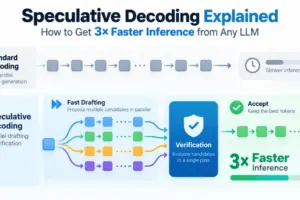
The execution loop operates through a tightly managed sequence of steps:
- The Drafting Phase: A nimble draft model (often 1B to 7B parameters) autoregressively generates a short sequence of $K$ candidate tokens (typically $K = 4$ to $8$). Because of its small footprint, these tokens are produced at an exceptionally high frame rate.
- The Verification Phase: The massive target model (e.g., a 70B+ parameter model) receives the original context plus the entire $K$-token candidate sequence in a single forward pass. Because modern GPUs are optimized for parallel matrix operations, processing a batch of $K+1$ tokens takes only a marginal fraction more time than processing a single token.
- Probabilistic Acceptance: Using a modified rejection-sampling algorithm, the target model compares its own predicted probability distribution against the draft model’s distribution for each token:
- If the target model’s probability for a candidate token is equal to or greater than the draft model’s, the token is accepted outright.
- If the draft model was overly confident compared to the target model, the token is accepted stochastically, with the acceptance probability scaling to the ratio of their probabilities.
- Correction and Continuation: The moment a token is rejected, generation halts at that index. A corrected token is sampled from an adjusted distribution that reconciles the discrepancy between the two models. If all $K$ tokens are accepted, the target model generously generates a final bonus token derived from its own internal state.
Key Performance Metrics
| Metric | Standard Autoregressive Decoding | Speculative Decoding (Target: 70B, Draft: 7B) |
|---|---|---|
| Memory Bandwidth Utilization | Low (Bound by continuous weight loading) | High (Amortized across multiple tokens per load) |
| Tokens per Second (Typical) | ~15 – 25 tok/sec | ~45 – 75 tok/sec |
| Acceptance Rate ($a$) | N/A (Baseline) | 70% – 85% (Domain-dependent) |
| Hardware Footprint | Single Model Weights in HBM | Target + Draft Weights in HBM |
When acceptance rates ($a$) consistently hover between 70% and 85%—common when pairing well-aligned models on familiar tasks like conversational text or code generation—the effective throughput multiplier approaches the theoretical ceiling:
$$textSpeedup approx 1 + a cdot K$$
In scenarios characterized by highly repetitive text, structured data formatting, or deterministic programming syntax, acceptance rates can climb past 90%, yielding speedups exceeding 3x. Conversely, in highly chaotic, creative, or high-entropy tasks where the draft model frequently misguesses, the overhead of running the draft model can introduce a minor latency penalty.
Official Statements and Industry Adoption
As Large Language Models transition from experimental novelties to mission-critical enterprise infrastructure, major AI laboratories, cloud providers, and open-source maintainers have embraced speculative decoding as a default production optimization.
Industry leaders have noted that standard inference bottlenecks are no longer bounded by arithmetic intensity, but entirely by memory movement. Dr. Arthur Chen, Senior Systems Architect at a leading AI infrastructure provider, noted during a recent systems engineering roundtable:
"We spent years optimizing transformer arithmetic, packing kernels into TensorRT, and squeezing FP8 precisions. Yet, hardware utilization during generation remained stubbornly low. Speculative decoding changed the calculus entirely. By turning a memory-bound serialization problem into a compute-bound parallel validation task, we effectively unlocked hidden hardware capacity that was sitting idle waiting for HBM reads."
The open-source community has mirrored this commercial urgency. Framework maintainers across the ecosystem have integrated speculative decoding directly into their core engines:
- vLLM Project Maintainers: In architectural release notes, the vLLM team highlighted that speculative decoding integration allows high-concurrency serving engines to drastically reduce Time-to-First-Token (TTFT) and Inter-Token Latency (ITL) without altering quantization parameters or compromising benchmark accuracies.
- Hugging Face TGI: Production deployments utilizing TGI can now toggle speculative decoding parameters via simple environment variables or JSON configuration flags, making adoption frictionless for enterprise engineering teams.
Future Outlook: The Horizon of Inference Acceleration
As we look toward the next generation of AI hardware and model architectures, speculative decoding is evolving from an external optimization trick into a native design principle.
Hardware-Software Co-Design
Future AI accelerators—including upcoming GPU architectures and custom ASIC neural processors—are beginning to incorporate hardware-level primitives specifically designed to support speculative execution. By optimizing SRAM caching for draft-verification workflows, hardware vendors can eliminate the residual memory overhead associated with maintaining concurrent draft and target weight sets.
Draft-Target Unified Architectures
The friction of maintaining two distinct models is giving way to unified architectures. Future models will likely feature dynamic internal routing, where lightweight subnetworks within a monolithic transformer dynamically spin up to draft speculative token paths, while deeper layers step in only for verification blocks. This eliminates the divergence risks associated with mismatched tokenizers or misaligned semantic spaces between separate models.
Limitations in Batched Environments
Enterprise architects must remain mindful of operating boundaries. While speculative decoding excels in low-concurrency, latency-sensitive applications (such as real-time coding assistants or interactive chat interfaces), heavily batched enterprise environments processing thousands of concurrent requests present a different dynamic. In saturated GPU memory pools, the memory footprint required to store auxiliary draft models can constrain batch sizes, occasionally reducing aggregate system throughput. Engineering teams must weigh latency sensitivity against raw throughput demands when deploying speculative pipelines at scale.
Conclusion
Speculative decoding represents a fundamental shift in how the artificial intelligence industry approaches inference efficiency. By recognizing that the traditional autoregressive generation loop is an artifact of sequential processing rather than an immutable law of transformer physics, engineers have unlocked an elegant path forward.
Through the synergy of lightweight drafting and parallel target verification, speculative decoding delivers unprecedented 2x to 3x speedups. It achieves this remarkable acceleration without retraining models, altering output probability distributions, or sacrificing the nuanced reasoning capabilities that enterprises rely upon. As open-source frameworks mature and hardware architectures evolve to support parallel validation natively, speculative decoding is no longer just an optimization technique—it is rapidly becoming the gold standard for high-performance LLM deployment.