Executive Overview
Every week, a new artificial intelligence provider claims its latest agentic system is state-of-the-art. Marketing collateral glows with impressive double-digit performance gains, and public leaderboards shift continuously. Yet, for enterprise engineering teams, product managers, and decision-makers who have actually deployed AI agents into production environments, a single pragmatic question eclipses all others: Does the system reliably do the job it was hired to do?
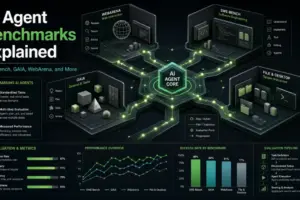
This comprehensive guide cuts through the leaderboard noise. It examines the architectural anatomy of major AI agent benchmarks—including SWE-bench, GAIA, WebArena, and OSWorld—and contrasts them with traditional model-level testing. By understanding what these evaluations truly measure, why each captures only a fraction of real-world capability, and how training data contamination and evaluation noise skew results, technical leaders can transition from passive consumers of marketing metrics to rigorous evaluators of autonomous software. Ultimately, public benchmarks should be treated as directional signals and preliminary filters, never as performance guarantees for live production systems.
Detailed Chronology: The Evolution from Static Models to Dynamic Agents
To understand why contemporary AI agent benchmarks exist, it is necessary to trace how evaluation methodologies evolved alongside foundational large language models (LLMs).
Phase I: The Era of Static Benchmarks (2020–2022)
In the early years of the modern generative AI boom, evaluation focused almost entirely on static text generation and raw pattern matching. Benchmarks like MMLU (Massive Multitask Language Understanding) and HumanEval established the standard for evaluating models in a single turn.
- The Methodology: A user submits a prompt, the model generates a response in a single forward pass, and an automated oracle scores the output against a static ground-truth answer.
- The Limitation: While these tests effectively quantify language understanding, factual recall, and isolated programming logic, they tell developers nothing about an AI’s capacity to navigate environments, correct its own errors, or achieve multi-step objectives over extended time horizons.
Phase II: The Rise of Multi-Step Execution Frameworks (2023)
As model reasoning improved, developers began wrapping LLMs in loop structures, granting them access to external APIs, calculators, and search engines. This gave birth to the "AI agent."
Recognizing that static tests could not measure iterative problem-solving, the research community introduced task-specific, interactive environments. In 2023, early iterations of SWE-bench and web navigation testbeds emerged, forcing models to take sequences of actions, evaluate intermediate states, and adjust their strategies when encountering failure.
Phase III: Standardization and Specialized Environments (2024–Present)
Today, the evaluation landscape has matured into a diverse ecosystem of specialized environments. Benchmarks are no longer just about generating text or writing snippets of code; they simulate entire software engineering repositories (SWE-bench Verified), complex multi-modal research tasks (GAIA), e-commerce workflows (WebArena), and complete desktop operating systems (OSWorld). However, this specialization has exposed a paradox: as benchmarks become more sophisticated and realistic, they also become more fragile, computationally expensive, and susceptible to data contamination.
Supporting Context & Metrics: Deconstructing the Major Benchmarks
Evaluating an agent requires moving away from the "written exam" paradigm and toward a "live work simulation." The table below outlines how modern benchmarks differ in scope, mechanics, and failure modes.
| Benchmark | Primary Environment | Core Task | Success Criterion | Major Limitation |
|---|---|---|---|---|
| SWE-bench (Verified) | Python Code Repositories | Resolve real GitHub issues | Passing unit tests | Ignores code quality, security, and maintainability |
| GAIA | Multi-modal web / files | Complex research & synthesis | Exact match / verified output | Designed for single-correct-answer scenarios; lacks real workflow messiness |
| WebArena / BrowserGym | Sandboxed Web Apps | E-commerce / CMS workflows | Functional task completion | High risk of training data contamination |
| OSWorld | Desktop OS (Linux/GUI) | Cross-app workflows, file manipulation | State change / final file verification | Highly fragile; infrastructure/rendering crashes break runs |
SWE-bench and SWE-bench Verified: The Software Engineering Standard
SWE-bench represents the closest approximation to a gold standard for software engineering agents. Presented with a real GitHub issue pulled from major open-source Python repositories—such as Django, SymPy, or scikit-learn—the agent must diagnose the bug, locate the relevant files, write a code patch, and apply it.
- The Mechanism: Success is binary and automated: does the repository’s existing unit test suite pass after the agent’s patch is applied?
- The Verified Subset: Recognizing that the original SWE-bench contained ambiguous tasks or flawed test suites that could be satisfied by incorrect solutions, researchers introduced SWE-bench Verified. Human engineers curated this subset to ensure every task is genuinely solvable and that the test suites strictly validate correct behavior.
- The Caveat: Passing a test suite is not synonymous with writing production-grade software. An agent can produce a patch that satisfies automated tests while simultaneously introducing a critical memory leak, degrading performance, or violating security protocols. SWE-bench measures functional compliance under a narrow lens, not code maintainability or architectural integrity.
GAIA: General AI Assistants and Multi-Modal Reasoning
Co-developed by Meta, Hugging Face, and other leading institutions, GAIA (General AI Assistants) targets the ability to handle complex, multi-step queries that require reasoning across diverse modalities—including text documents, spreadsheets, images, and web browsing.
- The Mechanism: A GAIA task might require an agent to ingest a PDF report, extract specific data points, cross-reference them with a live web search, perform a localized calculation, and synthesize a coherent final output.
- The Design Philosophy: GAIA questions are intentionally engineered to be trivially simple for a human assistant with internet access, yet brutally difficult for current AI models due to the deep coordination required.
- The Caveat: GAIA tasks tend to have deterministic, single correct answers. Real-world administrative and assistant workflows are rarely so tidy; goals shift, instructions are ambiguous, and the correct path often relies on implicit context that cannot be retrieved via search.
WebArena and BrowserGym: Navigating the Web
Web browsing is one of the most commercially valuable use cases for AI agents. WebArena provides a reproducible, sandboxed web environment containing realistic enterprise applications, including e-commerce platforms, customer support boards, content management systems, and forums.
- The Mechanism: Agents must interact with these interfaces exactly as humans do: clicking DOM elements, filling out multi-stage forms, managing authentication states, and parsing visual layouts. BrowserGym extends this philosophy into a modular framework, allowing researchers to plug in diverse web environments and evaluation metrics.
- The Caveat: Data contamination is an acute vulnerability here. Because many WebArena tasks have circulated in public repositories for years, newer models frequently memorize task structures during pre-training. A high score may reflect pattern matching against memorized trajectories rather than genuine zero-shot web navigation capability.
OSWorld: The Ultimate Operating System Frontier
Moving beyond the browser, OSWorld expands the evaluation boundary to an entire desktop operating system environment.
- The Mechanism: The agent is dropped into a sandboxed OS desktop and given natural-language instructions to execute complex, cross-application workflows—such as extracting data from a local spreadsheet, formatting it in a word processor, and emailing the output via a desktop mail client.
- The Caveat: OSWorld is arguably the most fragile benchmark in existence. If a simulated window manager hiccups, a display server crashes, or a desktop application throws an unexpected pop-up dialog, the agent fails—even if its underlying logical reasoning was completely sound. Scores are frequently bounded by infrastructure stability rather than pure model intelligence.
Official Statements & Industry Perspectives
As the limitations of public leaderboards become increasingly apparent, leading AI researchers and industry practitioners are speaking out on the necessity of re-evaluating how agentic systems are tested.
Dr. Margaret Mitchell, Chief Ethics Scientist at Hugging Face and a prominent voice in AI evaluation, has repeatedly emphasized the systemic disconnect between leaderboard metrics and practical utility:
"When we optimize exclusively for leaderboard scores, we incentivize models that are great at passing tests, but ill-equipped for the chaotic, high-stakes nuance of human environments. A benchmark score tells you how a model behaved in a frozen snapshot of time under idealized conditions. It tells you nothing about how it will handle a disgruntled customer, a corrupted database, or a sudden shift in business logic."
Similarly, systems architects deploying agents in enterprise environments point out the hidden costs that public evaluations ignore. A senior infrastructure engineer at a major cloud provider noted during a recent systems evaluation panel:
"An agent can achieve an 85% success rate on a public benchmark by burning through ten thousand API calls, spawning infinite sub-agent loops, and running for forty-five minutes per task. In a production environment, that operational overhead translates to unsustainable token costs and unacceptable latency. We don’t just need smart agents; we need economically viable ones."
What Leaderboards Conspicuously Omit
While public benchmarks provide a vital baseline for academic comparison, they systematically exclude the non-functional requirements that dictate whether an AI deployment succeeds or fails in the enterprise.
- Cost and Computational Efficiency: Public leaderboards rarely track the financial toll of an agentic run. Success achieved via brute-force token consumption is fundamentally different from success achieved via concise, efficient reasoning loops.
- Latency and Time-to-Completion: Whether a workflow completes in five seconds or fifteen minutes profoundly impacts user experience. Current benchmarks place virtually no weight on execution speed.
- Safety, Guardrails, and Boundary-Following: An effective enterprise agent must possess negative capability—knowing what not to do. Benchmarks rarely test whether an agent refuses destructive shell commands, respects data privacy boundaries, or halts when faced with ambiguous, high-stakes instructions.
- Error Recovery and Resilience: The true test of autonomy is not how an agent behaves when everything goes right, but how it pivots when a subprocess fails, a link breaks, or an API throws a 500 error. While some modern frameworks award partial credit, robust error recovery remains under-represented in primary metrics.
- Automated Grading Noise: Many agent evaluations utilize secondary LLMs (often termed "LLM-as-a-judge") to score whether an agent’s terminal state is correct. This introduces systematic bias: confident-sounding incorrect answers frequently fool automated judges, artificially inflating benchmark scores.
Future Outlook: Building Private Evaluation Pipelines
The era of relying on a single, universal leaderboard to vet AI agents is rapidly coming to an end. As autonomous systems become deeply integrated into business-critical workflows, the methodology for testing them must evolve accordingly.
The Shift Toward Private, Domain-Specific Benchmarks
Forward-thinking engineering teams are abandoning public leaderboards as decision-making tools, utilizing them merely as preliminary filters. If an open-source model scores near zero on SWE-bench, it can safely be eliminated from software engineering considerations. However, passing public benchmarks is no longer a green light for deployment.
Instead, organizations are investing in private evaluation harnesses tailored to their unique operational footprints:
- Custom Simulation Sandboxes: Enterprises are spinning up internal environments that mirror their exact tech stacks, proprietary APIs, and legacy databases.
- Stochastic Stress Testing: Evaluating agents not just on deterministic "golden paths," but injecting randomized latency, missing parameters, and conflicting instructions to measure resilience.
- Human-in-the-Loop (HITL) Validation: Integrating continuous expert review loops into evaluation pipelines to score qualitative factors like tone, code maintainability, and strategic alignment.
Conclusion
AI agent benchmarks—SWE-bench, GAIA, WebArena, and OSWorld—represent monumental milestones in the scientific evaluation of autonomous systems. Each framework illuminates a critical dimension of machine capability, moving the industry far beyond static multiple-choice exams.
Yet, mistaking a benchmark score for a production guarantee is a recipe for costly system failure. Public leaderboards are exceptionally useful tools for starting the conversation, mapping the state-of-the-art, and filtering out underperforming architectures. But finishing the conversation requires engineering teams to build their own evaluations, test under realistic constraints, and measure what truly matters to their bottom line. Use the leaderboards to begin your search; build your own benchmarks to finish it.