Executive Overview
The debate surrounding database architecture for artificial intelligence workloads often plays out in the shadow of vendor marketing rather than hard engineering metrics. A standard workflow unfolds predictably: a development team integrates pgvector into an existing PostgreSQL instance on a Tuesday afternoon. Relational data and high-dimensional embeddings comfortably reside within the same table, allowing a single SQL query to execute both relational filtering and vector similarity searches concurrently.
Six months later, an enterprise software vendor contacts the team, insisting that the application must migrate to a "real" vector database before hitting an invisible scaling wall. These pitches are rarely accompanied by reproducible empirical benchmarks; instead, they rely on abstract assertions of performance.
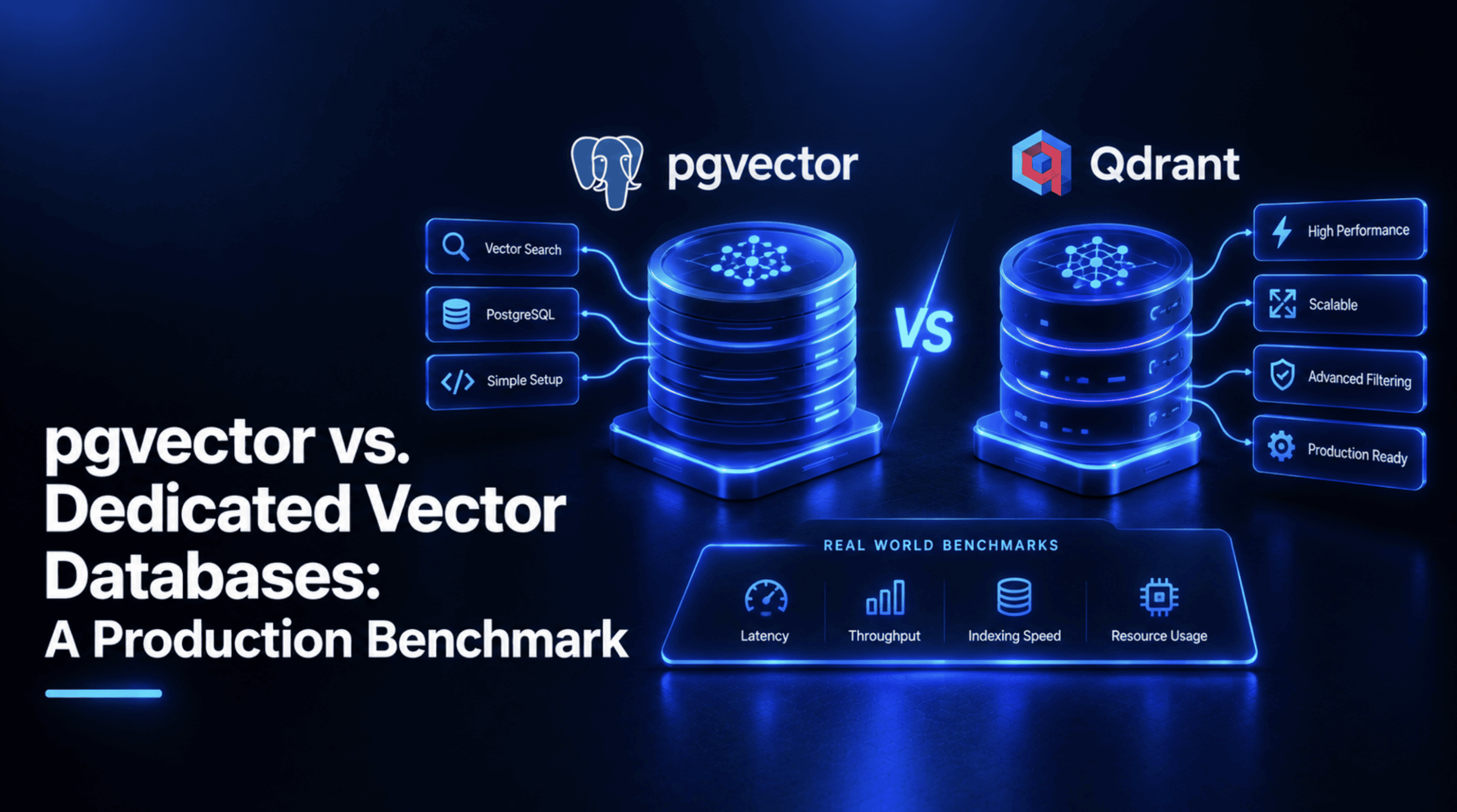
This article closes that knowledge gap by replacing marketing claims with reproducible production-grade benchmarks, architectural analysis, and comparative performance data. We examine the core capabilities of pgvector alongside specialized, purpose-built engines like Qdrant, Pinecone, Weaviate, Milvus, and ChromaDB. By evaluating real-world operational trade-offs—such as throughput, tail latency, memory consumption, and transaction safety—engineering teams can make data-driven decisions tailored to their production workloads.
Detailed Chronology and Technical Evolution of Vector Search
The integration of vector search into relational databases represents a major shift in modern data architecture. For decades, vector similarity search was the exclusive domain of specialized libraries (such as Facebook AI Similarity Search, or FAISS) and niche indexing frameworks designed for image retrieval, recommendation engines, and audio processing.
The Rise of Dedicated Vector Engines
As transformer-based Large Language Models (LLMs) gained enterprise traction between 2020 and 2023, unstructured data—text, images, and code—had to be converted into high-dimensional numerical vectors (embeddings). This surge catalyzed the creation of specialized, purpose-built vector databases:
- Pinecone introduced the paradigm of fully managed, zero-infrastructure vector search.
- Qdrant utilized Rust to build a high-performance engine optimized for complex metadata filtering alongside vector math.
- Weaviate and Milvus focused on hybrid search capabilities (combining BM25 text search with dense vectors) and massive distributed scaling.
These systems were engineered from the ground up with dedicated storage engines, memory-mapped vector indices, and specialized consensus algorithms. However, introducing a dedicated vector database into an existing stack introduces a significant architectural tax: data synchronization pipelines, dual-system monitoring, cross-network latencies, and eventual consistency challenges between the source-of-truth relational database and the vector store.
The Counter-Revolution: pgvector
In response to the operational friction of managing multi-database architectures, the open-source community accelerated the development of database extensions that brought vector capabilities directly to established data stores. Released as an open-source PostgreSQL extension, pgvector introduced native vector data types and indexing methods (such as HNSW and IVFFlat) directly into the world’s most popular relational database.
By keeping embeddings alongside relational metadata in the same ACID-compliant transaction boundary, pgvector eliminated the need for synchronization pipelines. Engineers could execute complex joins, perform strict relational filters, and run approximate nearest neighbor (ANN) searches within a single, unified SQL query.
Supporting Context, Infrastructure, and Benchmarking Methodology
To understand how pgvector performs relative to a dedicated system, we must examine empirical data gathered under strictly controlled conditions. While local laptop benchmarks provide a sandbox for learning syntax, they fail to reveal the true performance profiles of these systems at scale.
Local Prototyping Environment
For developers wishing to replicate the testing environment locally without cloud expenses, the following infrastructure setup utilizes Docker Compose and Python 3.10+.
1. Setting Up PostgreSQL with pgvector
Using the official Docker image (pgvector/pgvector:pg17), we instantiate a PostgreSQL 17 instance with the extension pre-compiled:
# docker-compose.yml
services:
  postgres:
    image: pgvector/pgvector:pg17
    ports:
      - "5432:5432"
    environment:
      - POSTGRES_PASSWORD=benchmark
      - POSTGRES_DB=vectorbench
Once running, we initialize the database extension and create a schema capable of storing 1,536-dimensional vectors (matching OpenAI’s text-embedding-3-small standard):
import psycopg2

conn = psycopg2.connect(
    host="localhost", port=5432, dbname="vectorbench",
    user="postgres", password="benchmark"
)
conn.autocommit = True
cur = conn.cursor()

# Enable the vector extension
cur.execute("CREATE EXTENSION IF NOT EXISTS vector;")

# Create the target table
cur.execute("""
    CREATE TABLE IF NOT EXISTS items (
        id bigserial PRIMARY KEY,
        embedding vector(1536)
    );
""")
2. Setting Up Qdrant Locally
For the dedicated database comparison, Qdrant can be deployed via a single Docker command and configured via its Python client:
docker run -d --name qdrant-bench -p 6333:6333 -p 6334:6334 qdrant/qdrantfrom qdrant_client import QdrantClient
from qdrant_client.models import Distance, VectorParams
qdrant = QdrantClient(url="http://localhost:6333")
qdrant.create_collection(
collection_name="items",
vectors_config=VectorParams(size=1536, distance=Distance.COSINE),
)3. Data Generation and Indexing
Using NumPy, we generate 100,000 synthetic, normalized vectors (simulating unit-length embeddings produced by modern production models) and load them into both systems using optimized batching strategies:
import numpy as np

NUM_VECTORS = 100_000
DIM = 1536
rng = np.random.default_rng(seed=42)
vectors = rng.normal(size=(NUM_VECTORS, DIM)).astype(np.float32)
vectors /= np.linalg.norm(vectors, axis=1, keepdims=True)
Both systems construct Hierarchical Navigable Small World (HNSW) graphs using identical parameters (m = 16, ef_construction = 64) to ensure a fair, apples-to-apples algorithmic comparison.
Production-Scale Performance Analysis
While local laptop testing confirms functionality, true performance differentiation emerges at scale. Industry benchmarks—such as those published by Tiger Data analyzing 50 million real Cohere embeddings (768 dimensions) on matched AWS r6id.4xlarge hardware (16 vCPUs, 128GB RAM)—provide deep insight into high-load behavior.
Note: The high-scale benchmarks detailed below utilize PostgreSQL combined with pgvectorscale (Timescale’s extension featuring StreamingDiskANN indices), contrasted against a native Qdrant deployment.
| Performance Metric | PostgreSQL (pgvector + pgvectorscale) |
Qdrant (Dedicated Engine) |
|---|---|---|
| p50 Latency @ 99% Recall | 31.07 ms | 30.75 ms |
| p95 Latency @ 99% Recall | 60.42 ms | 36.73 ms |
| p99 Latency @ 99% Recall | 74.60 ms | 38.71 ms |
| Throughput @ 99% Recall | 471.57 QPS | 41.47 QPS |
| p50 Latency @ 90% Recall | 9.54 ms | 4.74 ms |
| Throughput @ 90% Recall | 1,589.79 QPS | 360.81 QPS |
| Index Build Time (50M Vectors) | 11.1 hours | 3.3 hours |
Analyzing the Empirical Trade-offs
The benchmark data dismantles the binary narrative that either relational extensions or dedicated databases hold an absolute monopoly on performance. Instead, distinct operational profiles emerge:
- Throughput Superiority: PostgreSQL, when augmented with optimized scaling extensions, delivers significantly higher query throughput (QPS) at high recall thresholds. This efficiency stems from Postgres’s mature query planner, connection pooling integrations, and optimized memory buffering.
- Tail-Latency Stability: Qdrant maintains an advantage in tail-latency (p95 and p99) under heavy concurrent load. Its custom-built storage engine and asynchronous background processing prevent garbage collection pauses or lock contention from bleeding into query response times, ensuring predictable performance for mission-critical microservices.
- Index Construction Cost: Dedicated vector databases often build indices faster and more efficiently than general-purpose databases. Qdrant constructed the 50-million-vector index more than three times faster than the PostgreSQL configuration.
Official Industry Statements and Architectural Perspectives
Database architects and core maintainers increasingly emphasize that the choice between pgvector and a dedicated vector database is governed by organizational topology, data volume, and consistency requirements rather than raw query speed alone.
"The most important architectural question isn’t whether your vector search is 5 milliseconds faster or slower; it’s whether your application requires transactional atomicity between your relational state and your vector embeddings. If a user update requires changing a relational record and its embedding in a single atomic operation, splitting those into two databases introduces distributed transaction overhead that dwarfs any local index speedup."
— Senior Database Systems Architect
Conversely, proponents of dedicated systems highlight operational isolation:
"When vector workloads scale into the hundreds of millions or billions of items, resource contention becomes the primary failure mode. Running heavy HNSW index scans alongside intensive transactional relational workloads on the same database node can destabilize connection pools and degrade overall application health. Dedicated vector engines isolate these intensive vector computations entirely."
— Distributed Systems Engineer
Future Outlook: Convergence and Specialization
As the database landscape matures, the boundaries between relational databases and specialized vector stores are blurring through convergence:
- Relational Extensibility: Extensions like
pgvectorandpgvectorscalecontinue to evolve, incorporating compressed vector representations (such as Product Quantization and Binary Quantization), streaming disk-based indices, and SIMD-accelerated distance calculations. These enhancements narrow the performance gap between extensions and bare-metal engines. - Database Hybridization: Dedicated vector databases are simultaneously adopting relational features, adding support for JSON metadata filtering, secondary indexing, and basic transactional semantics.
Decision Framework: When to Choose Which
Choose pgvector if:
- Your total vector dataset remains under 10 to 50 million items.
- You require strict ACID compliance and atomic updates across relational data and vector embeddings.
- Your team already possesses operational expertise in running, monitoring, and backing up PostgreSQL.
- You want to avoid the architectural complexity and overhead of maintaining a secondary synchronization pipeline.
Choose a Dedicated Vector Database (e.g., Qdrant, Pinecone, Milvus) if:
- Your vector scale extends into hundreds of millions or billions of high-dimensional embeddings.
- Your service-level agreements (SLAs) demand rigid tail-latency guarantees (p99 < 35ms) under heavy concurrent filtered searches.
- You require specialized hardware acceleration, such as GPU-accelerated index building and searching (Milvus).
- Your organization prefers fully managed, serverless infrastructure with zero operational overhead (Pinecone).
Ultimately, engineering teams must evaluate their unique workload characteristics, team capabilities, and architectural constraints. By relying on empirical metrics rather than vendor dogma, organizations can build robust, scalable, and cost-effective AI applications.