Executive Overview
As Large Language Models (LLMs) transition from experimental novelties to core operational infrastructure across global enterprises, development teams face a punishing economic and technical reality: inference gets slow and expensive as traffic scales. Production applications routinely bog down as queues lengthen behind massive generation tasks, GPU High-Bandwidth Memory (HBM) overflows with cached attention states, and expensive hardware sits idle, waiting endlessly on memory read operations rather than processing compute.
Inference optimization is no longer a peripheral concern for systems engineers; it is the definitive differentiator between sustainable AI economics and runaway cloud infrastructure bills. However, the ecosystem of optimization techniques—ranging from quantization and speculative decoding to continuous batching, prefix caching, and prefill-decode disaggregation—is vast and often contradictory. Each technique operates on specific, rigid assumptions about your workload’s behavior. Deploying the wrong technique not only fails to solve the underlying performance degradation, but often introduces cascading latency penalties and architectural complexity.
To cut through the noise, infrastructure architects must abandon the trial-and-error approach. This guide provides a rigorous, six-question decision-tree framework designed to match specific LLM inference optimization techniques directly to the empirical bottlenecks in your workload. By diagnosing whether your system is bound by memory bandwidth, compute overhead, KV cache fragmentation, or concurrency contention, you can systematically configure a high-performance, cost-effective inference pipeline.
Detailed Chronology and Diagnostic Framework: The Six-Question Decision Tree
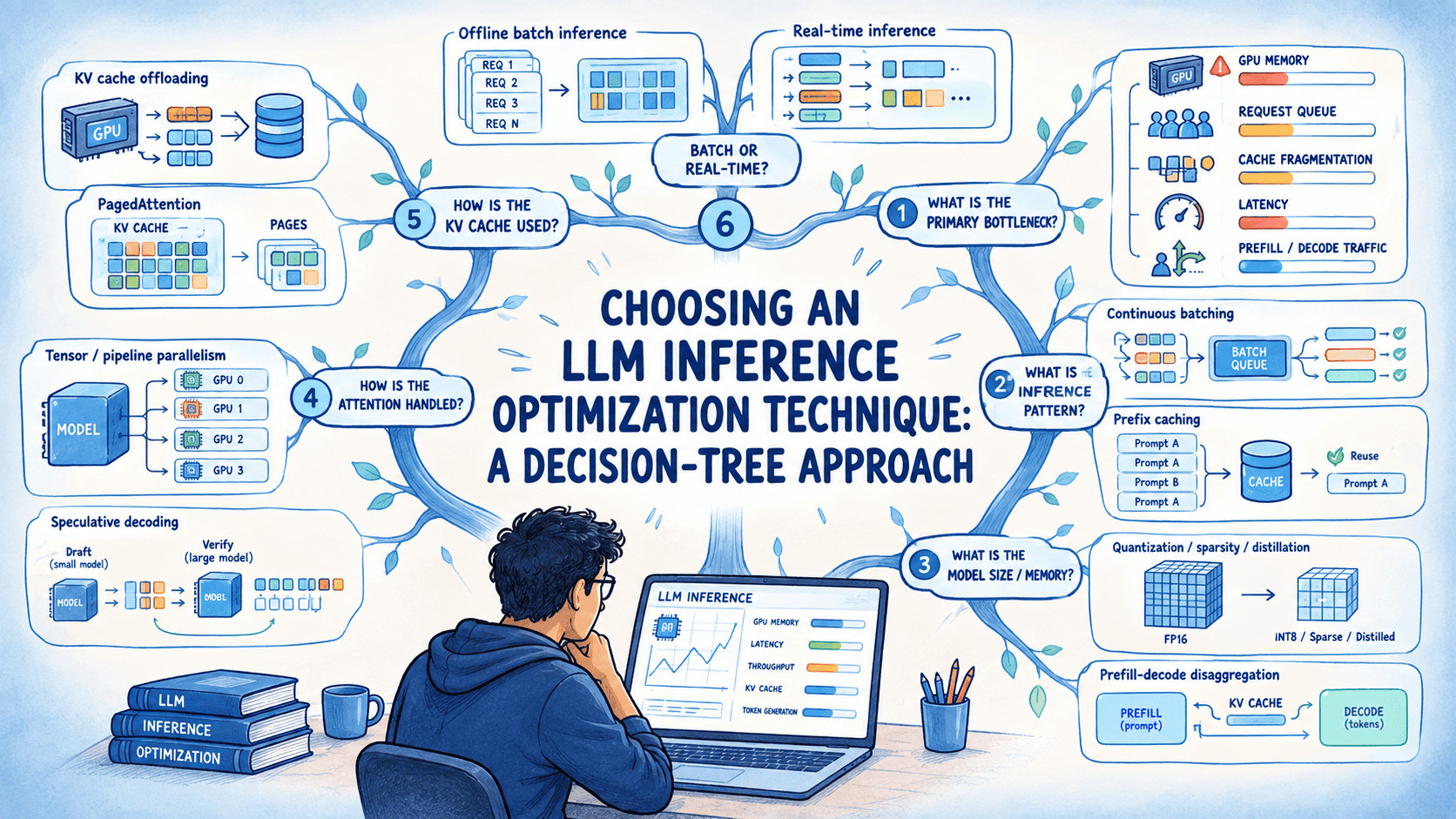
Optimization must be a deliberate, step-by-step diagnostic process rather than an ad-hoc collection of flags enabled in a serving engine. The decision tree outlined below walks engineers through six branching questions. Each query isolates a specific property of your model, memory architecture, or traffic pattern, providing a direct route to the correct intervention.
Question 1: Does the Model Fit Comfortably on Your Target Hardware?
Before analyzing the serving framework or batch scheduler, engineers must evaluate whether the base model itself is the primary structural bottleneck. A model that barely fits into your GPU memory footprint leaves virtually no contiguous headroom for the Key-Value (KV) cache. This severely caps your maximum batch size, regardless of how sophisticated your underlying scheduling engine might be.
- The Diagnostic: If the unoptimized model consumes greater than 80% of available VRAM at batch size one, or if token generation is fundamentally compute-bound by tensor operations, you must start with model-level compression.
- The Solutions:
- Quantization: Reducing weight and/or activation precision (e.g., from FP16 to INT8 or INT4) to shrink the model footprint.
- Sparsity: Pruning redundant neural network weights to accelerate compute.
- Distillation: Training a smaller, highly efficient student model to mimic the target model’s behavior.
- Architectural Trade-off: Model-level compression reduces memory pressure and can dramatically increase throughput, but it inevitably carries an accuracy risk. Furthermore, quantizing activations without quantizing weights—or vice-versa—can lead to unexpected performance regressions if the GPU must continuously upcast data types during runtime execution.
If the model fits within your target hardware with adequate headroom for memory overhead, proceed to Question 2.
Question 2: Do Your Requests Share Repeated Prompt Structure?
Modern production AI rarely consists of completely isolated, random prompts. Chat applications resend the entire conversation history on every single user turn. Agentic frameworks repeatedly instantiate identical system prompts across thousands of autonomous loop iterations. Retrieval-Augmented Generation (RAG) pipelines perpetually prepend standardized system guardrails and formatting instructions to wildly divergent, dynamically retrieved external contexts.
- The Diagnostic: Analyze your production ingress logs. If a statistically meaningful percentage of your aggregate traffic features an identical sequence of starting tokens (a shared prefix), your system is wasting substantial compute recomputing identical attention states.
- The Solution: Prefix Caching. This technique caches and reuses the KV cache generated from static prompt prefixes. As long as incoming requests share an identical character-for-character prefix, the serving engine bypasses prefill computation entirely for those tokens.
- Best Practice: Prefix caching demands absolute determinism. Because it relies on exact string matches, engineers must front-load static content (system instructions, structural templates) and push variable parameters (user queries, dynamic context) to the very end of the prompt.
If your workloads consist primarily of unique, highly varied prompts with minimal structural overlap, proceed to Question 3.
Question 3: Are Requests Arriving Concurrently With Variable Output Lengths?
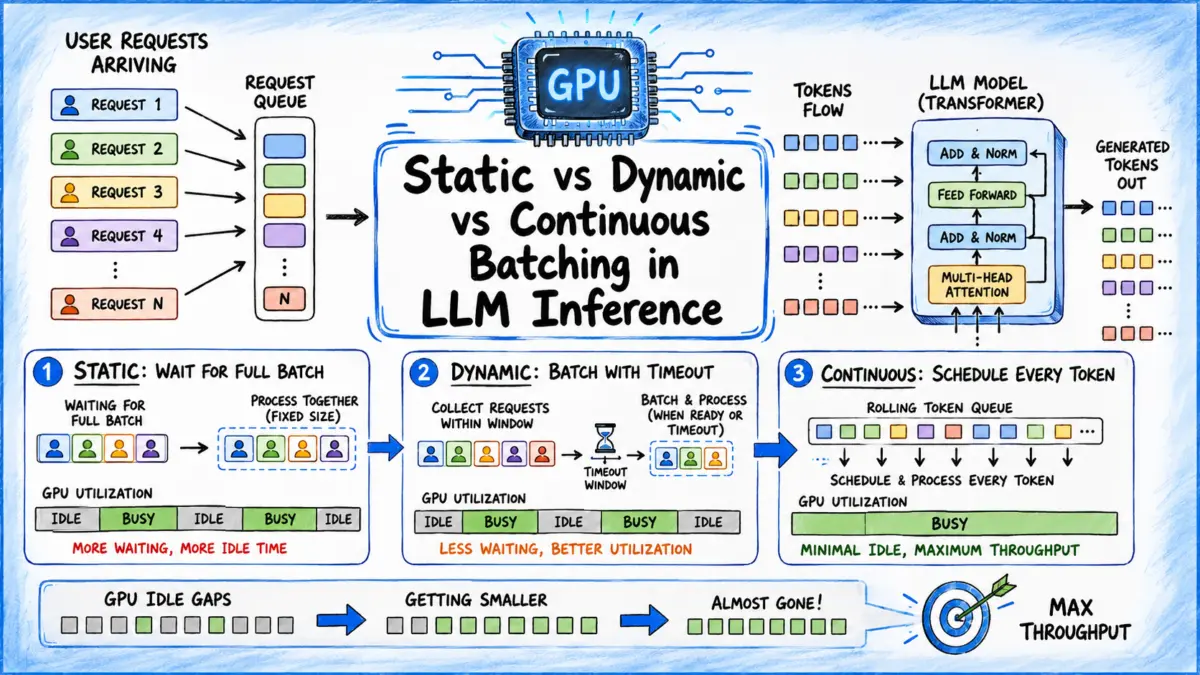
In a standard production environment, traffic is rarely uniform. Consider an enterprise support chatbot that generates concise, one-sentence responses operating alongside a code-generation assistant that occasionally outputs hundreds of lines of complex logic. Under naive, static batching configurations, these concurrent requests are locked together; the entire batch must stall, waiting indefinitely for the slowest, longest generation to complete. This leaves the GPU critically underutilized.
- The Diagnostic: Check your GPU utilization metrics during peak traffic bursts. If you observe jagged performance, periodic idle spikes, and high queue wait times despite incoming traffic, your batching scheduler is broken.
- The Solution: Continuous (In-Flight) Batching. Continuous batching dynamically alters the batch composition at the iteration level rather than the request level. As soon as an individual sequence completes its generation phase, it is immediately evicted from the active batch, and a new incoming request is slotted into its place without waiting for batch boundaries.
- Architectural Note: Continuous batching is the bedrock of modern serving engines (such as vLLM and TensorRT-LLM) and should be enabled by default in virtually all production setups.
If your traffic is already dynamically batched and hardware idle time is mitigated, proceed to Question 4.
Question 4: Is KV Cache Fragmentation Limiting Your Batch Size?
As LLM generation progresses, the system must store the Key and Value tensors for every historical token to avoid recalculating attention over the entire context window. Traditional serving engines allocate a fixed, contiguous block of memory per request, sized strictly for the maximum potential sequence length (e.g., 4096 or 8192 tokens). Because the vast majority of real-world requests terminate far earlier, this reserved space sits entirely vacant for the duration of the request, blocking other sequences from utilizing it.
- The Diagnostic: Monitor your GPU memory allocation versus active batch sizes. If your system runs out of memory and rejects incoming requests despite having substantial pools of scattered, unused VRAM, you are suffering from severe memory fragmentation.
- The Solution: PagedAttention. Borrowing from operating system virtual memory principles, PagedAttention breaks the KV cache into fixed-size blocks (pages) that can be mapped non-contiguously in physical GPU memory. The attention mechanism retrieves these blocks dynamically during execution.
- Architectural Trade-off: While PagedAttention nearly eliminates memory waste and allows massive batch sizes, it introduces a microscopic pointer-lookup overhead into the attention computation layer.
If memory fragmentation is not constraining your active concurrency pools, proceed to Question 5.
Question 5: Is Per-Token Decode Latency the Metric You Are Focusing On?
In interactive, user-facing applications (such as real-time voice assistants, coding co-pilots, or live chat interfaces), the dominant performance metric is not aggregate system throughput (tokens per second per dollar), but rather Time-to-First-Token (TTFT) and inter-token latency (the visual streaming speed of the text). Because LLM generation is inherently autoregressive—generating one token at a time in a memory-bandwidth-bound loop—decoding can feel sluggish to human users.
- The Diagnostic: Evaluate whether your users are complaining about sluggish text streaming speeds, even when server-side GPU utilization is well-managed.
- The Solution: Speculative Decoding. This technique pairs your primary, high-capacity LLM with a much smaller, highly efficient "draft" model. The draft model rapidly generates a series of candidate tokens in parallel. The primary model then evaluates all candidate tokens in a single, highly parallelized verification pass. When the draft model’s predictions align with the primary model’s expectations, multiple tokens are unlocked in a single decode step, dramatically accelerating perceived stream latency.
- Architectural Trade-off: Speculative decoding is entirely dependent on the acceptance rate of the draft model. If the draft model’s predictions are frequently rejected by the primary model, the overhead of running verification operations will actually degrade overall performance.
If you lack a suitable, domain-aligned draft model or if your application prioritizes raw throughput over individual stream latency, proceed to Question 6.
Question 6: Are Prefill and Decode Contending for the Same GPU at Scale?
At massive production scales, LLM serving faces a fundamental architectural conflict: the prefill phase (processing the incoming prompt) is heavily compute-bound and requires massive parallelism, while the decode phase (generating tokens sequentially) is strictly memory-bandwidth-bound. When both phases execute simultaneously on the same physical GPU, they contend for identical hardware resources. Long prefills stall ongoing decodes, spiking inter-token latency; conversely, active decodes starve prefill operations, driving up Time-to-First-Token.
- The Diagnostic: Analyze your production telemetry at high concurrency thresholds. If you observe simultaneous degradation in both TTFT and inter-token streaming latency under heavy load, your system is suffering from phase-contention bottlenecks.
- The Solution: Prefill-Decode Disaggregation (PD Disaggregation). This advanced architecture physically separates the inference pipeline across specialized hardware nodes. Dedicated "Prefill Nodes" ingest incoming prompts, compute the initial attention states, and immediately offload the resulting KV cache over high-speed networks to dedicated "Decode Nodes," which are optimized exclusively for high-concurrency token generation.
- Architectural Trade-off: Disaggregation introduces network transmission overhead (moving massive KV caches across the fabric) and complex routing infrastructure. It should only be deployed when traffic scales justify the architectural complexity.
Supporting Context & Metrics: Optimization Matrix
To synthesize the diagnostic framework, the following operational matrix maps every major optimization technique directly to its primary use case, ideal operational profile, and inherent architectural trade-offs.
| Optimization Technique | Primary Operational Target | Best Suited For | Inherent Architectural Trade-off |
|---|---|---|---|
| Quantization / Sparsity | Memory & Compute | Models exceeding hardware capacity or strict latency budgets | Accuracy degradation; activation quantization complexity |
| Prefix Caching | Memory & Compute | Conversational agents, multi-turn chat, and RAG architectures | Fails instantly on any character-level prompt mismatch |
| Continuous Batching | Compute Utilization | High-concurrency environments with highly variable output lengths | Minimal downside; largely dependent on engine-level configuration |
| PagedAttention | Memory Management | Workloads choked by KV cache fragmentation and over-provisioning | Introduces a page-table indirection layer into attention math |
| Speculative Decoding | Inter-Token Latency | Latency-sensitive, single-user interactive streaming | Highly dependent on draft model accuracy and acceptance rates |
| PD Disaggregation | Infrastructure Scale | Massive enterprise-scale deployments experiencing phase contention | Network transport latency for KV caches; routing complexity |
| Tensor / Pipeline Parallelism | Model Footprint | Ultra-large models that exceed single-device VRAM limits | Pipeline bubbles and cross-device synchronization overhead |
| KV Cache Offloading | Memory Expansion | Long-context windows running short on GPU HBM capacity | Memory bus latency when fetching offloaded cache back to GPU |
| Offline Batch Inference | Maximum Throughput | Asynchronous, non-interactive batch data processing | Completely unusable for real-time or interactive use cases |
Official Statements and Industry Consensus
Leading systems architects and infrastructure researchers emphasize that modern LLM deployment is shifting away from monolithic optimizations toward hybrid, stack-aware engineering.
According to systems engineering briefs from top-tier AI infrastructure providers: "The primary failure mode in modern LLM serving is not a lack of compute power, but a mismatch between scheduler assumptions and workload topology." Industry consensus highlights that deploying advanced mechanisms like PagedAttention or continuous batching without first analyzing memory access patterns often masks deeper inefficiencies, such as unoptimized tokenizers or poorly structured prompt templates.
Furthermore, infrastructure pioneers stress that speculative decoding and disaggregation are not universal panaceas. As engineering teams push context windows past 128k tokens and beyond, memory bandwidth management—specifically through advanced quantization schemes and optimized KV cache eviction policies—remains the single most critical battleground for cost reduction.
Future Outlook: The Next Frontier in LLM Inference
As we look toward the future of enterprise AI infrastructure, the boundary between hardware design and serving software will continue to blur. Several emerging paradigms promise to redefine how engineers approach inference optimization:
- Native Hardware-Software Co-Design: Next-generation AI accelerators are beginning to integrate hardware-level support for sparse attention mechanisms and dynamic KV cache management directly onto the silicon, reducing the software overhead currently required by engines like vLLM.
- Adaptive, Workload-Aware Compilers: Future serving engines will dynamically recompile model execution graphs in real-time, shifting seamlessly between speculative decoding, standard generation, and disaggregated topologies based on live telemetry and predictive traffic modeling.
- Advanced Context Compression: Beyond standard KV caching, upcoming breakthroughs in state space models (SSMs) and attention compression algorithms will fundamentally alter memory requirements, allowing massive context windows to reside within compressed latent spaces without sacrificing retrieval accuracy.
Wrapping Up
Choosing the correct LLM inference optimization technique is a methodical engineering discipline that begins with precise bottleneck identification. Whether your constraints stem from raw model size, prompt structural overlap, traffic concurrency, memory fragmentation, or phase contention between prefill and decode operations, every performance ceiling points to a specific architectural remedy.
Mastering these techniques requires continuous profiling, a deep understanding of your workload’s empirical behavior, and a willingness to stack complementary optimizations rather than searching for a single silver bullet. By systematically navigating this decision framework, engineering teams can build resilient, scalable, and economically sustainable AI inference platforms.