Executive Overview
Every week, a new artificial intelligence provider steps onto the stage to claim that its latest autonomous agent is state-of-the-art. Marketing pages glow with hyper-inflated percentages, leaderboards update with blistering frequency, and venture-backed startups promise that fully generalized digital workers are just around the corner. Yet, for any chief technology officer, engineering lead, or product manager who has actually deployed an AI agent in a live production environment, a gulf of skepticism remains. The ultimate question that matters far more than any leaderboard score is simple: Does it reliably do the job you hired it for?
To answer this, the industry relies on a suite of standardized evaluations designed to test autonomous capabilities. Benchmarks like SWE-bench, GAIA, WebArena, and OSWorld have become the gold standard for measuring how well AI models handle multi-step tasks, external tool use, and complex operating environments. However, treating these evaluations as guarantees of real-world performance is a dangerous gamble.
This deep-dive investigation cuts through the leaderboard noise. We examine what major AI agent benchmarks actually measure, how they represent a fundamental paradigm shift from traditional model testing, and why every single evaluation captures only a narrow slice of real-world functionality. By looking beyond the marketing hype, development teams can learn how to use these benchmarks as directional signals—not as final certifications of production readiness.
Detailed Chronology: The Evolution from Single-Turn Models to Multi-Step Agents
To understand how today’s complex agent benchmarks came to be, it is necessary to trace the trajectory of AI evaluation over the past decade. The industry has evolved through distinct generational shifts, moving from static language understanding to dynamic, interactive problem-solving.
Era 1: The Static Prompt-Response Paradigm (Pre-2023)
In the early days of modern large language models, evaluation was straightforward. Benchmarks like MMLU (Massive Multitask Language Understanding) and HumanEval were designed to test a model’s ability to generate a correct response in a single turn. A user would input a prompt, the model would output a completion, and an automated script would score the accuracy.
While these traditional benchmarks were vital for measuring raw language understanding, factual recall, and isolated code-generation skills, they possessed a fatal flaw: they were closed-loop systems. They tested a model’s memory and static reasoning in a vacuum, completely ignoring real-world friction. They could not evaluate whether a system could browse the web, recover from an error, or adapt to a changing environment over a series of sequential actions.
Era 2: The Emergence of Tool-Use and Function Calling (2023–2024)
As models gained the ability to call external APIs and execute code, the limitations of single-turn benchmarks became glaringly apparent. Researchers began introducing interactive environments where models could use calculators, database queries, and basic web search tools. This period marked the birth of "agentic" workflows, where language models were no longer just answering questions—they were attempting to orchestrate multi-step processes.
However, evaluation during this transitional phase was fragmented. Providers relied heavily on proprietary, internal test suites, making cross-model comparisons difficult and prone to selection bias. The community desperately needed standardized, reproducible environments that could test an agent’s capability across diverse domains.
Era 3: The Modern Benchmark Ecosystem (2024–Present)
Today, we live in an era dominated by specialized, rigorous agent benchmarks. Platforms like SWE-bench for software engineering, GAIA for general digital assistants, WebArena for web navigation, and OSWorld for complete desktop automation have transformed the landscape.
These modern benchmarks do not simply ask questions; they drop a model into a fully realized sandbox environment—complete with terminal access, file systems, web browsers, and complex software dependencies. Failure in these benchmarks is no longer just a wrong text string; it is a stuck programming loop, an unhandled runtime exception, or a workflow abandoned halfway through.
Supporting Context & Metrics: Breaking Down the Industry Standards
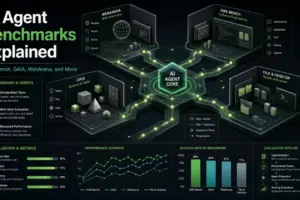
To navigate this landscape effectively, technical leaders must understand the specific mechanics, strengths, and hidden blind spots of the four major agent benchmarks dominating the research community today.
+---------------------------------------------------------------------------------+
|                        THE AI AGENT BENCHMARK SPECTRUM                          |
+--------------------------+-----------------------------+------------------------+
| Benchmark                | Primary Environment         | Core Challenge         |
+--------------------------+-----------------------------+------------------------+
| SWE-bench / Verified     | GitHub Repositories (Python)| Code Patches & Tests   |
| GAIA                     | Multi-tool / Web / Files    | Complex Reasoning      |
| WebArena / BrowserGym    | Sandboxed Web Applications  | GUI & Form Navigation  |
| OSWorld                  | Desktop Operating Systems   | Full OS Control        |
+--------------------------+-----------------------------+------------------------+
1. SWE-bench and SWE-bench Verified: The Software Engineering Standard
SWE-bench is widely considered the closest thing to a gold standard for evaluating software engineering agents. Instead of asking a model to write a snippet of code from scratch, the benchmark presents the agent with a real, complex GitHub issue drawn from major open-source Python repositories like Django, SymPy, and scikit-learn.
The agent must navigate the codebase, locate the source of the bug, and produce a functional code patch. Success is determined objectively: the patch is applied, and the repository’s existing unit test suite is run. If the tests pass, the agent succeeds.
- The Nuance (SWE-bench Verified): The original SWE-bench suffered from ambiguous tasks and flawed test suites that could occasionally be passed with incorrect or brittle solutions. To counter this, SWE-bench Verified was introduced—a human-curated subset where engineers verified that every task is genuinely solvable and that the evaluation criteria are robust.
- The Hidden Limitation: Passing a unit test suite is not synonymous with writing clean, maintainable software. An agent can easily generate a messy patch that technically satisfies automated tests while introducing severe memory leaks, security vulnerabilities, or regression bugs in unmonitored edge cases. SWE-bench measures automated compliance, not architectural engineering quality.
2. GAIA (General AI Assistants): Multimodal Reasoning
While SWE-bench focuses strictly on code, GAIA targets the broader capabilities required of a general-purpose digital assistant. A typical GAIA task requires an agent to ingest a multimodal document (such as a PDF containing charts and text), cross-reference it with live data from the web, perform complex calculations, and synthesize a coherent, multi-step response.
GAIA tasks are deliberately designed to be simple for a human assistant with internet access, yet brutally difficult for current AI architectures.
- The Hidden Limitation: GAIA tasks, by design, prioritize single, verifiable correct answers. Real-world executive assistance is rarely so binary. Human workflows involve shifting goals, vague instructions, and contextual ambiguity that cannot simply be queried via a search engine.
3. WebArena and BrowserGym: Navigating the Web
WebArena evaluates an agent’s capacity to operate within realistic web applications. Rather than turning agents loose on the live, unpredictable internet, WebArena spins up sandboxed environments emulating e-commerce platforms, corporate content management systems, issue-tracking tools, and collaborative forums. The agent must interact with these interfaces like a human user: clicking buttons, filling out complex forms, navigating dropdown menus, and interpreting visual layouts. BrowserGym builds upon this by providing a modular framework for researchers to test various web-browsing agents across diverse browser states.
- The Hidden Limitation: Data contamination is a persistent threat here. Because many WebArena tasks have been in circulation within the research community for months or years, newer models may have inadvertently memorized task structures or expected interaction paths during their pre-training phase. High scores can sometimes reflect pattern matching rather than genuine adaptive web navigation.
4. OSWorld: The Desktop Operating System Frontier
Taking the most expansive view of autonomy, OSWorld places an agent inside a sandboxed desktop operating system (such as Ubuntu). The agent is tasked with executing multi-application workflows: opening spreadsheet software, manipulating local files, adjusting system settings, sending emails, and coordinating tasks across disparate native GUI applications.
- The Hidden Limitation: OSWorld is arguably the most fragile benchmark in existence. If the underlying virtual machine experiences a rendering glitch, a display server crash, or an unexpected operating system update, the agent will fail—even if its logical reasoning and step-by-step planning were flawless. Consequently, OSWorld scores are heavily skewed by the stability of the testing infrastructure itself.
Official Statements and Industry Perspectives
As the race toward artificial general intelligence increasingly intersects with enterprise automation, industry leaders, researchers, and safety advocates have expressed growing concern over how benchmarks are interpreted and marketed.
Dr. Nathan Lambert, a prominent researcher in reinforcement learning and AI systems, has frequently cautioned against the dangers of "benchmark optimization":
"When a metric becomes a target, it ceases to be a good metric. AI labs are increasingly tuning their agent architectures specifically to pass the friction points of SWE-bench or WebArena, creating models that look superhuman in a sandboxed test tube but shatter under the chaotic weight of an actual corporate network."
Enterprise deployment architects echo these sentiments. In recent briefings on autonomous workflow integration, engineering executives from Fortune 500 financial institutions highlighted the stark disconnect between published leaderboard percentages and production realities. According to internal deployment studies, an agent boasting an 80% success rate on a benchmark often sees its reliability drop below 40% when introduced to legacy databases, undocumented internal APIs, and permission-restricted enterprise environments.
Furthermore, leading model providers have acknowledged that current benchmarks fail to capture economic efficiency. An executive at a major foundation model lab noted in a recent panel discussion:
"We can make an agent pass almost any benchmark if we allow it to execute hundreds of thousands of reasoning steps and burn through millions of tokens per task. But in production, an agent that costs fifty dollars in API fees to resolve a ten-dollar customer service ticket is a commercial failure, regardless of whether it got the right answer."
Future Outlook: The Next Generation of Agent Evaluation
Where is AI agent evaluation heading as models transition from experimental novelties to ubiquitous enterprise workers? Industry consensus points toward several crucial transformations over the next three to five years:
1. From Static Benchmarks to Dynamic, Adversarial Environments
Static leaderboards have a short shelf life. As models rapidly saturate existing tests (approaching near-100% scores on older evaluations), the research community is shifting toward dynamic, procedurally generated benchmarks. These systems use secondary AI agents to act as adversarial red teams, generating novel edge cases, shifting user requirements, and injecting unexpected system failures in real time. This ensures that models cannot simply memorize evaluation benchmarks during training.
2. Holistic Economic and Latency Metrics
Future evaluations will move beyond binary success-or-failure scoring to incorporate holistic efficiency metrics. Benchmarks will inherently penalize agents that consume excessive compute, exhibit high latency, or make redundant API calls. The industry will measure performance not just by accuracy, but by cost-per-successful-task and time-to-completion.
3. Rigorous Safety, Governance, and Boundary-Following Tests
Current benchmarks almost entirely ignore safety boundaries—such as whether an agent knows when not to act. As agents are granted broader access to financial accounts, medical records, and infrastructure controls, future evaluations will rigorously test negative constraints. Can an agent successfully refuse a destructive command? Does it properly handle ambiguous high-stakes decisions by escalating to a human supervisor rather than guessing? Developing standardized safety evaluations will be the defining challenge for agent researchers through the remainder of the decade.
4. Enterprise-Specific Custom Evaluation Pipelines
Ultimately, the future of agent evaluation lies away from public leaderboards entirely. Forward-thinking enterprises are already abandoning public scores in favor of private, highly tailored evaluation harnesses. By building custom sandbox environments that mirror their proprietary software stacks, companies can test agents against their exact internal workflows, legacy codebases, and security constraints.
Conclusion
Public AI agent benchmarks—ranging from SWE-bench and GAIA to WebArena and OSWorld—represent genuine, monumental progress in the scientific evaluation of autonomous systems. Each framework brilliantly illuminates a distinct, vital dimension of machine capability: software engineering, multimodal retrieval, web interaction, and desktop control.
However, none of them tells the whole story. Understanding what each benchmark measures—and, more importantly, where each one breaks down—delineates the difference between engineering teams that deploy autonomous agents with absolute confidence and those that suffer catastrophic, unexpected production failures.
Use public leaderboards for what they are: initial directional filters to narrow down which foundational architectures are worth exploring. But never mistake a test-tube score for a production guarantee. To build truly resilient autonomous systems, organizations must leverage public benchmarks to start the conversation, and then build their own custom, rigorous evaluations to finish it.