Executive Overview
The landscape of agentic Artificial Intelligence has matured at a blistering pace. What began in 2023 as experimental scaffolding and brittle proof-of-concept scripts has evolved into a crowded, highly specialized ecosystem of serious orchestration frameworks. These platforms come with strong, often opinionated philosophies regarding how autonomous agents should reason, coordinate, share context, and—crucially—fail. For software architects and engineering leaders building systems destined for production, choosing the right framework is no longer a low-stakes weekend experiment; it is a foundational architectural decision that will shape system scalability, maintenance overhead, and operational resilience for years.
The core challenge facing developers today is that traditional metrics for evaluating software libraries fail entirely when applied to agentic AI. GitHub stars, leaderboard benchmark scores, and "time-to-hello-world" rankings offer zero predictive insight into how a framework will behave when a complex, multi-agent workflow encounters a bizarre edge case at 2:00 AM on a Sunday. A framework designed for open-ended, collaborative research will inevitably collapse under the strict compliance and determinism requirements of a regulated financial pipeline. Conversely, a platform optimized for rigid, deterministic state machines will feel like suffocating bureaucratic overhead when deployed for a dynamic, conversational assistant.
To cut through the noise, this guide introduces a rigorous, decision-tree-based approach. By mapping your workload’s actual technical requirements against the core strengths and limitations of the industry’s leading frameworks—LangGraph, CrewAI, AutoGen / AG2, PydanticAI, and the OpenAI Agents SDK—engineering teams can select the precise orchestration layer needed to build resilient, production-ready agentic systems.
Detailed Chronology: The Evolution of Agentic Orchestration
To understand where the agentic framework market stands today, it is essential to review how the ecosystem evolved from basic monolithic wrappers to sophisticated, multi-agent orchestration engines.
2023: The Era of Monolithic Scaffolding and Linear Chains
In the early days following the breakout success of Large Language Models, application development was defined by linear chaining libraries. Frameworks focused primarily on connecting an LLM to a vector database and a prompt template. Agents, where they existed, were largely monolithic loops: an LLM was given a generic prompt and a toolbox, and instructed to iterate until it deemed a task complete.
These early architectures lacked guardrails, resulting in infinite loops, runaway token consumption, and unpredictable failure modes. Debugging required parsing massive, unstructured chat logs, and maintaining state across tool calls was a manual, error-prone exercise.
2024: The Rise of Multi-Agent Specialization and Metaphors
As developers pushed LLMs toward more complex tasks, the limitations of the single-agent paradigm became glaringly obvious. A single model struggling to write, review, and execute code simultaneously would hallucinate fixes or ignore system constraints.
This realization sparked the "virtual organization" movement. Frameworks emerged that abstracted multi-agent workflows using human organizational metaphors—assigning roles, backstories, and hierarchical structures to different model instances. While this drastically accelerated prototyping and unlocked impressive emergent problem-solving behaviors, it introduced a new class of headaches: non-deterministic agent interactions, conversational drift, and a severe lack of granular state control.
2025–2026: Production Hardening, Durability, and Type Safety
Today, the industry has pivoted away from loose metaphors toward rigorous production engineering. Enterprises demanded deterministic execution paths, comprehensive audit trails, strict type safety, and fault tolerance capable of handling hours-long, multi-step operations.
Modern frameworks like LangGraph introduced state machine mechanics and "time-travel" debugging, while lightweight libraries like PydanticAI brought strict software engineering standards to LLM interactions. The focus shifted decisively from what an agent could theoretically accomplish in a sandbox to how reliably it could operate within a mission-critical, enterprise environment.
Supporting Context & Metrics: When Do You Actually Need a Multi-Agent System?
Before evaluating specific orchestration frameworks, engineering teams must confront a fundamental question: Does your task actually require a multi-agent architecture?
The single most common pitfall in agentic engineering is over-orchestration. Reaching for multi-agent complexity before it is warranted introduces unnecessary latency, multiplies token costs, and exponentially complicates debugging. A single agent equipped with well-defined system prompts and robust tool definitions can handle an astonishing array of complex tasks. Furthermore, a single-agent architecture is exponentially easier to monitor, test, and reason about.
                  [ Do you need Multi-Agent? ]
                                |
         +----------------------+----------------------+
         | Yes                                         | No
         v                                             v
[ Check Triggers: ]                            [ Build Single-Agent ]
- Conflicting expert domains                    [ System First       ]
- Parallel workstreams
- Adversarial review loops
- Strict privilege separation
Key Triggers for Multi-Agent Complexity
You should only introduce a multi-agent framework when a single agent hits a definitive operational ceiling. Look for these specific architectural triggers:
- Conflicting Expert Domains: The task requires deeply specialized knowledge bases, system prompts, or toolsets that would pollute a single model’s context window or confuse its reasoning capabilities (e.g., combining medical diagnostics with pharmaceutical compliance verification).
- Parallel Workstreams: The workload can be radically accelerated by spinning up multiple sub-tasks simultaneously (e.g., scraping and analyzing ten distinct competitor websites in parallel before synthesizing the findings).
- Adversarial Review Loops: Quality assurance requires a separation of concerns, such as a generator agent producing code and a distinct reviewer/critic agent attempting to break it in an iterative refinement loop.
- Strict Privilege Separation: Different parts of the workflow require different security boundaries—for example, an untrusted research agent that browses the open web should not share memory space or tool permissions with a privileged database execution agent.
If none of these triggers apply, build a robust single-agent system first. Add orchestration complexity only when concrete operational bottlenecks demand it.
The Decision Tree: Narrowing the Framework Field
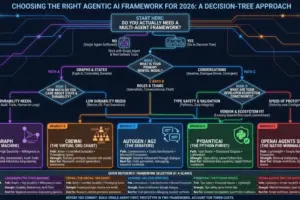
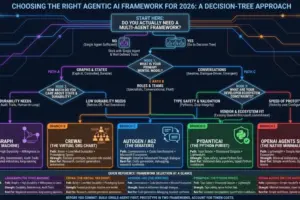
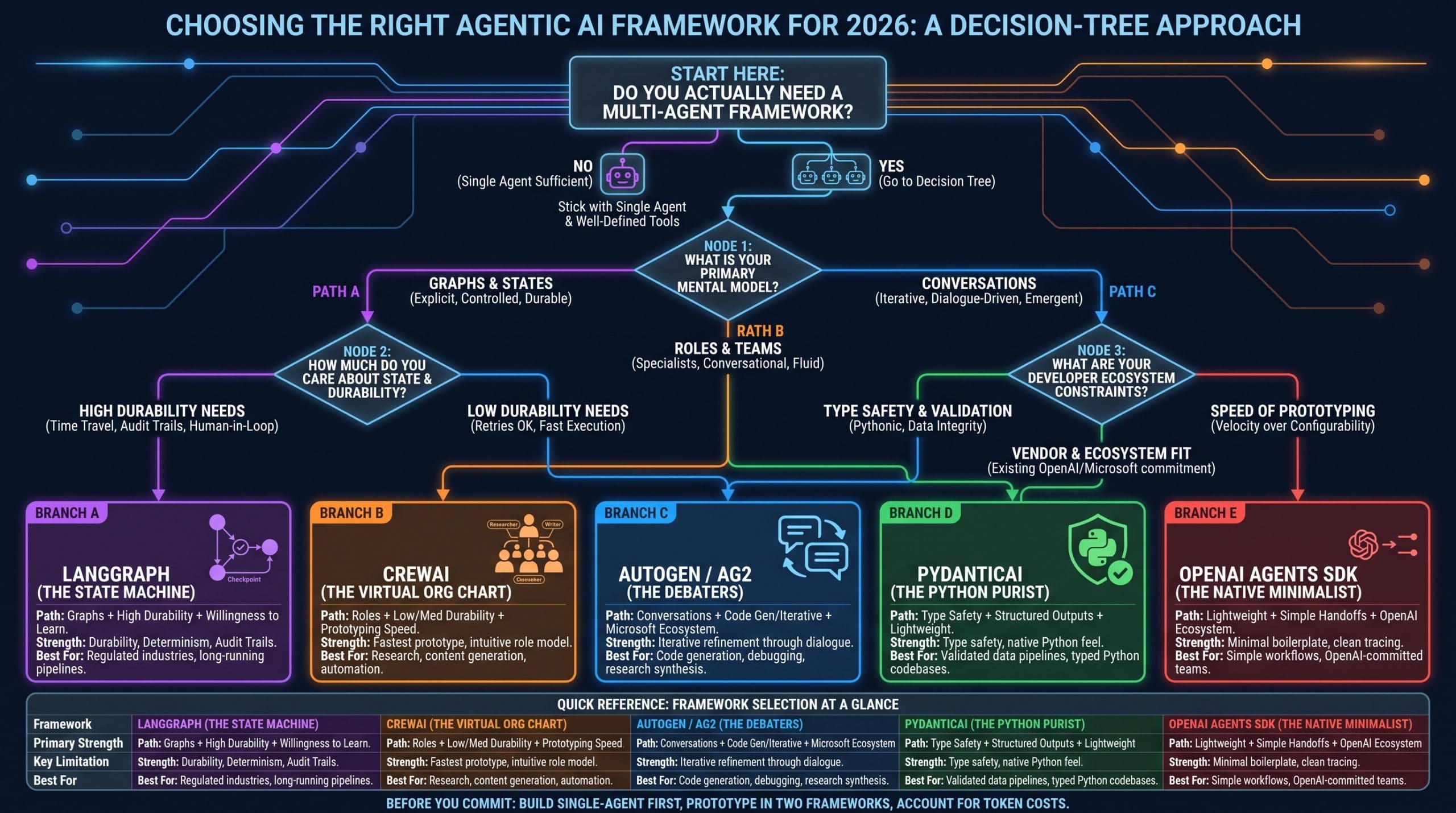
If your workload genuinely demands multi-agent orchestration, navigate the following three decision nodes to identify your optimal framework path.
Node 1: What Is Your Primary Mental Model?
How do you and your team naturally visualize the execution flow of your application?
- Graph & State Machines (Option A): Your workflow consists of discrete steps, explicit transitions, and clear branching logic. You care deeply about error recovery, retries, and human-in-the-loop validation checkpoints.
- Roles & Teams (Option B): Your work maps naturally to human organizational structures—researchers, writers, editors—handing off deliverables in a collaborative, conversational manner.
- Iterative Dialogue (Option C): Your output is refined through back-and-forth debate, code execution, and error reporting between specialized agents until a strict convergence threshold is met.
Node 2: How Much Do You Care About State and Durability?
- High Durability Needs: Workflows run for minutes or hours. You must be able to pause execution, inspect intermediate states, roll back errors, require human sign-off, and maintain an immutable audit trail for regulatory compliance.
- Low Durability Needs: Workflows execute in seconds. If a failure occurs, restarting the entire pipeline from scratch is computationally and financially trivial.
Node 3: What Are Your Developer Ecosystem Constraints?
- Strict Type Safety: Your team writes heavily typed Python, and runtime data corruption at function boundaries is unacceptable.
- Ecosystem Alignment: Your infrastructure is deeply embedded in the Microsoft/Azure ecosystem or tightly coupled with OpenAI’s native API primitives.
- Velocity of Prototyping: Speed-to-market is your primary metric; you are willing to trade fine-grained control for rapid proof-of-concept delivery.
Detailed Framework Analysis: The Five Branches
Based on the decision tree, the agentic ecosystem branches into five distinct architectural pathways.
Branch A: LangGraph — The State Machine for Regulated Environments
- Ideal Path: Graph-based mental model + High durability needs + Investment in a steep learning curve.
Developed as part of the LangChain ecosystem, LangGraph models agentic workflows as explicit directed graphs. Nodes represent execution functions, edges define state transitions, and a typed dictionary acts as the persistent state flowing through the system.
Because state is fully serializable, LangGraph unlocks powerful features like "time-travel"—allowing engineers to pause a live execution, inspect memory at any arbitrary node, modify state parameters, and resume or branch execution. Human-in-the-loop approvals are natively supported, making LangGraph the gold standard for regulated industries such as banking, legal tech, and healthcare.
- The Trade-Off: LangGraph demands verbosity. Defining state schemas, wiring edges, and configuring checkpointers requires significant upfront code. It punishes teams looking for a quick prototype.
- Best Fit: Production pipelines requiring strict determinism, auditability, and human oversight.
Branch B: CrewAI — The Virtual Org Chart for Rapid Prototyping
- Ideal Path: Role-based mental model + Low-to-medium durability needs + Prioritizing speed.
CrewAI structures multi-agent systems around the metaphor of a corporate team. Developers define agents with distinct roles, goals, and backstories, assign tasks, and assemble a "crew."
This paradigm is immediately intuitive, allowing teams to go from concept to working multi-agent prototype in hours. However, the conversational delegation model offers less granular control when an agent hallucinates or enters a semantic loop. Debugging relies heavily on parsing unstructured agent dialog rather than inspecting structured state dictionaries.
- The Trade-Off: Limited fine-grained control and difficult constraint enforcement in mission-critical environments.
- Best Fit: Content generation, automated research pipelines, and business process automation.
Branch C: AutoGen / AG2 — The Conversational Debaters
- Ideal Path: Conversational mental model + Code generation/refinement workflows + Microsoft ecosystem alignment.
Originally pioneered by Microsoft and now governed under AG2, this framework relies on autonomous agents engaging in multi-turn natural language dialogues to solve complex problems. One agent writes code, another executes it in a sandboxed environment, and a third critiques the output in an iterative feedback loop.
- The Trade-Off: Conversational drift and unpredictable loop expansion can derail strict operational timelines without aggressive prompt engineering.
- Best Fit: Automated software engineering, iterative data science, and Azure-centric enterprises.
Branch D: PydanticAI — The Python Purist’s Toolkit
- Ideal Path: Lightweight tool execution + Strict type safety + Structured data outputs.
PydanticAI takes a minimalist approach, avoiding heavy orchestration abstractions in favor of a FastAPI-inspired developer experience. Agents are defined with typed inputs and outputs, and tools are secured using native Pydantic validation models.
- The Trade-Off: It is an agent framework, not a full orchestration engine; developers must build their own long-running state persistence layers if required.
- Best Fit: Teams with strict Python typing standards seeking reliable, structured data extraction.
Branch E: OpenAI Agents SDK — The Native Minimalist
- Ideal Path: Lightweight tool execution + Simple handoffs + Exclusive commitment to OpenAI.
Released to streamline integration with OpenAI’s ecosystem, the OpenAI Agents SDK provides clean tracing and minimal boilerplate for linear or simple handoff workflows.
- The Trade-Off: Severe vendor lock-in and a lack of support for complex, parallel branching topologies.
- Best Fit: Small-to-medium internal tools built entirely on OpenAI infrastructure.
Quick Reference: Framework Selection Matrix
| Framework | Primary Strength | Key Limitation | Best For |
|---|---|---|---|
| LangGraph | Durability, determinism, audit trails | Steep learning curve, verbose setup | Regulated industries, long-running workflows |
| CrewAI | Fast prototyping, intuitive role model | Harder to constrain misbehaving agents | Research, content generation, automation |
| AutoGen / AG2 | Iterative refinement through dialogue | Conversational drift, unpredictable execution | Code generation, Microsoft ecosystem |
| PydanticAI | Type safety, native Python feel | Not a full orchestration framework | Validated data pipelines, typed codebases |
| OpenAI Agents SDK | Minimal boilerplate, clean tracing | Vendor lock-in, limited orchestration complexity | Simple workflows, OpenAI-committed teams |
Future Outlook: Where Agentic Architecture Is Heading
As we look toward the remainder of the decade, several macro-trends will redefine how production agentic systems are built:
- Standardization of Agent Protocols: Expect the emergence of universal interoperability standards (akin to MCP or open API specifications) that will allow agents built in LangGraph to seamlessly communicate with crews running in CrewAI across disparate enterprise networks.
- Hardware-Accelerated State Management: As workflows scale to hundreds of concurrent agents, distributed vector memory and ultra-low-latency state checkpointing will migrate from application-level databases directly into specialized infrastructure layers.
- Deterministic Guardrails via Hybrid Neural-Symbolic AI: The tension between probabilistic LLM generation and deterministic software logic will be resolved through hybrid architectures, where symbolic state machines govern the outer loop while neural networks handle local reasoning within strictly bounded sub-tasks.
Final Recommendations
Before committing to any architecture, adhere to three core engineering rules: build single-agent first, prototype in two competing frameworks when stuck at a architectural boundary, and factor token multiplication costs into your financial projections. Define your constraints first, and let your workload dictate your framework—not marketing hype.